The Growth Game: How to Scale Your New Business Like a Pro

Why New Business Growth Demands a Strategic Approach
New business growth is the lifeblood of entrepreneurial success, but it’s also where many ventures stumble. Whether you’re a startup or an established company, sustainable expansion requires more than just hope and hard work.
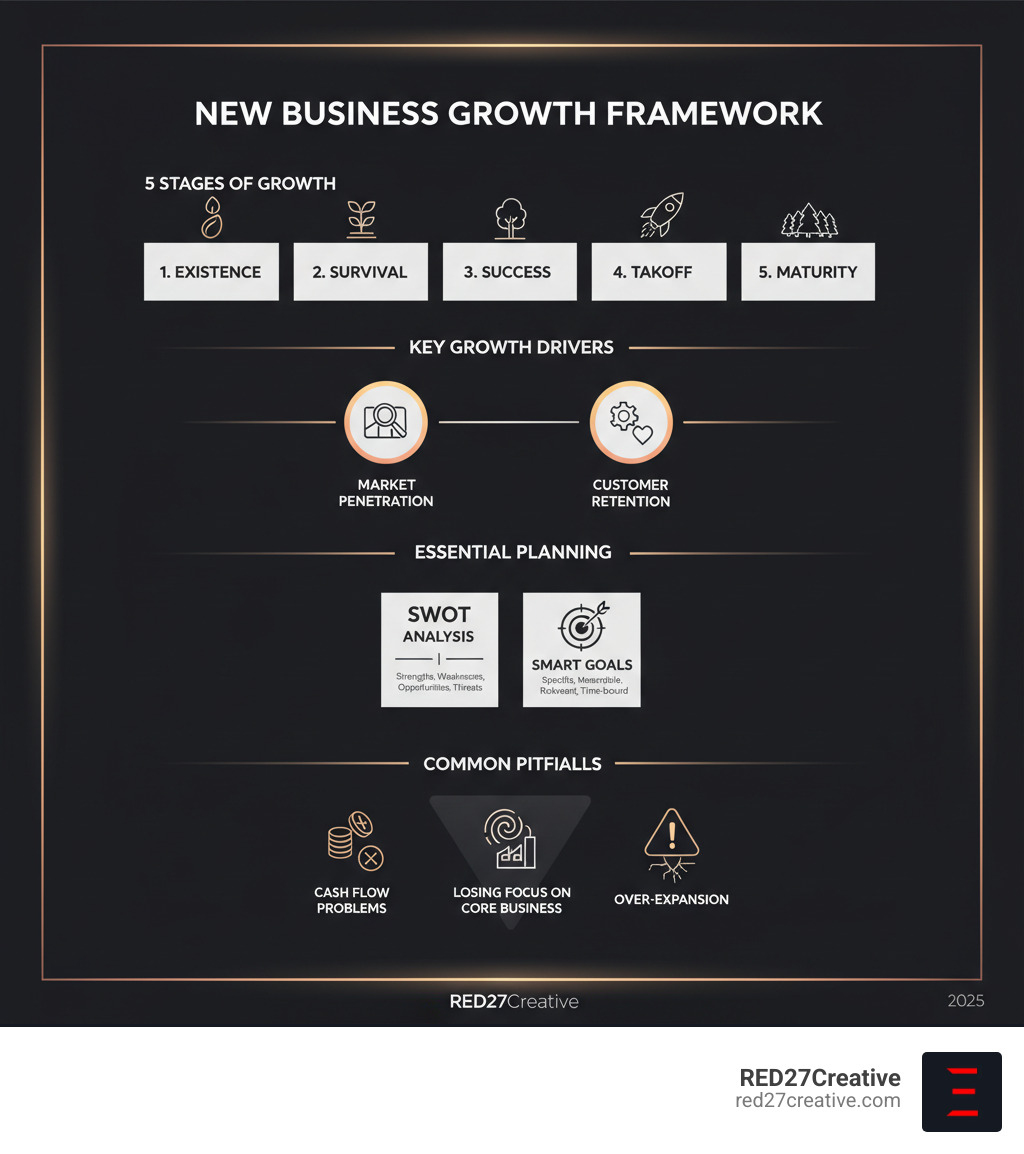
Key drivers of successful new business growth include:
- Strategic planning with clear, measurable goals
- Market penetration strategies to maximize existing opportunities
- Customer retention programs that build long-term value
- Product diversification to reduce market risk
- Financial management that supports sustainable expansion
- Technology integration to automate growth processes
Statistics show that businesses with formal growth plans are 30% more likely to grow, yet most new ventures fail to scale effectively. This happens because growth isn’t just about getting bigger—it’s about getting better at serving your market while building systems that can handle increased demand.
The challenge isn’t finding opportunities; it’s choosing the right strategies at the right time and executing them with precision. Most growth failures stem from growing too fast without proper infrastructure, losing focus on core customers, or running out of cash despite increasing revenues.
I’m Kiel Tredrea, founder of RED27Creative. Over the past 20 years, I’ve helped businesses steer the complexities of new business growth through strategic marketing and digital change. My experience shows that successful scaling requires both creative vision and analytical rigor.
Understanding the Foundations of Business Growth
Before you can accelerate new business growth, you need to understand the predictable patterns that successful companies follow. Growth isn’t random; it follows identifiable stages and responds to specific drivers. Understanding these foundations allows you to anticipate challenges and make strategic decisions.
The Primary Drivers of Growth
Businesses that thrive align their internal strengths with external opportunities. This alignment is where new business growth shifts from luck to strategy. The magic happens when you master these key drivers:
- People: Your foundation is a talented, engaged team that believes in your vision. Without the right people, even the best strategies will fail.
- Process: Efficient, repeatable systems separate growing businesses from chaotic ones. Strong processes ensure you can deliver consistent quality as demand increases.
- Product: Your offering must solve a real problem that customers will pay for. It needs to evolve with customer needs to remain relevant.
- Profit: Healthy margins are your growth fuel. Profit provides the resources to reinvest, weather challenges, and attract further investment.
These internal drivers must respond to external forces:
- Customer Demand: Truly understanding what your customers want is the key to meaningful innovation.
- Market Opportunity: Find the sweet spots where demand exists but is not fully satisfied by competitors.
- Innovation: Markets and customer expectations are always changing. Continuous innovation, whether big or small, keeps you ahead of the curve.
A business grows when it aligns its internal capabilities with external market needs to create a repeatable, profitable model.
The 5 Stages of Small Business Growth
Businesses, like people, go through predictable life stages. Knowing your current stage helps you prepare for what’s next, as each phase has unique challenges and opportunities.
- Existence: The initial stage is focused on survival. The main goals are to acquire customers, deliver on promises, and prove the business concept is viable. The owner does everything.
- Survival: The business is generating enough revenue to cover expenses, but profitability is inconsistent. Cash flow management becomes critical. Many businesses get stuck here.
- Success: The business is profitable and has a stable customer base and established systems. The owner faces a key decision: maintain this level of success or push for more growth.
- Take-off: This is a period of rapid expansion where new business growth is both exciting and risky. The owner’s role shifts from doing to managing. This stage can make or break a company.
- Resource Maturity: The business is well-established with a strong market position and professional management. The primary challenge shifts from survival to avoiding complacency and staying innovative.
Understanding these stages removes some of the uncertainty from growth. You’ll still face challenges, but you’ll be better prepared to see them coming.
Crafting Your Strategic Growth Plan
When it comes to new business growth, a solid plan is your GPS for navigating expansion. Businesses that create a formal growth plan are 30% more likely to grow than those that don’t. This advantage can be the difference between success and failure.
How to Effectively Plan for Growth
An effective growth plan starts with an honest assessment of your current position. Successful businesses are willing to acknowledge both their strengths and their blind spots.

Your growth roadmap begins with a SWOT analysis—examining your Strengths, Weaknesses, Opportunities, and Threats. This exercise helps you understand your competitive landscape and identify the levers you can pull to drive growth.
Next, set SMART goals. These are Specific, Measurable, Achievable, Relevant, and Time-bound targets. For example, instead of “get more customers,” a SMART goal would be “increase B2B lead conversion by 25% in six months.”
Finally, break these goals into an action plan with clear responsibilities, deadlines, and resource allocation. A plan must be a living document that guides daily decisions, not something that collects dust. For expert help, fractional marketing can help businesses access high-level strategy without the full-time overhead.
Measuring and Tracking Your Progress
How do you know if your strategies are working? The answer is data. Use Key Performance Indicators (KPIs) to make informed decisions.
- Revenue Growth Rate: This tracks your top-line expansion month-over-month and year-over-year.
- Customer Acquisition Cost (CAC): This measures how much you spend to acquire each new customer. A rising CAC can signal a problem.
- Customer Lifetime Value (CLV): This reveals the long-term value of your customer relationships. When CLV is significantly higher than CAC, you have a sustainable model.
- Market Share: This shows if you are gaining ground on your competitors.
- Conversion Rates: This metric reveals how effectively you turn prospects into customers.
Tracking these KPIs consistently turns raw numbers into actionable insights. This is where the impact of data-driven marketing strategies becomes clear, fueling smarter growth.
Key Financial Considerations for Expansion
New business growth consumes cash. Many profitable businesses fail because their growth outpaces their cash flow planning.
Cash flow management is critical during expansion. You may have record sales, but if you have to pay suppliers before customers pay you, you can face a cash crunch. Forecast your cash needs months in advance.
For funding options, you can reinvest profits, which keeps you in control but may slow growth. External funding like loans or venture capital can accelerate growth but comes with strings attached. Match your funding strategy to your growth stage.
Budgeting for growth means strategically investing in areas with the highest return, such as new hires, marketing, or technology. As you scale, you must also protect your profit margins to ensure your expansion is truly profitable.
Core Strategies for Sustainable New Business Growth
With a strategic foundation, you can focus on tactics that move the needle. New business growth requires deliberate strategies that expand your reach while deepening relationships with existing customers. These strategies build on your strengths and amplify what you already do well.
Increasing Market Share and Penetration
Market penetration is about becoming the obvious choice in your industry. This strategy focuses on selling more of your existing products to your current market, often by winning customers from competitors or encouraging more frequent purchases.
- Competitive Analysis: Understand your competitors’ positioning, pricing, and weaknesses. This isn’t about copying them but finding gaps where you can excel.
- Niche Targeting: Focusing on specific customer segments where your value shines makes your marketing more precise. A specialized approach often beats a general one.
- Value Proposition: Constantly refine what makes customers choose you. Articulate the unique experience and outcome you deliver in a way that resonates with your target audience.
This approach to new business growth is less risky because you are leveraging existing knowledge and capabilities. For help attracting the right prospects, B2B Lead Generation 101: How to Attract and Convert Ideal Buyers offers valuable insights.
The Power of Customer Retention and Loyalty
Acquiring a new customer can cost five times more than retaining an existing one. This makes customer retention one of the most profitable growth strategies available. Your existing customers already trust you and understand your value.
- Customer Experience: Create an exceptional experience at every touchpoint. When you exceed expectations, customers become loyal advocates who refer others.
- Upselling and Cross-selling: By understanding customer needs, you can identify opportunities to provide more value. This increases customer lifetime value and strengthens the relationship.
- Loyalty Programs: Implement programs that reward repeat customers with exclusive benefits or special pricing. This makes customers feel valued and incentivizes them to stay.
- Feedback Loops: Actively seek customer input and use it to improve your offerings. This dialogue shows you value the relationship beyond the transaction.
Satisfied customers buy more and provide powerful word-of-mouth marketing, creating a stable foundation for new business growth.
Advanced Growth Levers: Expansion and Innovation
Once you have a stable foundation, you can explore more ambitious strategies for new business growth. This involves moving into new territories, creating new offerings, and leveraging external forces to accelerate your expansion.
Diversifying Products and Tapping New Markets
To open up significant growth, you may need to look beyond your current horizons. The Ansoff Matrix provides a useful framework for evaluating these options and their associated risks.

- Market Development: This involves taking your existing products to new markets. For example, you might expand into a new geographic region or target a different customer demographic.
- Product Development: Here, you create new products or services for your existing market. This is often less risky because you already understand your audience’s needs and preferences.
- Diversification: This is the boldest move—introducing new products into new markets. While it can spread risk across multiple revenue streams, it requires significant capital and expertise.
The key is to test new waters gradually. Learn as you go and scale what works rather than betting the entire business on an unproven venture.
Leveraging Technology and Strategic Partnerships for new business growth
You don’t have to grow alone. Technology and partnerships are power tools that can accelerate your new business growth exponentially.
Technology transforms how you operate and reach customers.
- Marketing Automation: Use these tools to handle email campaigns, social media, and lead nurturing, allowing you to engage customers at scale.
- CRM Systems: A Customer Relationship Management system helps you track interactions, personalize communications, and spot opportunities.
- Artificial Intelligence: AI can optimize sales processes, generate content, and cut wasteful spending. As we’ve covered, AI in Marketing Transforms Business Growth by helping businesses work smarter.
Strategic partnerships can multiply your reach overnight.
- Strategic Alliances: Teaming up with complementary businesses exposes you to new audiences where both companies benefit.
- Franchising: This strategy allows for rapid expansion without massive capital investment, but it requires a proven, repeatable business model.
By combining technology with smart partnerships, you can achieve a level of growth that would be impossible to accomplish on your own.
Building a Growth-Ready Organization and Avoiding Pitfalls
Achieving new business growth is one challenge; sustaining it is another. Rapid growth can break a business if its internal foundation isn’t prepared to handle the pressure. The companies that thrive are those that build their organization with growth in mind from the start.
The Importance of Culture and Employee Engagement
There’s a saying that culture eats strategy for breakfast. You can have a brilliant growth plan, but it will fail if your team isn’t aligned and engaged. A strong company culture is one of your most powerful drivers of sustainable growth.

- Hiring the Right People: Hire for both skills and cultural fit. An aligned team that shares your values is more engaged, innovative, and productive.
- Vision Alignment: Ensure every team member understands the company’s mission and how their role contributes to it. This empowers them to make better decisions independently.
- Communication: As you scale, informal communication is no longer enough. Implement systems for open, honest feedback to catch problems before they escalate.
- Empowerment and Delegation: You can’t micromanage your way to growth. Hire talented people, give them clear expectations, and trust them to deliver.
Common Pitfalls to Avoid When Pursuing new business growth
The path to new business growth is filled with predictable mistakes. Being aware of these traps is the first step to avoiding them.
- Growing Too Fast: Scaling too quickly breaks operations, burns out staff, and hurts quality. Paced, strategic growth is more sustainable than rapid, chaotic expansion.
- Losing Focus on Your Core Business: In the excitement of new opportunities, don’t neglect the customers and products that got you here. Your core business funds your growth experiments.
- Poor Cash Management: Growth consumes cash. Forecast your financial needs and manage cash flow carefully to avoid “growing broke”—being profitable on paper but unable to pay your bills.
- Neglecting Customer Service: When you’re scrambling to handle demand, service quality can slip. Retaining customers is far cheaper than acquiring new ones.
- Ignoring Company Culture: Culture can dilute as you add people. Be intentional about preserving the values that made you successful in the first place.
Frequently Asked Questions about New Business Growth
Business owners ready to scale often ask the same critical questions about new business growth. Here are answers to the three most common concerns we encounter.
What are the first steps to planning for business growth?
Start with a SWOT analysis to assess your Strengths, Weaknesses, Opportunities, and Threats. Then, set SMART (Specific, Measurable, Achievable, Relevant, Time-bound) goals for the next 1-3 years. Finally, create a detailed action plan that outlines the steps, resources, and timelines needed to achieve your objectives.
How do I know if my business is ready to scale?
Your business is ready to scale when you have proven product-market fit with predictable demand and high customer retention. You must also have consistent positive cash flow and operational processes that can handle a significant increase in demand without sacrificing quality or service.
What is the most common mistake new businesses make when trying to grow?
The most common mistake is pursuing growth without a solid financial plan, leading to severe cash flow problems. Businesses can become profitable on paper but fail because they lack the cash to pay bills. This “growing broke” scenario happens when expansion costs outpace available working capital.
Conclusion: Playing the Growth Game to Win
The journey of new business growth is a marathon, not a sprint. It requires careful planning, bold execution, and a relentless focus on your customers and team. With the right preparation and mindset, you can cross the finish line stronger than when you started.
The businesses that win the growth game understand that data-driven strategies are their compass. Knowing your KPIs allows you to engineer growth, not just hope for it. By tracking metrics and making informed decisions, you can steer market shifts with confidence.
Building a resilient organization means preparing your business to handle success. The winners invest in their people, refine their processes, and create systems that can adapt as they scale. Remember the five stages of growth—recognize where you are and prepare for where you’re going next.
Your growth story is unique, but you don’t have to write it alone. When you’re ready to develop and execute a marketing strategy that truly fuels your expansion, consider exploring the business consulting services offered by RED27Creative.
The game of new business growth is challenging but rewarding. With the right strategies, team, and support, you’re not just playing to participate—you’re playing to win.

Kiel Tredrea
https://red27creative.comTop Marketing Agency • Web, SEO & Leads • RED27Creative