The B2B SEO Blueprint: From Strategy to Success

Why B2B SEO Strategies Are Essential for Long-Term Growth
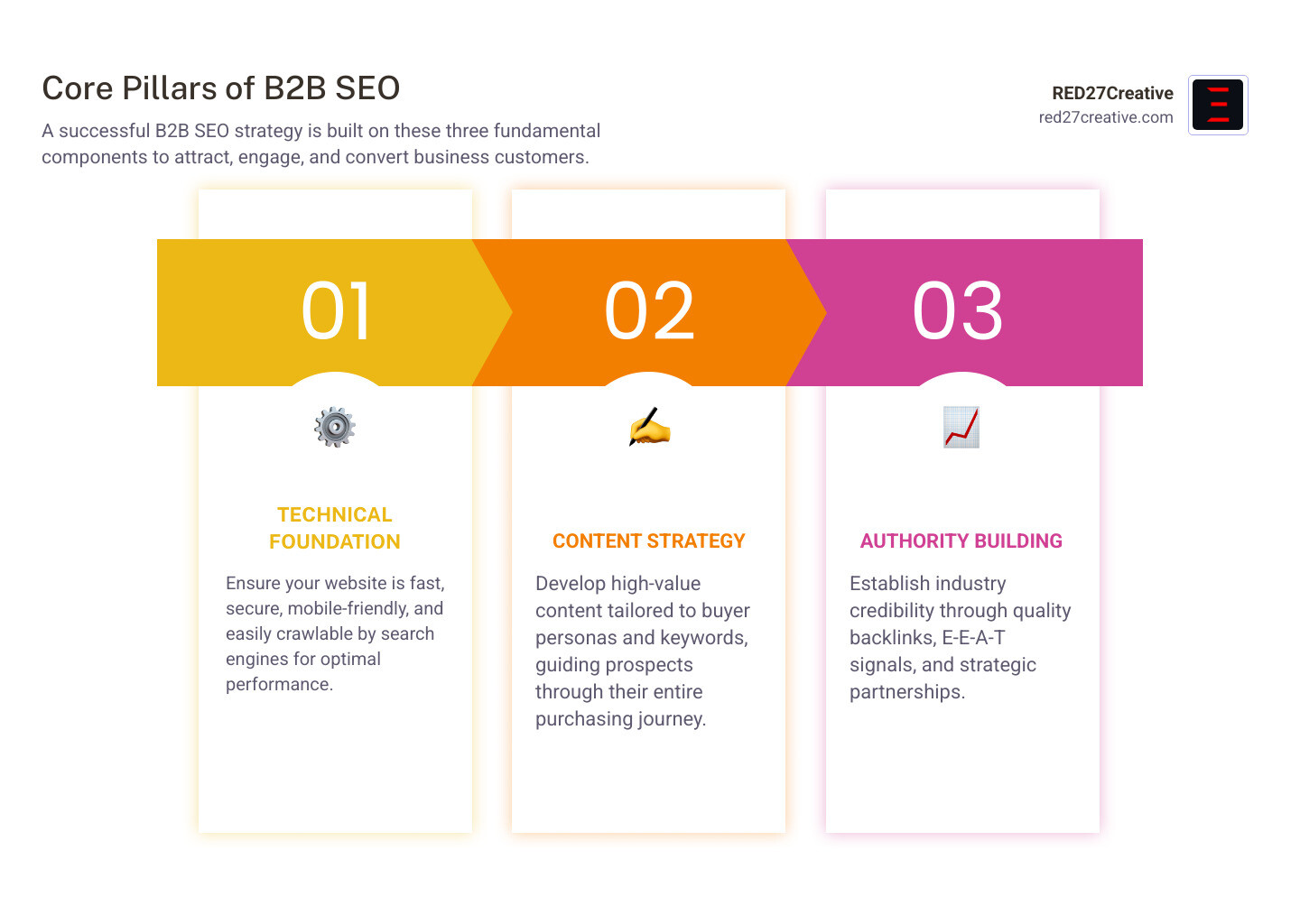
Effective B2B SEO strategies attract qualified leads and drive revenue by targeting professional decision-makers who conduct extensive research before high-value purchases. An effective strategy involves:
- Targeting niche, high-intent keywords that solve specific buyer pain points.
- Creating educational content for every stage of the buyer’s journey.
- Building domain authority through strategic backlinks and thought leadership.
- Optimizing for technical SEO to ensure a fast, secure, and mobile-friendly experience.
- Measuring success with lead quality metrics like MQLs, SQLs, and pipeline influence.
With 71% of B2B researchers starting their journey on Google, your business cannot afford to be invisible. The challenge is that B2B buyers follow a complex, non-linear journey involving multiple stakeholders and months of evaluation.
The stakes are high, as these are strategic decisions requiring trust. Many B2B companies struggle with SEO by applying generic B2C tactics, chasing non-converting keywords, and ignoring technical foundations.
This guide will show you how to build a complete B2B SEO system—from understanding your audience to creating conversion-focused content and measuring real business impact.
I’m Kiel Tredrea, founder of RED27Creative. With over 20 years of experience, my team helps B2B companies drive revenue growth through data-driven B2B SEO strategies that combine technical precision, content authority, and measurable lead generation.
Understanding the Core Differences: B2B vs. B2C SEO
B2B SEO is fundamentally different from B2C. The audience, intent, and purchasing process are distinct; ignoring these differences leads to poor results.
Here’s a quick overview of how they diverge:
| Feature | B2B SEO | B2C SEO |
|---|---|---|
| Audience | Niche, professional decision-makers, multiple stakeholders | Broad, individual consumers |
| Sales Cycle | Long, complex, research-heavy, nurturing required | Short, often impulse-driven, immediate gratification |
| Keyword Intent | Problem-solving, solution-focused, technical, high CPC, low volume | Informational, transactional, emotional, high volume |
| Content Focus | Educational, authoritative, data-driven, ROI-centric, in-depth | Entertaining, aspirational, product-focused, brief |
B2B buyers seek solutions to complex problems, resulting in a longer sales cycle. Therefore, B2B SEO strategies must focus on building trust and demonstrating expertise, not just a quick sale.
The Crucial Role of SEO in the Modern B2B Buying Process
Most B2B buying journeys begin with online research, putting pressure on businesses to rank for key queries. B2B SEO helps your business in several critical ways:
- Building Authority: Consistently producing high-quality, expert-driven content positions your brand as a thought leader, which is essential for earning trust.
- Establishing Credibility: Every piece of content, reputable backlink, and positive review contributes to your brand’s credibility in high-stakes decisions.
- Generating Qualified Leads: B2B SEO prioritizes lead quality over traffic volume by targeting niche, high-intent keywords that signal strong commercial interest.
- Reducing Customer Acquisition Costs: Growing organic search visibility decreases reliance on paid advertising, offering a sustainable path to growth.
For more insights into attracting and converting ideal buyers, check out our guide on B2B Lead Generation 101.
Step 1: Building Your Foundation with B2B Keyword Research and Audience Insights
A successful B2B SEO strategy starts with understanding your audience and their search terms. The goal is to understand search intent (informational, commercial, or transactional), which shapes your entire strategy.
Avoid the “curse of knowledge”—using industry jargon customers don’t. Prospects search for problems, not product names. For example, a CFO might search “how to reduce month-end close time” before searching for “financial consolidation software.”
This is where buyer personas are crucial. These semi-fictional profiles represent your ideal customers, built from market research and client data. In B2B, you often need multiple personas for the buying committee—the technical evaluator, budget holder, and end user all have different concerns and search behaviors.
For each persona, we identify their job title, goals, challenges, and preferred information sources. The more detailed your personas, the more precisely your B2B SEO strategies can target the right people with the right message. HubSpot’s free Make My Persona tool is a great starting point.
Mastering B2B Keyword Research for High-Intent Traffic
B2B keyword research prioritizes specificity, relevance, and commercial value over high volume. We focus on long-tail keywords—longer, more specific phrases that signal genuine purchase intent.
While these keywords have lower search volumes, they are incredibly valuable. A search for “ERP software for multi-location healthcare providers” is far more qualified than “ERP software,” representing buyers with a specific problem and budget.
Keyword modifiers like “software,” “platform,” “for enterprise,” or “for [specific industry]” are your best friend, as they signal clear business intent. A high Cost Per Click (CPC) also indicates value, as competitors are paying a premium for that traffic because it converts. Tools like Ahrefs and Semrush reveal these metrics and help identify competitor gaps and opportunities.
The goal is to rank for searches that bring qualified leads who close. To learn more about data-driven marketing, explore our insights on The Impact of Data Driven Marketing Strategies.
Developing Buyer Personas to Guide Your B2B SEO Strategies
Once you have keywords, detailed buyer personas ensure your content targets the right people. A strong persona captures your ideal customer’s motivations, obstacles, and decision-making patterns.
Start by defining their job titles, responsibilities, and business goals. What metrics define their success? A VP of Sales cares about pipeline velocity, while a CIO worries about security and total cost of ownership.
Next, identify their pain points and challenges. Understanding their frustrations helps you create content that resonates by addressing their real-world experiences.
Finally, map their online behavior and trusted information sources. Knowing where they go for information—industry publications, LinkedIn groups, podcasts—tells you where to build authority and earn backlinks. Document their search behavior at each stage of the buying journey, from early-stage problem identification (“why is our inventory always wrong”) to late-stage evaluation (“inventory management software demo”).
Built with real research (customer interviews, sales insights), personas become the bedrock of your B2B SEO strategies, ensuring your content is relevant and effective.
Step 2: Crafting High-Value Content for the Entire B2B Buyer’s Journey
B2B customers research complex purchasing decisions along a winding path. With 90% of B2B buyers wanting relevant content at each step, your B2B SEO strategies must deliver.
Content mapping is essential. We align specific content types with the three main stages of the buyer’s journey: Awareness (identifying a problem), Consideration (evaluating solutions), and Decision (choosing a vendor). Each stage requires a different message and format.
We often use a hub-and-spoke content model to build topical authority. A central pillar page covers a broad topic in depth, while cluster pages explore specific sub-topics, all interlinked. This structure helps search engines understand your expertise and makes it easier for buyers to find what they need.
For more insights on creating content that converts, check out our guide on Content Marketing for Manufacturers.

Top-of-Funnel (ToFu): Building Awareness with Educational Content
In the Awareness stage, prospects are realizing they have a problem. They are learning, not shopping. Your job is to be helpful and build trust by providing value, not to sell.
Effective Top-of-Funnel content formats include blog posts addressing industry challenges, how-to guides with actionable advice, and original research that provides unique data. Publishing original research makes you a primary source that others link to, boosting your SEO authority. Industry trend reports and infographics also work well to attract a wider audience and build brand recognition.
Middle-of-Funnel (MoFu): Driving Consideration with In-Depth Resources
In the Consideration stage, buyers research and compare solutions. Your content must demonstrate deep expertise and differentiate your approach.
You’re still educating, not hard-selling. This positions you as a trusted advisor. Case studies are powerful here, as they show real-world results and prove you can solve similar problems. Whitepapers and ebooks establish authority on complex topics, while webinars and podcasts offer deeper engagement. Comparison guides help buyers evaluate different approaches while highlighting your strengths.
Bottom-of-Funnel (BoFu): Converting Leads with Decision-Stage Content
At the Decision stage, buyers are ready to commit. Your content must be direct, persuasive, and answer the key question: “Why choose you?”
Your product and service pages should focus on benefits and business outcomes. Demo videos make your solution tangible, while transparent pricing pages reduce friction. ROI calculators are highly effective in B2B, as they help prospects quantify value and justify the investment. Finally, testimonials and reviews provide the social proof needed to alleviate final doubts and close the deal.
This is where your B2B SEO strategies pay off by converting the right people you’ve educated throughout their journey.
Step 3: Technical and Off-Page SEO to Build Authority and Trust
Great content isn’t enough; a slow, broken, or insecure site will fail. Technical SEO is your foundation and off-page SEO is your reputation—both are vital for successful B2B SEO strategies.
The Critical Role of Technical SEO in B2B
Technical SEO ensures your site is fast, secure, and easy for users and search engines to navigate. A poor website experience is an immediate red flag for B2B buyers.
- Core Web Vitals: These Google metrics measure user experience via loading speed (LCP), interactivity (FID), and visual stability (CLS). Good scores are crucial for keeping users on your site. Check your performance with Google PageSpeed Insights.
- Mobile-Friendliness: This is non-negotiable. Decision-makers research on their phones, and Google uses mobile-first indexing. An unoptimized site is invisible to a large part of your audience.
- Security (HTTPS): An unsecured site erodes trust, especially when users are sharing contact information. Google also favors secure sites in its rankings.
- Site Architecture: A logical structure with clear navigation and organized XML sitemaps helps Google crawl and index your most important pages. If search engines can’t find your content, neither can customers.
- Schema Markup: This structured data gives Google a cheat sheet about your content, helping your pages appear as rich snippets in search results, which increases visibility and click-through rates.
For more on how web design impacts SEO, explore our guide on 10 Strategies to Master Web Design for B2B Marketing.
Building Authority with Off-Page SEO and E-E-A-T
Off-page SEO proves your credibility to Google and customers. In B2B, reputation is everything, making E-E-A-T (Experience, Expertise, Authoritativeness, and Trustworthiness) your competitive advantage.
Google heavily weighs E-E-A-T for YMYL (Your Money Your Life) topics, which include many B2B subjects due to the financial stakes involved.
- Quality Backlinks: Links from reputable industry sites are votes of confidence. We focus on earning these links by creating valuable content that others want to reference. Learn more in our B2B Link Building guide.
- Guest Posting and Digital PR: Publishing expert insights on high-authority sites earns backlinks and positions your team as thought leaders, expanding your reach and building brand recognition.
- Brand Mentions and Reviews: Mentions from influential sources and positive reviews on platforms like G2 or Clutch build social proof that both search engines and buyers notice.
- Showcasing Author Expertise: Detailed author bios with credentials, experience, and citations directly address the “Experience” and “Expertise” components of E-E-A-T. Google’s guidance on creating helpful content emphasizes demonstrating first-hand knowledge.
Solid technical SEO and strategic authority building create a website that search engines and business buyers trust.
Step 4: Measuring and Refining Your B2B SEO Strategies
B2B SEO strategies are meaningless without proof of performance. Measurement is about turning data into actionable insights to guide your next steps.
In B2B, success is about lead quality, not traffic volume. A top ranking is worthless if it attracts the wrong audience. We measure what matters: lead quality, pipeline progression, and revenue.
Key KPIs for Measuring B2B SEO Performance
We track the metrics that move the needle. While organic traffic is a starting indicator, we focus on what happens after a visitor arrives.
- Keyword Rankings: Show how you’re performing against competitors.
- Conversions: Track meaningful actions like form submissions, demo requests, and downloads.
- Lead Quality: Classify leads as Marketing Qualified Leads (MQLs) and Sales Qualified Leads (SQLs) to ensure you’re attracting the right prospects.
- Customer Lifetime Value (CLV): Understand the long-term impact of SEO-acquired customers.
- Cost Per Acquisition (CPA): Demonstrate SEO’s efficiency compared to other channels.
Integrating your SEO analytics with your CRM (like HubSpot or Salesforce) is key. This allows you to track the entire journey from search query to closed deal, proving real ROI. To optimize your lead generation, explore our Lead Generation Services.
Overcoming Common B2B SEO Challenges
B2B SEO has unique obstacles. Understanding them upfront helps set realistic expectations.
- Long Sales Cycles: B2B decisions can take months. SEO results also require patience, with significant lead growth often taking 6-12 months. The long-term payoff is worth the wait.
- Niche, Low-Volume Keywords: Many B2B industries have specialized terms with low search volume. While a keyword may only get 50 searches a month, those searches can represent decision-makers with large budgets, making them incredibly valuable.
- Gaining Stakeholder Buy-in: Convincing executives to invest in a long-term strategy can be tough. We help by setting realistic expectations and demonstrating incremental progress with clear, regular reporting.
- Attributing Revenue to SEO: In a complex sales funnel, a prospect may interact with multiple channels. We use multi-touch attribution models to give SEO proper credit for initiating and nurturing leads, not just the final click.
These challenges are manageable with the right strategy, expectations, and measurement. This approach turns your B2B SEO strategies into a powerful engine for sustainable growth.
Frequently Asked Questions about B2B SEO
What is the main difference between B2B and B2C SEO?
The primary difference lies in the audience and intent. B2B SEO targets a niche audience of professional decision-makers with a long, research-heavy buying cycle, focusing on generating high-quality leads. B2C SEO targets a broad consumer base with a shorter, often emotional purchase journey, focusing on high-volume sales.
How long does it take for B2B SEO to show results?
B2B SEO is a long-term strategy. While some initial improvements can be seen in 3-6 months, significant results like substantial lead growth and high rankings for competitive terms often take 6-12 months or more. The timeline depends on competition, industry, and the intensity of the strategy.
What is the most important part of a B2B SEO strategy?
Understanding your target audience is the most critical part. Every other element—from keyword research and content creation to link building—stems from a deep knowledge of your ideal customer’s pain points, challenges, and the solutions they are searching for throughout their complex buying journey.
Conclusion: Turn Your Blueprint into Business Growth
In today’s B2B landscape, robust B2B SEO strategies are essential for growth. A successful strategy requires understanding your audience, creating valuable content, ensuring technical excellence, and building authority.
This blueprint is a long-term investment yielding compounding returns. It’s about building a digital presence that resonates with decision-makers, establishes your brand as a resource, and drives qualified leads.
At RED27Creative, we build data-driven marketing systems that unify your website, SEO, and lead generation into a powerful growth engine. Our team of experts delivers complete marketing solutions designed to attract visitors, build trust, and convert opportunities into measurable success for businesses in Geneva, St. Charles, Naperville, Chicago, and beyond.
Ready to transform your online presence and turn your B2B SEO strategies into tangible business growth? Let’s talk. Learn more about our SEO Services and how we can help you level up your approach.

Kiel Tredrea
https://red27creative.comTop Marketing Agency • Web, SEO & Leads • RED27Creative