Unlock Your Potential: The Essential Marketing Strategy Review

Why Your Marketing Strategy Review is Your Most Powerful Growth Tool
A Marketing strategy review is a systematic evaluation of your current marketing efforts to identify what’s working, what’s not, and where to focus resources for maximum return. It’s the diagnostic process that transforms guesswork into growth by analyzing performance data, competitive positioning, and customer insights to optimize your approach and drive measurable business results.
Quick Overview: What a Marketing Strategy Review Delivers
- Performance Analysis – Measure ROI, CAC, LTV, and conversion rates against your goals
- Channel Effectiveness – Identify which marketing channels drive the best results
- Competitive Insights – Understand your market position and uncover new opportunities
- Strategic Adjustments – Update tactics, messaging, and budget allocation based on data
- Clear Next Steps – Set new benchmarks and create an actionable plan for growth
Here’s a sobering fact: 74% of small and medium businesses lack confidence in their marketing strategies. Yet 82% of marketers believe their strategies are effective. This gap reveals a critical problem—most businesses are flying blind, unable to separate what actually works from what just feels productive.
Markets, customers, and competitors constantly change. What drove growth last year might be bleeding your budget this quarter. Without a regular review, you’re pouring resources into outdated tactics. Think of it as a navigation system for your business. Your marketing strategy is your long-term vision—the “why” behind your efforts. Your marketing plan is the tactical roadmap—the “how” and “when.” Both need regular evaluation to stay effective.
Companies that conduct regular reviews don’t just catch problems; they find opportunities sooner. They understand true customer acquisition costs and can prove marketing ROI to leadership. Yet many businesses create a strategy and let it gather dust, wondering why results plateau. The reality is your marketing strategy should be a living framework that adapts to your business.
A proper review examines the full picture: Are you targeting the right audience with the right message on the right channels? Is your budget allocated for real business outcomes, or just vanity metrics? This is about building a marketing system that compounds results. Every review sharpens your strategy and brings you closer to predictable, scalable growth.
I’m Kiel Tredrea, founder of RED27Creative. For over 20 years, I’ve guided businesses through transformative marketing strategy reviews that turned underperforming efforts into revenue engines. Let me show you how to conduct a review that drives real growth.
Marketing strategy review vocab to learn:
The Critical Difference Between a Strategy and a Plan
Before any marketing strategy review, understand the difference between a marketing strategy and a marketing plan. This distinction shapes the entire evaluation process.
A marketing strategy is your overarching, long-term vision. It defines your target audience, unique value proposition, and high-level goals. It’s the “why” and “what” of your marketing—your destination.
In contrast, a marketing plan is the detailed roadmap of actions, tactics, channels, and budget needed to execute that strategy. It’s the “how” and “when” you’ll get there.
| Marketing Strategy (The ‘Why’) | Marketing Plan (The ‘How’) |
|---|---|
| Long-term vision | Specific actions |
| Defines goals and objectives | Outlines tactics |
| Identifies target audience | Details channels |
| Sets overall direction | Sets timelines |
| Focuses on market positioning | Allocates budget |
| High-level approach | Detailed execution |
This distinction is crucial because it lets us evaluate both our direction (strategy) and our execution (plan). If the plan isn’t delivering, we first check if the strategy is still sound before tweaking tactics.
Internal link: Learn more about RED27Creative’s marketing strategy and consulting services.
How Often Should You Review Your Marketing Strategy?
There’s no single right answer, but regular evaluation is non-negotiable. We recommend a multi-tiered approach for both agility and strategic depth.
Quarterly Reviews: These are essential for tactical adjustments. Every three months, we dive into performance data to assess campaigns and make necessary tweaks, preventing small issues from becoming big problems.
Annual Deep-Dives: Once a year, we conduct a comprehensive marketing strategy review. This is a broader look at market trends, competitive changes, and business objectives, where we re-evaluate our foundational strategy.
Event-Triggered Reviews: Sometimes, external factors demand an immediate review, like a new competitor or a major market shift. For example, during the COVID-19 pandemic, L’Oréal shifted its ad budget heavily online, boosting e-commerce sales by 62%—a direct result of an event-triggered review.
Beyond these structured reviews, we integrate continuous monitoring of key metrics into daily planning to stay proactive and informed.
External link: Guidance on marketing plan review frequency.
The Anatomy of a Comprehensive Review: What to Analyze
A thorough marketing strategy review is a comprehensive examination of your entire marketing ecosystem, grounded in real data. We’re not just looking at numbers; we’re understanding the story they tell about your growth, resource allocation, and customer connections.
The goal is to transform data into decisions that drive measurable results. We examine performance metrics, scrutinize your budget, understand your competitive standing, and verify you’re speaking to the right audience.
Internal link: The impact of data-driven marketing strategies.
Performance Metrics and KPIs
Every effective marketing strategy review starts with Key Performance Indicators (KPIs). These metrics tell us if we’re achieving business objectives or just spinning our wheels.
![Modern analytics dashboard showing KPIs like CAC, LTV, and conversion rates. Alt text: Marketing dashboard with key performance indicators.]
Marketing ROI (MROI) is our top priority. This metric reveals the financial return on every dollar invested in marketing, making it the ultimate accountability metric.
Customer Acquisition Cost (CAC) tells you how much you’re spending to acquire each new customer. It helps identify which channels are efficient and which are draining resources.
Customer Lifetime Value (LTV) estimates the total revenue a customer generates. A healthy business has an LTV that significantly exceeds its CAC.
Conversion rates across your funnel reveal leaks and show exactly where to focus improvement efforts.
Website traffic analysis goes beyond vanity metrics. We examine sources and user behavior to see if visitors are engaged and moving toward conversion.
Lead quality is crucial. We differentiate between Marketing Qualified Leads (MQLs) and Sales Qualified Leads (SQLs) to ensure marketing attracts the right prospects.
External link: More about key performance indicators (KPIs).
Channel and Content Effectiveness
Your marketing strategy review must evaluate which channels deliver results. Using multiple channels is effective, but that means the right channels for your audience, not all of them.
We analyze the performance of digital versus traditional marketing to find your optimal mix, which can vary for businesses in local markets like Geneva or Naperville.
SEO performance is critical, as organic search often becomes your most cost-effective channel. We assess rankings, organic traffic, and keyword performance to ensure your SEO drives qualified traffic.
Internal link: RED27Creative SEO services.
Social media engagement is measured by interaction rates and lead generation, not just follower counts. Short-form video is key, with 31% of marketers reporting it generates their highest ROI.
Internal link: RED27Creative social media strategy.
Email marketing metrics like open rates and click-through rates tell us if your messages are driving action.
Paid advertising results from Google Ads and social platforms are scrutinized for Cost Per Conversion and overall ROI.
Content performance is audited to see what resonates and converts. With 91% of marketers increasing investment in audio content, it’s a critical area to watch.
Competitive and Market Analysis
A complete marketing strategy review requires an external perspective to reveal opportunities and threats.
![SWOT analysis diagram. Alt text: SWOT analysis for marketing strategy review.]
We start with a SWOT analysis (Strengths, Weaknesses, Opportunities, Threats) to evaluate your current market position.
Competitor messaging analysis helps us refine your unique value proposition and differentiate your brand.
Market positioning reveals how customers perceive you relative to competitors, which directly influences purchasing decisions.
Identifying market gaps often uncovers underserved customer segments or unmet needs—valuable opportunities for growth.
New trends and technologies like AI are monitored constantly. With 75% of marketers using AI to reduce manual tasks, adopting new tech can provide a competitive edge.
Internal link: Explore how strategic market research can give your business an advantage.
Customer Insights and Satisfaction
Your marketing exists to serve customers, so every marketing strategy review must focus on understanding their needs.
Audience personas are regularly refined to ensure they accurately reflect your ideal customers’ pain points and behaviors.
Customer feedback is actively collected through surveys and focus groups to understand the customer’s perspective.
Surveys and reviews on platforms like Google Reviews offer unfiltered insights into customer sentiment, highlighting what they love and where you can improve.
Internal link: Learn strategies for how to get more reviews.
Net Promoter Score (NPS) measures customer loyalty. A high NPS means you’re creating promoters who market your business for you.
Personalization effectiveness is critical. With 96% of marketers reporting that personalization increases sales, we evaluate how effectively you’re tailoring the customer journey.
From Insights to Action: A 5-Step Process for Your Marketing Strategy Review
Here’s where most marketing strategy reviews fail: they produce reports that collect dust. The real value isn’t in the analysis—it’s in turning insights into action. This is how you turn data into decisions and decisions into growth.
The difference between companies that plateau and those that scale is a system that consistently moves from insights to implementation. Here’s how it works.
Internal link: Unlock the full potential of your marketing efforts with the secret of marketing ROI.
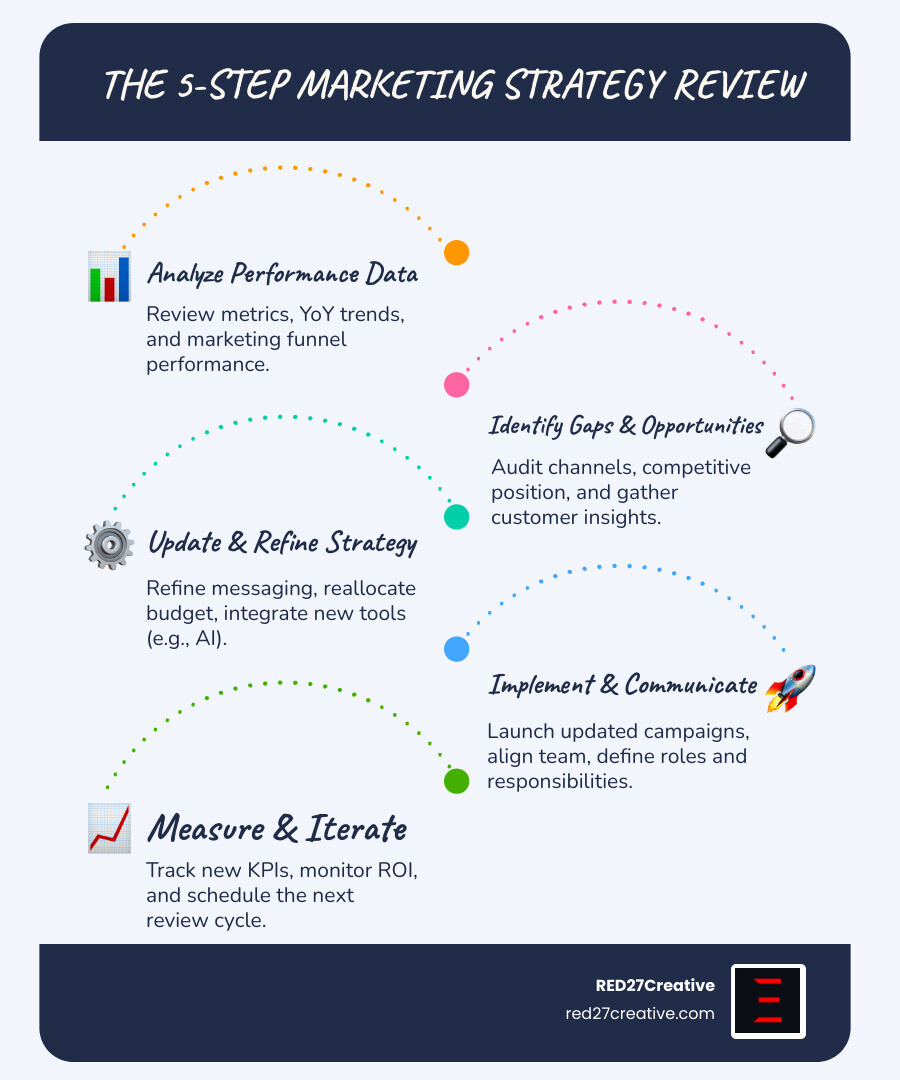
Step 1: Analyze Performance Data and YoY Trends
Start by gathering all relevant data. Compare current performance against past periods using Year-over-Year (YoY) and Quarter-over-Quarter (QoQ) trends to reveal patterns. For example, if traffic is up but conversions are down, the data tells you where to investigate a bottleneck in your funnel.
Don’t just note what happened; dig into the “why” to make your next moves strategic instead of random.
Internal link: Discover the competitive edge of data-driven marketing.
Step 2: Update the Strategy Based on Findings
Now, adjust your approach. This is about making informed adjustments that compound over time.
Brainstorm solutions for underperforming areas and double down on what’s working. If a channel isn’t meeting benchmarks, find out why. If a campaign is a winner, increase its budget.
This is also the time to re-evaluate your target audience and messaging to ensure they are still relevant. Finally, consider integrating new technologies like AI to automate tasks and gain a competitive advantage, as 86% of marketers report it saves them significant time.
Internal link: Learn how AI in marketing transforms business growth.
Step 3: Set New SMART Benchmarks for a Better ROI
A strategy without benchmarks is a wish list. After updating your approach, define success with specific, measurable objectives.
Use the SMART goal framework to create benchmarks that are Specific, Measurable, Achievable, Relevant, and Time-bound. Instead of a vague goal like “increase traffic,” a SMART benchmark is “Increase organic website traffic from our Chicago-area service pages by 20% in six months.” This creates a clear target and connects marketing activities directly to revenue goals.
External link: Use the SMART goal framework.
Step 4: Launch and Communicate the Updated Strategy
An updated strategy is useless without implementation. This requires clear communication and team alignment.
Document the new strategy in a clear, accessible format. Then, hold a team kickoff meeting to build buy-in by explaining the “why” behind the changes. When people understand the reasoning, they execute with more intention.
Clearly define roles and responsibilities to ensure accountability. Finally, make sure all stakeholders, including sales and leadership, understand the updated strategy to create a unified customer experience.
External link: More about your company’s internal knowledge base.
Step 5: Schedule the Next Marketing Strategy Review
This is the crucial final step that ensures long-term growth. Before you wrap up your current marketing strategy review, schedule the next one.
Put a firm date on the calendar for your next quarterly or annual review. This proactive planning reinforces that your marketing strategy is a living document. It makes the review process a consistent business rhythm, changing your marketing from reactive firefighting to proactive optimization. That’s the difference between hoping for growth and engineering it.
Frequently Asked Questions about Marketing Strategy Reviews
What is the primary purpose of a marketing strategy review?
The primary purpose of a marketing strategy review is to assess how your current efforts align with business goals. It identifies what’s working and what’s not, showing where to focus your budget for maximum ROI. This ensures your strategy remains agile and effective as markets and customer needs evolve.
What are the most important KPIs to track in a review?
We focus on KPIs that tell the whole story. Marketing ROI (MROI) shows financial return, while Customer Acquisition Cost (CAC) and Customer Lifetime Value (LTV) reveal the health of your business model. We also track lead-to-customer conversion rates and website traffic sources to pinpoint funnel performance and make data-driven adjustments.
How does a marketing strategy differ from a marketing plan?
This distinction is key. Your marketing strategy is the long-term “why”—your goals, audience, and market position. Your marketing plan is the tactical “how” and “when”—the specific campaigns, channels, and budget to execute the strategy. A review must evaluate both to know if you have the right destination (strategy) and the right route to get there (plan).
Turn Your Review into a Revenue Engine
A marketing strategy review is a forward-looking process that open ups your business’s full growth potential. When you commit to regular analysis and adaptation, your marketing transforms from a cost center into a revenue engine. You stop guessing and start knowing what drives results, moving from hoping for growth to engineering it.
Many businesses we work with at RED27Creative are spending on marketing but can’t connect it to their bottom line. They’re caught in the “we’ve always done it this way” trap while their market evolves around them.
A structured marketing strategy review changes everything. It provides the clarity to double down on what works and cut what doesn’t. It reveals competitor vulnerabilities and new customer opportunities.
This isn’t theoretical. For over 20 years, we’ve helped businesses in Geneva, Naperville, and across Illinois turn scattered efforts into cohesive systems that generate consistent, qualified leads. The expert team at RED27Creative specializes in building and refining data-driven marketing systems that deliver real results.
We don’t just hand you a report. We partner with you to implement insights and continuously optimize your approach, integrating SEO, content, and paid advertising into a unified growth engine. If you’re ready to treat marketing as an investment with measurable returns and want to know with certainty what’s working, we can show you.
Ready to build a marketing strategy that drives consistent growth? Explore our marketing strategy and consulting services to get started.

Kiel Tredrea
https://red27creative.comTop Marketing Agency • Web, SEO & Leads • RED27Creative