The Enterprise Content Playbook: From Strategy to Search Success

What is Enterprise Content Marketing? (And Why It’s More Than Just ‘More’ Content)
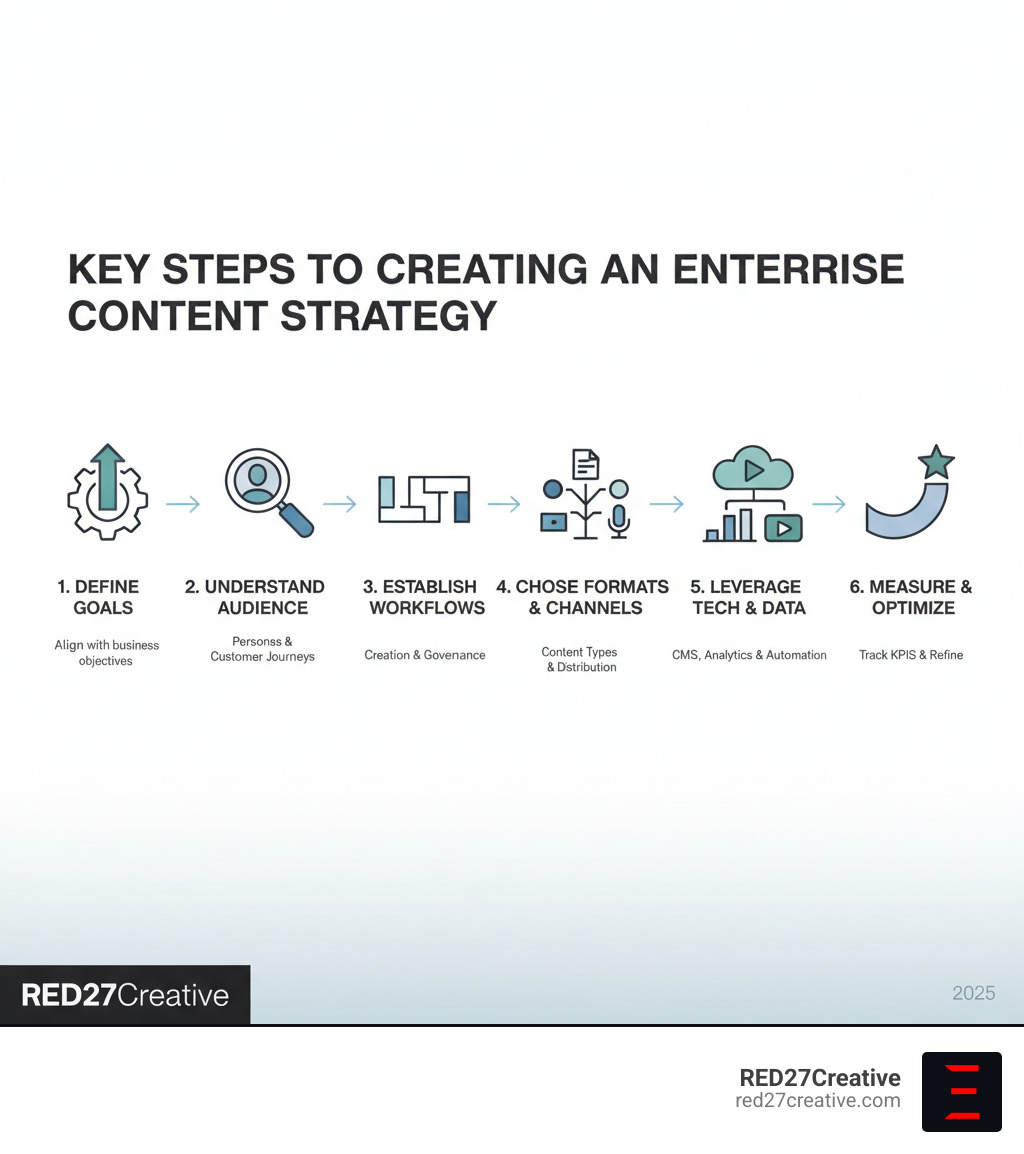
Enterprise content marketing is a strategic, integrated approach used by large organizations to create, manage, and distribute valuable content at scale. If you’re looking to build an effective content strategy for a large business, here’s a quick overview of what that entails:
- Define Clear Business Goals: Align all content efforts with overarching organizational objectives and measurable KPIs.
- Understand Your Audience Deeply: Go beyond demographics to create detailed personas and map customer journeys.
- Establish Production Workflows: Implement processes for content creation, approval, and governance across teams.
- Choose Right Formats & Channels: Select content types (e.g., articles, videos, research) and distribution channels that resonate.
- Leverage Technology & Data: Use CMS, analytics, and automation for personalization and localization.
For big companies, content isn’t just about making more noise. It’s about building trust, driving leads, and aligning a vast system towards specific business outcomes. Unlike smaller ventures, enterprise content marketing faces unique challenges like navigating internal silos, ensuring brand consistency across many departments, and proving concrete ROI.
In fact, new research shows that many enterprise marketers label their content strategies as only ‘moderately effective.’ This tells us that simply scaling up traditional tactics isn’t enough. It requires a thoughtful, structured approach.
Explore more about enterprise content marketing:
The Core Differences: Scale, Systems, and Strategy
Enterprise content marketing stands apart from traditional content marketing primarily due to its sheer scale and inherent complexity. While a small business might focus on a few blog posts, an enterprise—typically employing more than 1,500 people and earning annual revenues of $38.5 million or more—operates on a completely different playing field. This means managing a vast content ecosystem across multiple languages, regions, and product lines.
The strategic depth also differs significantly. Only 17% of marketers consider content as a stand-alone strategy, while a robust 60% integrate content into their overall marketing, sales, or communication strategy. For enterprises, this integration is non-negotiable; content is a foundational element woven into every aspect of their Digital Brand Presence. It requires sophisticated systems for creation, distribution, and measurement to effectively reach diverse audiences and build long-term assets.
Why a Strategic Approach is Essential
A strategic approach is essential for enterprise content marketing to prevent fragmented efforts and wasted resources. Content must align with business goals like brand awareness, customer engagement, and growth. A lack of clear goals is a major pain point for 47% of enterprise marketers. Our Marketing Strategy and Consulting Services focus on data-driven decisions to ensure every content piece has a purpose, helping to break down internal silos (a challenge for 61% of marketers) and maintain governance.
Building Your Enterprise Content Strategy: A 5-Step Framework

Building a successful enterprise content marketing program requires a documented strategy that connects every piece of content to clear business objectives. This five-step framework provides the structure to build, execute, and scale your content efforts for measurable results.
Step 1: Define Clear Business Goals and KPIs
Before creating any content, you must define what you’re trying to achieve. Your goals should be SMART—Specific, Measurable, Achievable, Relevant, and Time-bound. For enterprises, this means focusing on objectives like improving brand health metrics, driving qualified leads through B2B Lead Generation, or boosting customer retention.
Then, establish Key Performance Indicators (KPIs) that tie directly to revenue, such as content-assisted conversions, Marketing Qualified Leads (MQLs), Sales Qualified Leads (SQLs), and pipeline influence. This is how you prove The Secret of Marketing ROI to executives.
Step 2: Conduct a Deep Audience and Content Audit
In enterprise content marketing, a deep understanding of your audience is critical; top performers attribute 81% of their success to it. Create data-driven buyer personas that include psychographics, industry verticals, job roles, and customer lifecycle stage. Understand their pain points and content consumption habits.
Next, conduct a thorough inventory of your content to evaluate existing assets for relevance and performance, identifying pieces to refresh or retire. This audit reveals content gaps. Also, perform a competitor content analysis to find opportunities for differentiation. This ensures your SEO Topic strategy is built on data, not guesswork.
Step 3: Establish Content Production and Governance Workflows
The scale of enterprise content marketing demands robust systems for creation and management across teams and regions. Start by defining content pillars and themes aligned with your brand and audience to ensure strategic consistency.
A centralized content calendar is non-negotiable for organizing production and preventing duplication. Clearly define team roles and responsibilities for writers, editors, SEO specialists, and more. Use style guides and brand voice documents to maintain a consistent identity; our Online Brand Management services can help. Finally, integrate a legal and compliance review process into your workflow. This is essential for protecting your brand and meeting regulatory requirements.
Step 4: Select High-Impact Content Formats and Channels

While 94% of enterprise marketers use blog posts, effective programs use a diverse mix of formats tailored to their audience. For example, busy professionals may prefer podcasts, while others might need detailed white papers or video demos.
High-impact formats for enterprise content marketing include:
- In-depth blog posts and articles for thought leadership
- Original research and white papers to build authority
- Webinars and virtual events for direct engagement
- Marketing Video Production and product demos to simplify complexity
- Case studies and testimonials to build trust
- Interactive tools and calculators for engagement
- Podcasts for on-the-go content
The key is to match the format to your goal, audience, and their consumption habits. Choose your formats strategically after answering these questions.
Step 5: Plan for Technology, Personalization, and Localization
Technology is essential for scaling enterprise content marketing. Start with a robust Content Management System (CMS) that can handle high traffic and complex structures, like our Enterprise WordPress Solutions. Layer in analytics platforms and Marketing Automation tools for a unified view of performance and targeted distribution.
Personalization is key. Use data analytics to tailor content experiences to users based on their behavior, demographics, and stage in the buyer journey. For global enterprises, localization is also critical. This means adapting content for regional languages, cultural norms, and regulations to ensure your message feels authentic everywhere. Content that works in one market may need significant adaptation for others.
Overcoming the Problems of Effective Enterprise Content Marketing
Even with a carefully crafted strategy, enterprises often hit snags in their content marketing journey due to internal structures, scale, and the need for consistent, high-quality content. Here’s how to anticipate and overcome these common challenges.
Challenge 1: Breaking Down Silos and Gaining Buy-In
Internal communication challenges are a barrier for 61% of enterprises, leading to fragmented content. We overcome this by championing cross-functional collaboration between marketing, sales, product, and legal teams. Gaining executive sponsorship is also crucial. We communicate value by focusing on leadership-focused metrics like revenue growth, creating shared goals that transform content into a business driver, often with help from our Business Growth Consulting Services.
Challenge 2: Scaling Content Production Without Sacrificing Quality
Scaling content production without sacrificing quality is a common challenge, as 49% of enterprise marketers lack a scalable model. Our solution is to implement documented workflows and content templates for efficiency. We also repurpose content—turning webinars into blog posts, for example—to maximize asset value. To scale further, we combine internal teams with specialized freelancers or agencies, like our Professional Content Writing Services, using approved tools and processes to streamline creation.
Challenge 3: Ensuring Brand Consistency and Compliance
Maintaining brand consistency and compliance across vast content outputs is difficult. We solve this by establishing centralized brand guidelines for tone, style, and messaging, supported by our Visual Branding Solutions. Robust approval workflows and content governance tools manage the content lifecycle and ensure necessary reviews. Finally, regular training for content creators reinforces brand standards and legal adherence, protecting the client’s reputation.
Measuring Success: How to Prove the ROI of Your Content Engine
Enterprise content marketing only survives if it can prove its worth by connecting content directly to revenue, customer acquisition, and business growth.
Moving Beyond Vanity Metrics to Track What Matters
Page views and social shares don’t prove value. With only 48% of enterprise marketers measuring performance effectively, it’s crucial to focus on metrics that matter. We track content-assisted conversions, Marketing Qualified Leads (MQLs), Sales Qualified Leads (SQLs), and Customer Lifetime Value (CLV). The goal is to understand the true pipeline influence of each asset to prove ROI, justify investments, and build an accountable content engine.
Attribution Models for a Complex Buyer’s Journey
Enterprise sales cycles are complex, which is why 63% of marketers struggle with ROI attribution. Prospects interact with multiple content pieces before buying. Sophisticated attribution models are the solution. While first-touch attribution is useful, multi-touch attribution provides deeper insight by distributing credit across all touchpoints. Integrating content data with a CRM provides a holistic view of how content influences deals, giving you a Competitive Edge of Data-Driven Marketing by showing what content closes business.
Using Data to Optimize, Scale, and Report
Data is a roadmap for improvement, not just reporting. Use performance dashboards for real-time insights. Continuously A/B test headlines, CTAs, and formats, as small improvements compound at scale. Identify top-performing assets to replicate success and allocate resources strategically. The principles of data-driven optimization, as shown in our Google Ads Audit Complete Guide, apply here: test, measure, optimize, repeat.
Report to stakeholders in terms they understand: revenue influenced, deals closed, and pipeline generated. This transforms enterprise content marketing from a cost center to a growth driver. This feedback loop ensures your content engine is always improving and accelerating.
Frequently Asked Questions about Enterprise Content Marketing
Got a few lingering questions about enterprise content marketing? You’re in good company! Here are some of the most common queries we hear, answered simply and directly to help clarify this powerful approach.
What is the main difference between enterprise and regular content marketing?
The core distinction boils down to scale and integration. Enterprise content marketing involves managing a vast, complex content ecosystem across many departments, languages, and global markets. It requires robust systems for governance, scalability, and measurement, deeply integrated with overall business goals. Traditional content marketing, in contrast, often operates in a more isolated fashion.
What is the first step in creating an enterprise content strategy?
The absolute first and most crucial step is to define clear business goals. Before you even think about content ideas, ask yourself: What are we trying to achieve? Whether it’s boosting qualified leads by 20%, enhancing customer retention, or becoming a thought leader in a new market, these specific goals will shape every single decision in your enterprise content strategy.
How do you measure the ROI of enterprise content marketing?
Proving the ROI of enterprise content marketing means connecting your content directly to revenue. This involves tracking metrics like content-assisted conversions, the quality of leads (MQLs and SQLs), and its influence on your sales pipeline, often through your CRM. Utilizing multi-touch attribution models helps you clearly demonstrate how content contributes to sales, especially across those lengthy, complex buyer journeys.
Conclusion: Turning Your Playbook into Lasting Growth
Building a truly effective enterprise content marketing program isn’t a quick fix; it’s more like a strategic marathon than a short dash. It asks for a thoughtful, long-term mindset, seamless teamwork across different departments, and a constant dedication to providing real value. This value goes both to your cherished audience and to your business’s bottom line.
When you put a structured playbook into action—one that covers strategy, content creation, careful governance, and clear measurement—you’ll see a remarkable shift. Your content moves from being just another business expense to becoming a dynamic, powerful engine that drives sustainable growth for your enterprise.
Are you ready to craft a content strategy that doesn’t just look good, but actually delivers tangible, real-world results? The dedicated team at RED27Creative specializes in building data-driven marketing systems. We’re here to help you transform mere visibility into a steady stream of qualified opportunities.
Find how our expertise can empower your business. Explore our National Enterprise SEO Services today, and let us help you build and execute a winning playbook designed for lasting success.

Kiel Tredrea
https://red27creative.comTop Marketing Agency • Web, SEO & Leads • RED27Creative