Demand Generation Demystified: Your B2B Growth Playbook
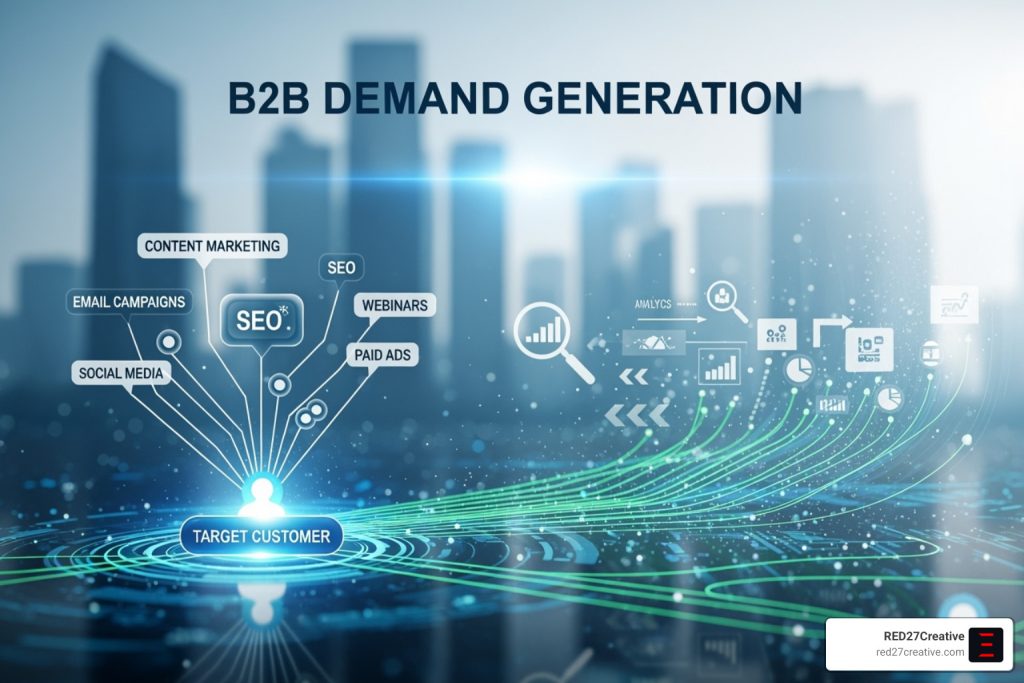
Why B2B Demand Generation is the Growth Engine Your Business Needs
B2B demand generation is a strategic marketing approach that creates awareness and builds interest in your products or services across your entire target market. It’s not just about finding buyers who are ready now; it’s about creating future customers.
Here’s a quick breakdown:
- What it is: A holistic strategy to educate prospects, build brand authority, and create demand throughout the buyer’s journey.
- Primary goal: Generate market-wide awareness and interest before prospects are actively looking to buy.
- Core benefit: Fills your pipeline with educated prospects who already trust your brand and understand your value.
Why does this matter? According to the 95/5 rule, only 5% of your target audience is ready to buy at any given time. The other 95% will buy later. B2B demand generation focuses on building a relationship with that 95%, making you the obvious choice when they are ready to purchase.
Most B2B companies struggle by focusing only on the 5%, leading to an unpredictable pipeline and expensive, difficult growth.
I’m Kiel Tredrea, founder of RED27Creative. For 20 years, I’ve helped B2B companies build scalable b2b demand generation systems for predictable growth. This guide shares our proven strategies from work with manufacturing, tech, and professional services clients.
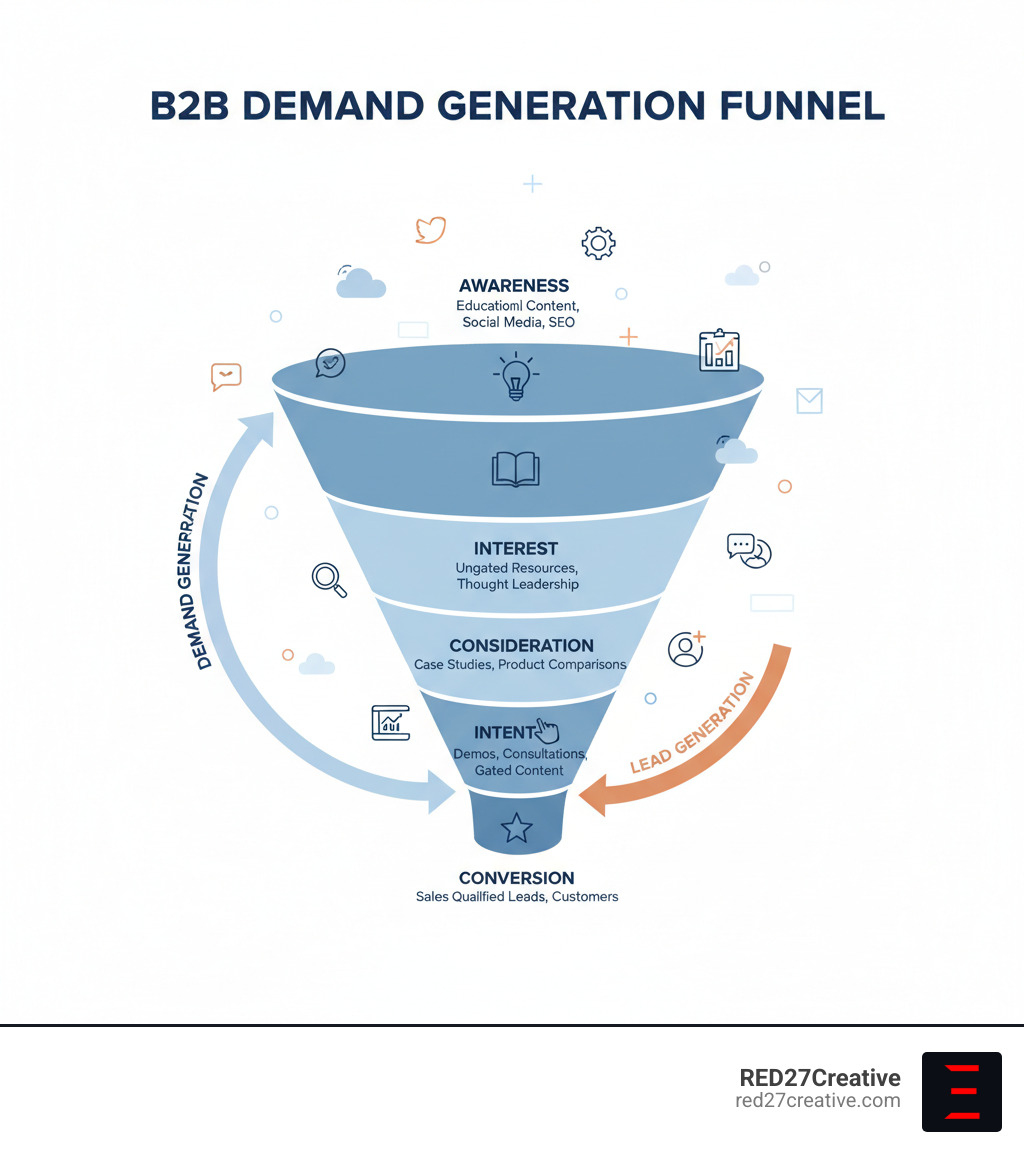
The Foundation: What is B2B Demand Generation and How is it Different?
Think of b2b demand generation as planting seeds, while lead generation is harvesting the crops. Both are essential, but they serve different purposes. Many B2B companies make the mistake of only focusing on the harvest—the 5% of buyers ready now—while ignoring the 95% who will buy later.
Let’s explore how these two strategies work together.
Demand Generation: Creating the Market
B2B demand generation creates genuine interest in your solutions before a prospect is actively shopping. It’s a top-of-funnel strategy focused on educating your market, building authority, and establishing trust. The goal is to become the go-to expert in your space.
According to the 95/5 rule, only 5% of your target buyers are in-market at any moment. The other 95% are learning and forming opinions. Demand generation builds relationships with that 95% today, making you their first choice when they’re ready to buy.
Lead Generation: Capturing the Demand
Once demand is created, lead generation converts that interest into opportunities for your sales team. This mid-to-bottom-funnel strategy focuses on prospects who are actively evaluating solutions.
The primary goal is to capture contact information from qualified prospects through gated content like whitepapers or free trials. Lead generation targets people who have raised their hand to say, “I’m interested.” We help clients master this entire process to ensure no opportunity is lost.
Comparing Demand Generation vs. Lead Generation
Understanding the distinct roles of these two strategies is key to allocating resources effectively.
| Feature | Demand Generation | Lead Generation |
|---|---|---|
| Goal | Build brand awareness, educate market, generate interest | Capture contact information, qualify prospects |
| Key Tactics | Ungated content, social media, webinars, SEO, PR | Gated content, landing pages, free trials, direct outreach |
| Metrics | Website traffic, brand mentions, engagement, pipeline value | Conversion rates, MQLs, SQLs, cost per lead |
| Funnel Stage | Top-to-Mid Funnel (Awareness, Interest) | Mid-to-Bottom Funnel (Consideration, Intent) |
In short, demand generation fills the pool with educated prospects who trust your brand. Lead generation identifies those who are ready to swim, capturing their information for sales. You need both for a complete growth engine.
Core Strategies for a Powerful Demand Engine
A robust b2b demand generation engine orchestrates multiple strategies to create awareness, build trust, and guide prospects. It’s about making each marketing channel work together to achieve a greater impact.

Content Marketing: The Fuel for Your Funnel
Content is the fuel for your demand generation engine. It educates your audience, answers their questions, and builds trust. According to a 2023 B2B Buyers Survey, 81% of buyers say content significantly impacts their purchasing decisions.
Our approach focuses on creating helpful resources that establish you as an authority. Effective content types include:
- Blog posts that solve real industry challenges.
- Webinars and podcasts that demonstrate expertise.
- Ebooks and white papers that offer deep dives into complex topics.
- Video content and case studies that provide social proof and show real-world results.
The key is matching content to the buyer’s journey. Our content marketing strategies for manufacturers show how this custom approach drives results.
Account-Based Marketing (ABM) and Intent Data
Account-Based Marketing (ABM) focuses marketing and sales efforts on specific, high-value target accounts. Instead of casting a wide net, you create personalized campaigns for your ideal customers, which improves reputation and strengthens relationships.
Modern ABM is powered by intent data, which tracks the digital research activities of companies. By analyzing these signals, we can identify which companies are actively in-market for your solutions, often before they contact you. This allows for timely outreach and shorter sales cycles.
Combining ABM with intent data allows us to prioritize accounts showing strong buying signals and deliver campaigns that address their specific needs. Learn how we leverage anonymous website visitors to fuel these efforts.
Paid Media and Email Marketing
Paid media and email marketing accelerate your reach and targeting precision.
Paid advertising on platforms like Google Ads and LinkedIn places your content in front of key decision-makers based on job title, industry, and company size. This ensures your budget is spent reaching qualified B2B prospects. See how PPC drives results for industrial companies.
Email marketing remains a high-ROI channel, delivering value through segmented lists and personalized nurturing sequences. We use email to share educational content and build relationships that lead to sales conversations.
Integrating Modern GTM Motions
Newer Go-To-Market (GTM) motions like Product-Led Growth (PLG) and Community-Led Growth (CLG) complement traditional strategies.
- Product-Led Growth (PLG) uses the product itself as the main driver of acquisition, often through freemium models or free trials. This bottom-up approach, seen with companies like Fal.ai, lets users experience value firsthand.
- Community-Led Growth (CLG) builds a community around your product or industry, creating a space for peer support and organic advocacy.
Integrating these motions with a strong content strategy and intent data creates a powerful, modern demand engine. Explore how data-driven marketing strategies tie these elements together.
Building and Executing Your Winning B2B Demand Generation Strategy
A winning b2b demand generation strategy requires a clear roadmap built on a deep understanding of your audience and the right tools. It’s about precision, not guesswork.

Start with Your Ideal Customer Profile (ICP)
The cornerstone of any successful strategy is a well-defined Ideal Customer Profile (ICP). This is a comprehensive picture of the businesses that benefit most from your solutions.
We go beyond basics to analyze:
- Firmographics: Industry, company size, revenue, and location.
- Technographics: The technology stack they currently use.
- Pain Points & Motivators: The challenges they face and the outcomes they desire.
A detailed ICP ensures your marketing, sales, and product messaging resonates with the most promising prospects, improving ROI and reducing wasted effort. Learn more about our approach to manufacturing industry market research.
Building Trust and Overcoming Common Problems
In B2B, trust is everything. We build it by providing genuine insights and establishing thought leadership, not just pitching products. This approach helps overcome common challenges:
- Sales and Marketing Misalignment: We foster collaboration with shared goals and clear processes to ensure marketing efforts are supported by sales.
- Measuring “Dark Social”: While hard to track, we account for interactions in private channels by focusing on broader brand awareness metrics and pipeline influence.
- Proving ROI: We continually test, measure, and refine strategies, using data to prove effectiveness and optimize for better results.
Let us help with your marketing strategy and consulting needs.
The Technology Stack for Effective b2b demand generation
The right technology stack is crucial for executing a modern b2b demand generation strategy. These tools automate tasks, provide data, and enable personalization at scale.
Key components include:
- CRM Platform: Systems like Salesforce manage customer relationships and provide a unified view of the buyer’s journey.
- Marketing Automation: Tools like HubSpot automate email campaigns, lead nurturing, and social media. Discover how marketing automation simplifies your efforts.
- ABM Platforms & Intent Data: These tools, including providers like Bombora, help identify and target high-value accounts showing buying signals.
- CMS & Analytics: A robust content management system and analytics tools are needed to host content and measure performance.
Integrating these tools creates a powerful ecosystem that multiplies the effectiveness of your strategy. Explore how data-driven marketing strategies impact results.
Measuring Success and Embracing the Future
To know if your b2b demand generation is working, you must track the right metrics. It’s also crucial to accept the future, where artificial intelligence is reshaping how we attract and engage B2B buyers.
Key Metrics That Truly Matter
Move beyond vanity metrics like website visitors and focus on numbers that demonstrate revenue impact. The metrics that matter most tell a story about the quality of demand you’re creating.
Key business-outcome metrics include:
- Cost Per Acquisition (CPA) & Customer Lifetime Value (CLV): These reveal how much you invest to win a customer and their long-term value.
- Sales Pipeline Growth: This is a direct indicator that you’re filling your funnel with real revenue opportunities.
- MQL to SQL Conversion Rate: This shows if you’re attracting the right prospects and how well your sales and marketing teams are aligned.
Top-of-funnel metrics like website traffic and brand mentions are useful leading indicators, but the goal is to connect marketing efforts to business outcomes. Understanding the secret of marketing ROI is key to proving the value of your spend.
The Impact of AI on b2b demand generation
Artificial intelligence is already here, making b2b demand generation more effective, efficient, and personalized. AI in marketing is transforming business growth, and we integrate it to give our clients a competitive edge.
AI is changing the game in several ways:
- Content Creation & Personalization: AI helps generate ideas and personalize messaging at scale, delivering hyper-relevant content to each prospect automatically.
- Predictive Analytics: AI models can predict which leads are most likely to convert, helping sales teams prioritize their efforts effectively.
- AI Chatbots: Modern AI chatbots engage visitors 24/7, answer questions intelligently, and qualify leads.
- The Future of Search: AI is reshaping search results with direct answers. We adapt our strategies to ensure your expertise appears in these new AI-powered experiences.
The future belongs to companies that blend the scale of AI with human creativity and strategic insight. Staying informed on the latest B2B marketing trends is essential.
Frequently Asked Questions about B2B Demand Generation
Here are straightforward answers to the most common questions we hear about b2b demand generation.
What is the first step in creating a B2B demand generation strategy?
The first and most critical step is defining your Ideal Customer Profile (ICP). This involves deeply understanding your best customers: their industries, company size, pain points, and motivations. This foundational work informs every part of your strategy, from content to messaging, ensuring your efforts are targeted and effective. Our market research services can help build this foundation.
How is demand generation different from lead generation?
B2B demand generation is the broad strategy of creating awareness and interest across your entire market. It focuses on educating and building trust with future buyers. Lead generation is a subset of this, focused on capturing contact information from prospects who are already interested and converting them into qualified leads for sales.
What are the most effective content types for demand generation?
The most effective content is educational, valuable, and usually ungated to build trust. This includes in-depth blog posts that solve problems, informative webinars and podcasts that showcase expertise, and insightful social media content that sparks conversation. The goal is to position your brand as a trusted authority. Our content marketing approach creates this type of high-value content.
Conclusion: Start Building Your Demand Engine Today
Sustainable B2B growth begins with a commitment to b2b demand generation. This is not a short-term tactic but a long-term strategy focused on building relationships with your entire market—especially the 95% of buyers who aren’t ready to purchase today.
A data-driven approach transforms an unpredictable pipeline into a reliable revenue engine. By defining your ICP, creating valuable content, and leveraging modern tools like intent data and AI, you build brand authority that compounds over time. The fundamentals are simple: understand your audience, provide value, and build trust.
At RED27Creative, we specialize in building and scaling demand generation systems that drive predictable growth. We help B2B companies align their teams, integrate technology, and create strategies that deliver real revenue impact, not just vanity metrics.
Your competitors are already investing in demand generation. Don’t get left behind chasing the same 5% of in-market buyers.
Ready to turn your marketing into a true growth driver? Contact us to learn more about our B2B Lead Generation Services and let’s build your custom demand generation strategy together.

Kiel Tredrea
https://red27creative.comTop Marketing Agency • Web, SEO & Leads • RED27Creative