From Prospect to Profit: Mastering Your B2B Lead Generation Funnel

What Is a B2B Lead Generation Funnel (And Why Most Companies Get It Wrong)
A lead generation funnel b2b is a structured system that moves potential buyers from first awareness of your brand all the way to becoming a qualified sales opportunity — and eventually, a paying customer.
Here’s a quick breakdown of how it works:
- Awareness (Top of Funnel) — Prospects discover you through search, social, events, or content
- Consideration (Middle of Funnel) — They engage deeper, comparing options and evaluating fit
- Decision (Bottom of Funnel) — They’re ready to buy and need a final reason to choose you
- Qualification — Throughout this journey, leads are scored and filtered into MQLs (Marketing Qualified Leads) and SQLs (Sales Qualified Leads)
The goal is simple: attract the right people, educate and nurture them, then hand off only the best-fit leads to your sales team.
But here’s where most companies go wrong. They either chase lead volume over lead quality, or they have no real system connecting their marketing and sales efforts. The result? Leads fall through the cracks, sales cycles drag on, and ROI is nearly impossible to measure.
The numbers back this up. Only 12% of B2B marketing-generated leads ever convert to revenue. Meanwhile, B2B buyers average 36 interactions before making a purchase — which means without a deliberate, multi-touch funnel, you’re likely losing prospects who were never truly nurtured.
This guide walks you through exactly how to build and optimize a funnel that converts.
I’m Kiel Tredrea, founder of RED27Creative, and over the past 20+ years I’ve helped B2B companies build lead generation funnel b2b systems that connect SEO, web strategy, and lead nurturing into one measurable growth engine. Let’s get into it.
Lead generation funnel b2b definitions:
Understanding the B2B Lead Generation Funnel Framework
B2B buying cycles; buying committees; lead vs. demand generation; Scientific research on B2B buyer behavior; More info about B2B lead generation services; [LIST]
Building a successful lead generation funnel b2b requires a shift in perspective. Unlike B2C, where one person can make a fast purchase, B2B deals often take weeks or months and involve multiple stakeholders.
That is why a funnel cannot rely on one campaign or one touchpoint. It needs to support a longer buying journey with useful content, consistent follow-up, and clear qualification rules.
Many companies also confuse lead generation with demand generation. They work together, but they are not the same:
- Demand generation: Creates awareness and interest before a buyer is ready to raise a hand.
- Lead generation: Captures contact information and turns interest into a trackable opportunity.
The modern funnel is rarely linear. A prospect may find your site through search, leave, come back from a LinkedIn ad, and later request a demo after reading a case study.
That is why we build a connected system of touchpoints rather than a simple straight line. When every channel supports the next step, your funnel becomes easier to measure and far more likely to convert.
Step 1: Define Your Ideal Customer Profile (ICP) and Buying Committee
Targeting framework; firmographics; job trigger events; Scientific research on ICP impact; More info about strategic consulting; [IMAGE]
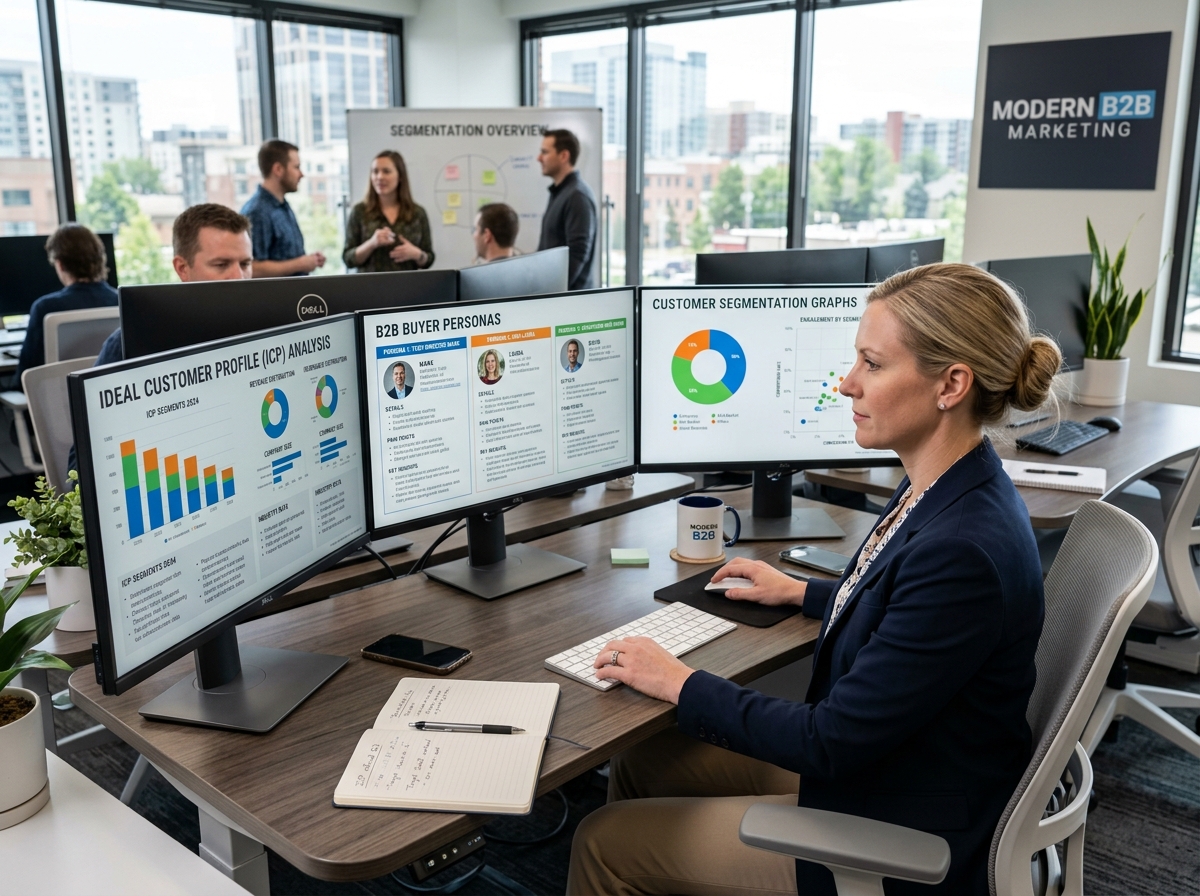
If you target everyone, you target no one. A high-converting funnel starts with a laser-focused Ideal Customer Profile (ICP). We recommend looking at your top 20% of customers—those with the highest lifetime value and shortest sales cycles—to find common traits.
Your ICP should include specific firmographics:
- Industry and Sub-sector: (e.g., SaaS, Manufacturing, or Healthcare)
- Company Size: Revenue ranges or employee counts (e.g., 50–200 employees)
- Technology Stack: What tools do they already use? (e.g., HubSpot or Salesforce)
- Geography: For our local partners, this might focus on the Chicago, Geneva, or Naperville areas.
Once the company is defined, map the buying committee. In a typical B2B deal, you’ll have a Champion (who uses the tool), a Decision Maker (who signs the check), and an Influencer (IT or Legal who vets the risk). Each needs different content to move forward.
Step 2: Top-of-Funnel (TOFU) — Awareness and Attraction
SEO and findability; lead magnets; multichannel outreach; Scientific research on B2B SEO ROI; More info about SEO services; [LIST]
The Top-of-Funnel is where the magic of discovery happens. At this stage, your prospects aren’t looking for a sales pitch; they are looking for answers to their problems.
We use a mix of “pull” and “push” strategies to fill the top of your lead generation funnel b2b:
- Advanced SEO: Targeting keywords with high informational intent. SEO leads close at a rate of 14.6%, nearly ten times higher than traditional outbound leads.
- Irresistible Lead Magnets: Offer high-value resources like research reports, whitepapers, or checklists. White papers remain the top-performing asset for 83% of B2B marketers.
- LinkedIn Ads: LinkedIn generates 80% of B2B social media leads. It’s the best place to reach decision-makers based on professional data.
- Public Speaking and Webinars: These establish immediate authority. Statistics show public speaking can deliver an 856% ROI for TOFU efforts.
The goal here is to be helpful. If you provide value first, you earn the right to ask for their email address.
Step 3: Mid-Funnel (MOFU) — Nurturing and Qualification
Lead scoring (MQL vs SQL); email sequences; webinars; Scientific research on lead nurturing; More info about email marketing; [IMAGE]
This is where most funnels leak. After a lead downloads a guide, they often sit in a database with no follow-up. We fix this by implementing automated, multi-touch nurture sequences.
Effective MOFU strategies include:
- Lead Scoring: Assign points for actions. A lead who visits your pricing page gets more points than someone who just reads a blog post. When they hit a threshold, they become a Marketing Qualified Lead (MQL).
- Educational Webinars: Webinars generate leads with 73% higher qualification scores. They allow you to demonstrate expertise and answer “how it works” questions in real-time.
- Case Studies: At this stage, prospects need proof. Show them how you solved a similar problem for a company in their industry.
Remember the “Rule of 7″—prospects usually need at least seven touches before they’re ready to talk to sales. Nurturing ensures those touches are automated and relevant.
Step 4: Bottom-of-Funnel (BOFU) — Driving Decisions
Sales alignment; ROI calculators; demos; Scientific research on BOFU content; More info about lead generation systems; [TABLE]
At the bottom of the lead generation funnel b2b, the prospect is evaluating specific solutions. They are asking, “Is this right for us?” and “What is the ROI?”
We help our clients close the gap with high-intent assets:
- Customized Demos: Don’t just show features; show solutions to the specific pain points identified during the nurture phase.
- ROI Calculators: B2B buyers are risk-averse. A tool that quantifies their potential savings or revenue gain removes friction.
- Competitor Comparisons: If you don’t tell them why you’re better than the “other guy,” they’ll go find biased reviews elsewhere.
| Feature | B2B Lead Gen Funnel | Traditional Sales Funnel |
|---|---|---|
| Primary Goal | Education & Qualification | Conversion & Closing |
| Cycle Length | Long (Months) | Short (Days/Weeks) |
| Stakeholders | Committee (6-10 people) | Single Buyer |
| Decision Driver | Logic & ROI | Emotion & Need |
Step 5: Implementation and Optimization
CRM integration; KPI tracking; sales pipeline velocity; Scientific research on funnel optimization; More info about web design and development; [LIST]
A funnel is not “set it and forget it.” It is a living system that requires constant tuning. We use data to find where prospects are dropping off and fix those leaks.
Key steps for a high-performing system:
- CRM as the Source of Truth: Whether you use a modern CRM like monday.com or Salesforce, every interaction must be logged. This ensures a seamless handoff from marketing to sales.
- Speed-to-Lead: Response times matter. Companies that respond to high-intent signals in under five minutes see significantly higher conversion rates.
- A/B Testing: We test everything—from the color of a CTA button to the subject lines of your nurture emails. Even small tweaks can lead to a 45% increase in ROI.
- Pipeline Velocity: Calculate how fast leads move through your stages. If leads are stalling in the “Evaluation” phase, you likely need better BOFU content.
Advanced Strategies: ABM and AI in the Funnel
Account-based marketing; AI-powered lead scoring; Scientific research on ABM ROI; More info about advanced SEO; [IMAGE]
For high-value accounts, a broad funnel isn’t enough. This is where Account-Based Marketing (ABM) comes in. Instead of waiting for leads to find you, you proactively target specific “golden accounts” with hyper-personalized content. 97% of marketers say ABM delivers a higher ROI than any other marketing initiative.
We also leverage AI to work smarter. AI-powered lead scoring can analyze thousands of data points to predict which leads are most likely to close, allowing your sales team to focus their energy where it counts.
Common Pitfalls in B2B Lead Generation and How to Avoid Them
Quantity vs quality; gating content; sales/marketing silos; Scientific research on funnel pitfalls; More info about local SEO; [LIST]
Even the best-laid plans can fail if you fall into these common traps:
- Focusing on Quantity over Quality: A thousand low-quality leads will only frustrate your sales team. Focus on the 12% that actually convert to revenue.
- Gating Everything: If you gate your best educational content too early, you’ll lose 57% of potential leads who are still in the anonymous research phase.
- Siloed Teams: If marketing and sales aren’t speaking the same language, leads will fall through the cracks. We recommend weekly pipeline reviews to ensure alignment.
Measuring Success: Essential KPIs for B2B Funnels
Conversion rates; CAC and CLV; attribution models; Scientific research on B2B KPIs; More info about digital marketing strategy; [INFOGRAPHIC]
To truly master your lead generation funnel b2b, you must track the metrics that move the needle. Don’t get distracted by vanity metrics like “likes” or “impressions.”
Focus on these three pillars:
- Lead-to-Opportunity Conversion: Are the leads you’re catching actually qualified? (Target: 25–35%).
- Sales Pipeline Velocity: How much revenue is moving through your funnel per day?
- Customer Acquisition Cost (CAC) vs. Lifetime Value (LTV): A healthy B2B ratio is 3:1. If it costs you more to acquire a customer than they are worth, your funnel needs a redesign.
Conclusion: Building a Funnel for Long-Term Growth
B2B lead generation is a marathon, not a sprint. By building a system that respects the complexity of the B2B buyer’s journey, you create a predictable engine for revenue.
At RED27Creative, we don’t just build websites; we build growth engines. From our home base in Geneva, IL, we help businesses across the Chicago suburbs and beyond turn digital visibility into measurable profit. If you’re ready to stop guessing and start growing, let’s build your funnel together.
FAQ: B2B Lead Generation Funnel
What is a B2B lead generation funnel?
A B2B lead generation funnel is a strategic framework designed to attract, engage, and qualify business prospects. It guides them through stages—Awareness, Consideration, and Decision—using tailored content and nurturing. The goal is to convert anonymous visitors into Marketing Qualified Leads (MQLs) and eventually into paying customers.
How does a B2B funnel differ from a B2C funnel?
B2B funnels are significantly longer, often lasting several months, and involve multiple stakeholders rather than a single consumer. They focus on logical ROI and long-term relationships rather than emotional, immediate purchases. Because B2B stakes are higher, the funnel requires more educational content, trust-building, and personalized nurturing.
What is the most important metric in a B2B funnel?
While several metrics matter, Pipeline Velocity is often considered the most vital. It measures how quickly leads move through your funnel and how much revenue they represent. This metric combines lead volume, win rate, deal size, and sales cycle length to provide a clear picture of growth.
Why do most B2B leads fail to convert?
Most leads fail because of a focus on quantity over quality and a lack of proper nurturing. Research shows that 80% of leads never convert without a structured follow-up process. Misalignment between marketing and sales teams also causes high-potential prospects to fall through the cracks during handoffs.
Is cold email still effective for B2B lead generation?
Yes, cold email remains highly effective when it is personalized and value-driven. In 2026, generic “blasts” fail, but targeted outbound sequences that address specific pain points can see response rates as high as 15%. It works best when integrated into a multichannel strategy alongside SEO and social.

Kiel Tredrea
https://red27creative.comTop Marketing Agency • Web, SEO & Leads • RED27Creative