Paid Search Management Explained (Without Making Your Head Spin)

Explaining Digital Advertising: What Google Paid Search Management Really Means
Google Paid Search Management is the strategic oversight of pay-per-click (PPC) advertising campaigns on Google’s search engine. Here’s what you need to know:
- Definition: Professional management of Google Ads campaigns to maximize ROI
- Core components: Keyword research, ad creation, bid management, and performance tracking
- Typical costs: $250-$2,500 monthly management fee plus 7-15% of ad spend
- Key benefit: You only pay when someone clicks your ad (hence “pay-per-click”)
- Main advantage: Immediate visibility at the top of search results, unlike SEO which takes months
When you type a search into Google, those ads at the top of the page don’t appear by magic. They’re the result of carefully managed paid search campaigns where advertisers bid on keywords relevant to their business.
Behind every successful Google Ads campaign is a structured management process. This includes researching high-value keywords, crafting compelling ad copy, setting strategic bids, designing conversion-focused landing pages, and continuously optimizing for better performance.
Unlike organic SEO efforts that can take months to show results, Google Paid Search delivers immediate visibility to potential customers actively searching for your products or services. This makes it an essential tool for businesses looking to drive targeted traffic and generate leads quickly.
The beauty of paid search is its measurability. Every click, conversion, and dollar spent can be tracked, allowing for data-driven decisions that continually improve campaign performance. When managed properly, Google Ads can deliver an impressive return on investment, with some businesses seeing returns of 5:1 or higher on their ad spend.
I’m Kiel Tredrea, founder of RED27Creative with over 20 years of experience implementing high-impact Google Paid Search Management strategies that drive measurable revenue for businesses across B2B and B2C industries. My approach focuses on conversion optimization and performance to ensure your digital advertising budget delivers maximum ROI.
Know your Google Paid Search Management terms:
– Google Ads account management
– Google Ads dynamic search ads
– Google Ads budget management
Google Paid Search Management 101
Ever wondered how those ads at the top of your Google search results get there? That’s Google Paid Search Management in action – a powerful way to put your business front and center when potential customers are actively searching for what you offer.
At its heart, these ads work on a pay-per-click (PPC) model, meaning you only pay when someone finds your ad interesting enough to click through to your website. It’s like having a storefront that only charges rent when customers walk through the door!
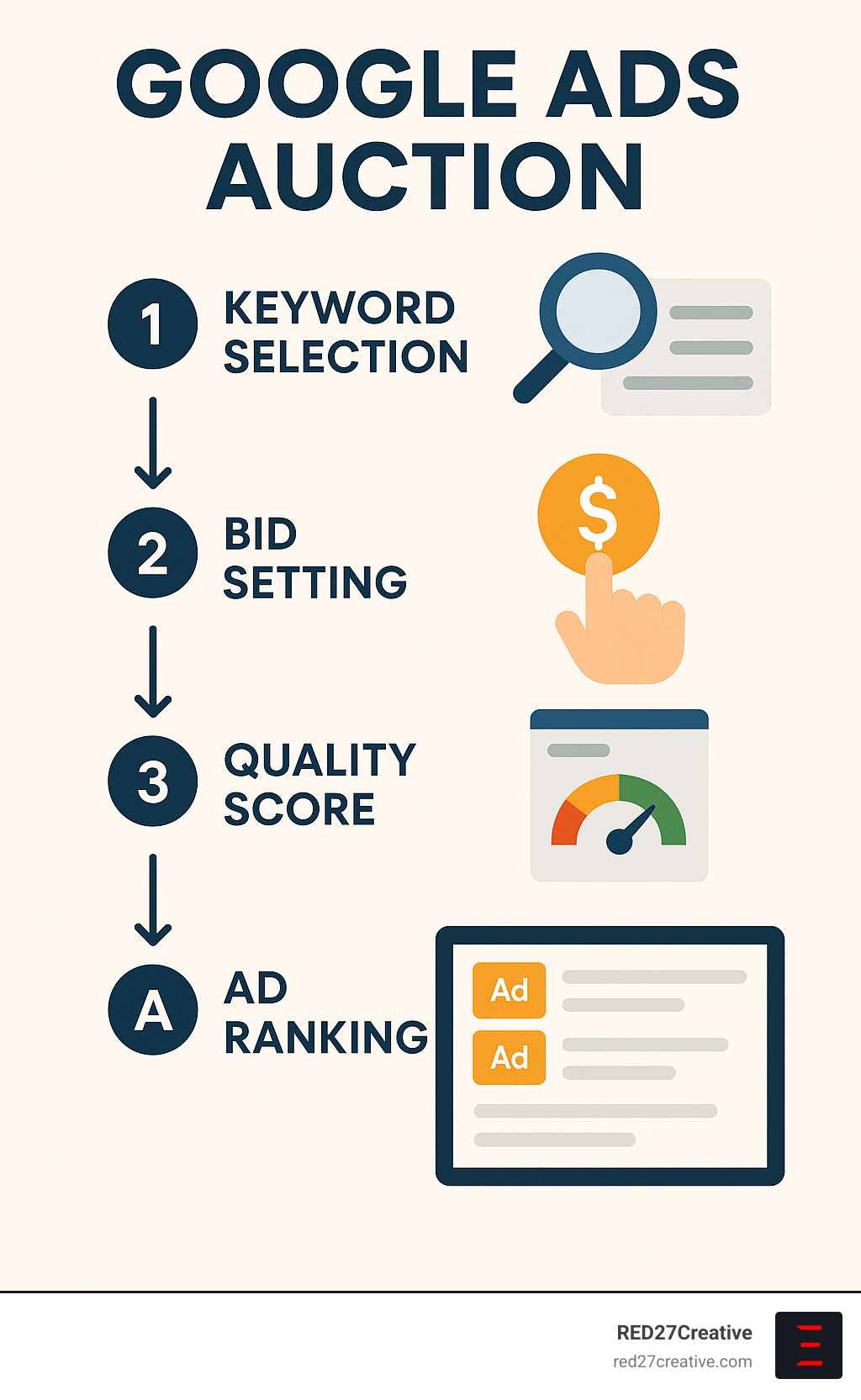
Google’s advertising platform uses an auction system that considers Quality Score – a measure of how relevant and helpful your ads, keywords, and landing pages are to the person searching. Your Ad Rank (where your ad appears) comes from multiplying your bid amount by your Quality Score.
This means even with a smaller budget, you can outshine bigger competitors if your ads are more relevant to searchers.
| Factor | Paid Search (PPC) | Organic Search (SEO) |
|---|---|---|
| Time to Results | Immediate visibility | 3-6+ months |
| Cost Structure | Pay per click | No direct cost per visitor |
| Targeting Control | Precise audience targeting | Limited targeting options |
| Longevity | Stops when you stop paying | Continues working over time |
| Scalability | Easily scalable with budget | Limited by search volume |
What Is Google Paid Search Management?
Google Paid Search Management is like having a skilled conductor leading an orchestra – it brings together multiple elements into a harmonious performance that drives business results. This comprehensive approach includes developing campaign strategies aligned with your business goals, researching the exact keywords your potential customers are typing into Google, and determining smart bid amounts for those keywords.
The process involves crafting compelling ad copy, creating landing pages that deliver on your ad’s promise, and carefully tracking performance metrics like click-through rates and conversion rates.
Modern Google Paid Search Management leverages Google’s AI-powered bidding technology, which adjusts your bids in real-time for each individual search based on conversion likelihood.
Paid Search (PPC) vs Organic Search (SEO)
Think of paid search and organic search as two different paths to the same destination – both aim to bring visitors from Google to your website, but they take different routes.
With paid search, your ads appear immediately at the top of search results, giving you instant visibility. You get precise control over who sees your ads based on location, device type, time of day, and even past online behavior. However, the traffic stops flowing the moment you turn off the budget.
Organic search through Advantages of Search Engine Optimization is more like planting a garden – it takes time to grow, but once established, it continues bearing fruit without paying for each visitor.
At RED27Creative, we’ve found the most effective digital strategies blend both approaches – using paid search for immediate results while building organic presence for long-term success.
Key Business Benefits
Google Paid Search Management offers remarkable advantages that make it a cornerstone of effective digital marketing:
The precision targeting is game-changing – your business appears exactly when someone is actively searching for what you offer. Quick ROI means you can generate leads and sales immediately, unlike traditional marketing channels. Full measurability lets you track every dollar spent and understand exactly what you’re getting in return.
The scalability of paid search is particularly valuable – as you find what works, you can easily increase investment to grow results proportionally. Brand protection ensures your business appears when people search specifically for you. And remarketing capabilities let you reconnect with previous website visitors who showed interest but weren’t quite ready to buy.
Real businesses are seeing remarkable results. Take tails.com, which saw trial sign-ups jump by 182% and clicks increase by 258% with AI-driven search ads. Similarly, HealthCare.com achieved 40% growth in both conversions and revenue by combining broad match keywords with value-based Smart Bidding.
Setting Up & Structuring Your First Campaign
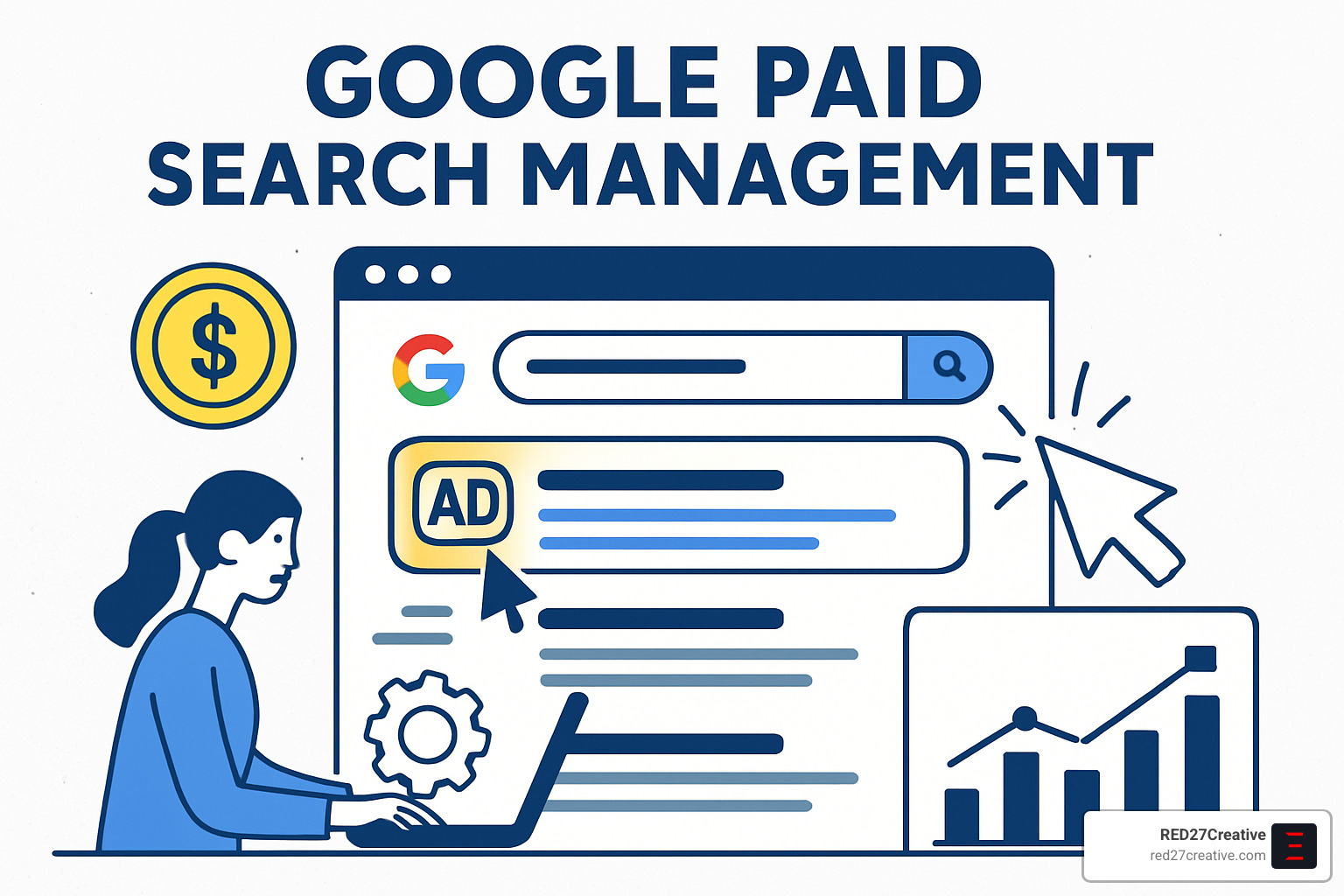
Ready to dive into Google Paid Search Management? Think of your Google Ads account as a well-organized filing cabinet. At the top level sits your account, which houses all your campaigns. Each campaign contains related ad groups, which in turn hold your actual ads and keywords. This neat hierarchy makes managing even complex advertising efforts much more manageable.
When I explain this structure to clients, I often compare it to a family tree: your account is the grandparent, campaigns are the parents, ad groups are the children, and ads and keywords are the grandchildren.
Pre-Launch Checklist for Google Paid Search Management
Before hitting that launch button, let’s make sure you’re truly prepared with this essential checklist:
First, get crystal clear on your objectives. Are you hunting for leads, driving sales, or building brand awareness? Next, dive into keyword research using Google’s keyword planner. This free tool helps you find what your potential customers are actually searching for.
Take a peek at what your competitors’ ads look like. What promises are they making? How can you stand out? And don’t forget to set up conversion tracking—without it, you’re essentially flying blind.
Creating dedicated landing pages that perfectly match your ad messaging is crucial. I’ve seen conversion rates double simply by aligning ad copy with landing page headlines!
Your keyword strategy should include decisions about match types (broad, phrase, or exact), and don’t forget about negative keywords—those search terms you definitely don’t want to appear for.
Creating the Campaign
When you log into Google Ads, you’ll need to select a campaign goal that aligns with your business objectives. For most businesses focused on Google Paid Search Management, a “Search” campaign type makes the most sense.
Your targeting settings are where the magic happens. You can zero in on specific geographic locations, languages, and even schedule your ads to appear only during your business hours. I’ve seen local businesses boost their ROI significantly by simply turning off ads when they’re closed!
Setting your daily budget is next—start conservative until you have performance data to justify scaling up. For bidding strategy, beginners often do well with automated options like Maximize Conversions, while experienced advertisers might prefer manual CPC for granular control.
Don’t overlook ad extensions—they expand your ad with additional information like phone numbers, links to specific pages, callouts, and more. These not only improve visibility but can significantly boost click-through rates.
When creating ad groups, think thematically. Each group should focus on a closely related set of keywords and products. For example, a furniture store might have separate ad groups for “dining tables,” “office desks,” and “coffee tables.”
For detailed step-by-step instructions, Google’s Create a Search campaign help page is an excellent resource.
Crafting High-Impact Ads
Your ad copy is where you make that crucial first impression. The difference between a good ad and a great one can mean thousands in additional revenue!
Google Paid Search Management pros know that compelling headlines are the foundation of high-performing ads. Include your keywords naturally, highlight what makes you special, and create a sense of urgency when appropriate.
With responsive search ads now the standard format, provide multiple headline and description variations to let Google’s AI mix and match the best combinations. Make sure your messaging speaks directly to the searcher’s intent.
Strong calls-to-action make a tremendous difference. Be specific about what you want users to do: “Book Your Free Consultation” is much more effective than a generic “Learn More.”
Armani beauty saw their click-through rates jump by 61% after implementing responsive search ads, along with an 11% boost in conversions. For more inspiration, check out Google’s comprehensive Responsive Search Ads guide.
Building Conversion-Ready Landing Pages
Even the best ads fall flat if they lead to poor landing pages. Your landing page is where conversion happens—or doesn’t.
Speed matters enormously. If your page takes more than 3 seconds to load, you’re losing over half your potential customers! I’ve seen businesses double their conversion rates simply by improving page speed.
Message match creates a seamless experience. When your landing page headline echoes the promise in your ad, visitors instantly know they’re in the right place.
Keep your forms as simple as possible—each additional field reduces completion rates. Trust signals like testimonials, reviews, and security badges reassure visitors they’re making a good decision.
Your call-to-action button should stand out visually and communicate value, not just action. “Get My Free Quote” works better than “Submit” because it emphasizes what the user receives.
At RED27Creative, we’ve mastered the art of creating landing pages that convert casual browsers into paying customers. Learn more about how we Increase Website Traffic and turn that traffic into revenue through carefully optimized landing pages.
Optimization & Scaling for Maximum ROI
Once your campaigns are live, the real work of Google Paid Search Management begins. Think of your campaign as a garden that needs regular tending – with the right care, it will flourish and produce impressive results.

How Quality Score Drives Cost & Performance
Google’s Quality Score is the secret sauce that can make or break your campaign’s success. This 1-10 rating system looks at three key elements:
Your expected click-through rate shows Google how likely users are to click your ad. Think of this as your ad’s ability to catch someone’s eye in a crowded room.
The ad relevance measures how well your ad matches what the person is searching for. It’s like speaking the same language as your customer.
Finally, your landing page experience determines whether visitors find what they expected after clicking. This is like promising a chocolate cake and actually delivering one when guests arrive.
A high Quality Score is like getting a VIP discount card for Google Ads. You’ll enjoy lower costs per click, better ad positions, more impressions, and ultimately a healthier return on your investment.
Want to boost your score? Focus on creating a seamless journey from keyword to ad to landing page. Check out Google’s guide on how to improve your quality score for specific tactics that work.
Ongoing Google Paid Search Management Tasks
Managing Google Ads is like tending to a high-performance vehicle – regular maintenance keeps everything running smoothly. Here’s what your maintenance schedule should look like:
Every day, take a quick look under the hood. Check your campaign performance and spending patterns. Spot any disapproved ads or policy issues before they cause problems. Review your search terms report to catch any irrelevant queries eating up your budget.
Weekly maintenance involves a deeper inspection. Analyze how your ads perform across different devices, locations, and times of day. Build out your negative keyword lists to prevent wasted spend. Test fresh ad variations to keep content engaging.
Monthly tune-ups require a comprehensive review. This is when you’ll generate detailed performance reports, look for opportunities to expand, refresh your ad copy with new messaging, and reevaluate your bidding strategies.
For a closer look at how we approach ongoing optimization, visit our Google Paid Search PPC page where we share our proven strategies.
Scaling Campaigns Safely
Once you’ve built a profitable campaign, scaling up is like growing your business – it requires careful planning rather than blind expansion.
Start with gradual budget increases of 20-30% at a time. This gives Google’s algorithm room to adjust without shocking the system. Think of it like slowly turning up the heat rather than cranking it to maximum.
Consider geographic expansion once you’ve proven success in your initial markets. Perhaps your ads perform beautifully in Chicago – might they work just as well in Milwaukee or Indianapolis?
Keyword expansion allows you to capture additional relevant traffic. After mastering your core keywords, branch out to related terms and experiment with broader match types to find new opportunities.
Audience layering adds another dimension to your targeting. By applying demographic and behavioral filters, you can refine who sees your ads, ensuring they reach the most qualified prospects.
As you grow more confident, explore campaign diversification into Shopping, Display, or Video formats. Consider implementing Performance Max campaigns that leverage Google’s AI to run ads across all Google properties with Open up the Power of Search.
When scaling, keep a watchful eye on performance metrics. Rapid expansion without proper monitoring is like driving with your eyes closed – dangerous and likely to end in a crash.
Costs, Pricing Models & When to Hire Help
Let’s talk money – the part everyone wants to know about! Understanding what Google Paid Search Management actually costs helps you budget effectively and measure your true return on investment.
When you’re diving into Google Ads, your costs break down into two main buckets: what you pay Google for the actual clicks, and what you might pay someone to manage those campaigns for maximum performance.
Budgeting for Google Paid Search Management
The cost of running Google Ads varies dramatically depending on your industry. Legal services, insurance, and financial products tend to have the highest costs per click – sometimes $50 or more for a single click! Meanwhile, local retail might pay just a few dollars per click.
For businesses just testing the waters, I recommend starting with at least $500-1,000 monthly in ad spend. This gives Google’s algorithms enough data to learn and optimize. Think of your first three months as paid education – you’re gathering valuable market intelligence while also generating leads.
One insider tip: always carve out 5-20% of your total budget specifically for remarketing campaigns. These ads targeting people who’ve already visited your site typically deliver 2-3 times better conversion rates than cold traffic.
Setting clear performance targets keeps your campaigns focused. Whether you’re aiming for a specific cost per lead or a target return on ad spend (like $3 back for every $1 spent), these guardrails prevent wasted spending while giving your campaigns room to grow.
Well-managed campaigns generating positive ROI aren’t really a cost – they’re a profit center. When you find that sweet spot where every dollar invested brings back more than a dollar in profit, the logical move is to increase your budget to capture more market share.
Signs You Need a Specialist or Agency
While the Google Ads interface looks deceptively simple, effective Google Paid Search Management requires specialized knowledge that takes years to develop. Here are clear signals it’s time to bring in professional help:
Your campaign performance has plateaued despite your best efforts to improve it. Sometimes fresh eyes and advanced techniques can break through performance ceilings.
You simply don’t have time to properly manage campaigns. Google Ads isn’t a “set it and forget it” platform – it requires regular attention to thrive.
Your business has complex product lines or services requiring multiple campaigns with different strategies and messaging.
You’re investing significant budget in paid search. As your spend increases, the stakes get higher – professional management often pays for itself through improved performance.
You find yourself struggling with technical aspects like conversion tracking setup, audience targeting, or understanding automated bidding strategies.
Professional management typically runs between $250-$2,500 monthly plus a percentage of ad spend (usually 7-15%), depending on your campaign complexity and budget size. While this adds to your overall investment, the improved performance typically more than offsets the management fee through better results and reduced wasted spend.
At RED27Creative, we’ve built our reputation on transparency and results. Whether you’re a local business in Chicago, Aurora, Naperville, or a national brand looking to dominate your market, we customize our approach to fit your specific business goals and budget realities.
Frequently Asked Questions about Google Paid Search Management
What does “pay per click” really mean?
Ever wondered why it’s called “pay per click”? It’s beautifully simple – you only pay when someone actually clicks on your ad and visits your website.
With traditional advertising, you’re paying for eyeballs that might never engage with your business. With Google Paid Search Management, you’re only charged when someone is interested enough to click through to learn more. If your ad appears 1,000 times but only gets clicked 10 times, you only pay for those 10 clicks.
The cost per click varies widely depending on your industry, competition, and Quality Score. Some businesses enjoy clicks for under $1, while others in competitive fields like legal, insurance, or finance might pay $50 or more per click.
How long before a new campaign shows results?
Your ads typically start appearing within 24 hours after approval. You’ll see immediate activity – impressions, clicks, and even some initial conversions. But don’t expect perfection right away.
Think of your new campaign like a freshly hired employee. They need time to learn the ropes before performing at their best. Your campaign goes through similar phases:
First comes the learning phase (1-2 weeks) where Google’s algorithm gathers initial data about your ads. Then there’s the conversion accumulation period (2-4 weeks) where you collect enough conversion data to make meaningful decisions. Finally, you’ll go through several optimization cycles (1-3 months) testing and refining based on performance.
While you’ll see activity right away, patience during this 2-3 month ramp-up period pays huge dividends.
How is Smart Bidding different from manual bidding?
Imagine the difference between driving a car yourself versus having an AI-powered chauffeur who knows traffic patterns, weather conditions, and the fastest routes in real-time. That’s essentially the difference between manual and Smart Bidding.
With manual bidding, you’re in complete control. You set specific bid amounts for each keyword and make all adjustments yourself. It works well for small accounts with limited data or highly specialized campaigns.
Smart Bidding harnesses Google’s powerful machine learning to make bid adjustments automatically. It analyzes hundreds of signals in real-time – device type, location, time of day, user behavior, and many more – then adjusts your bids for each auction based on the likelihood of conversion.
Smart Bidding options let you focus on business goals rather than bid management:
– Target CPA (cost per acquisition)
– Target ROAS (return on ad spend)
– Maximize conversions
– Maximize conversion value
The results can be remarkable. HealthCare.com achieved 40% growth in both conversions and revenue by combining broad match keywords with value-based Smart Bidding.
Conclusion
Mastering Google Paid Search Management truly blends art with science. It’s not just about setting up ads and hoping for the best—it’s about crafting strategies that connect with real people, analyzing data that tells meaningful stories, and continuously fine-tuning your approach to maximize every dollar spent. When managed thoughtfully, Google Ads becomes your business’s most powerful lead generation tool, delivering your message to potential customers at the exact moment they’re searching for what you offer.
At RED27Creative, we don’t just manage campaigns—we build partnerships with businesses across Geneva, Batavia, Aurora, St. Charles, Plainfield, Oswego, Naperville, and Chicago. Our approach to Google Paid Search Management goes beyond technical expertise. We bring creative thinking and genuine curiosity about your business goals to create campaigns that don’t just drive clicks but convert those clicks into loyal customers.
We understand that Google’s advertising platform can feel overwhelming, especially when you’re focused on running your business. That’s why we handle the complexities—from keyword research and bid management to ad creation and performance analysis—while keeping you informed with clear, jargon-free reporting that shows exactly how your investment is performing.
The digital advertising landscape evolves constantly, and our team stays ahead of the curve. We’re continuously learning, testing, and implementing new strategies to ensure your campaigns leverage the latest innovations. Whether it’s embracing AI-powered bidding strategies or crafting responsive search ads that resonate with your audience, we’re committed to keeping your campaigns fresh and effective.
Ready to transform your Google Paid Search Management from a confusing expense into a predictable revenue generator? Learn more about our Google Paid Search services or reach out for a friendly, no-pressure conversation about your goals. We’re genuinely excited to help you turn clicks into customers and advertising spend into business growth.


Kiel Tredrea
https://red27creative.comTop Marketing Agency • Web, SEO & Leads • RED27Creative