Cultivate Your Clicks: How Growth-Focused Web Design Drives Success

Why Your Website Should Be a Growth Engine, Not a Digital Graveyard
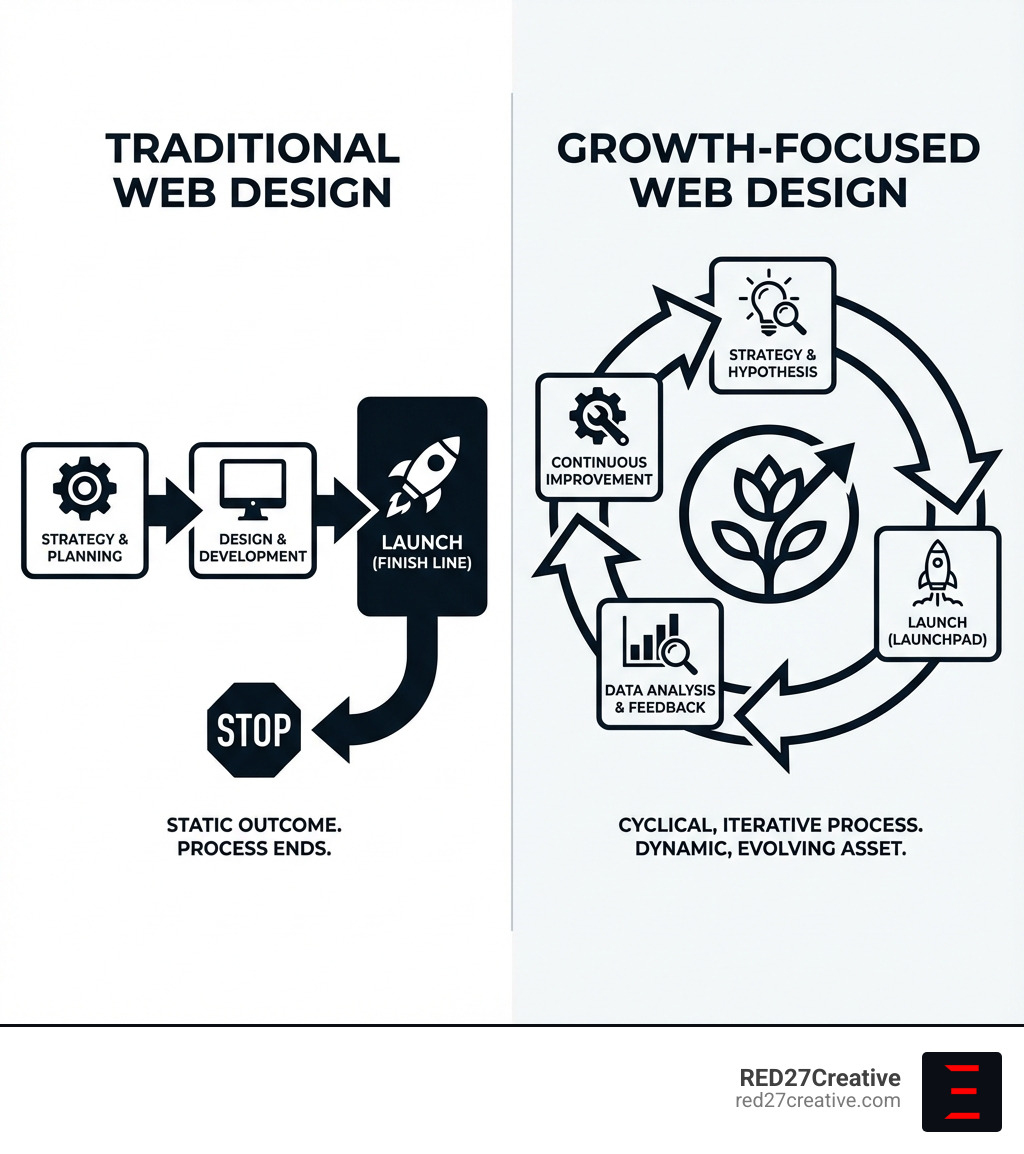
Growth focused web design is a modern, data-driven approach to building and improving websites through continuous iteration and real user feedback, rather than the traditional “launch and leave” model. Here’s what makes it different:
- Iterative Development: Launch quickly with a functional “launchpad” site, then improve continuously based on real data
- Data-Driven Decisions: Use actual user behavior and analytics to guide changes, not assumptions
- Continuous Improvement: Implement monthly optimization cycles focused on high-impact changes
- Faster Time-to-Value: Get a better-performing site live in 1-3 months instead of 6-12 months
- Predictable Costs: Spread investment over time with a retainer model instead of large upfront expenses
- Measurable Results: Agencies using this approach report 16.9% more leads after 6 months
If your website feels like a static brochure that rarely changes, you’re not alone. Traditional web design follows a broken model: spend months (and thousands of dollars) building a site based on best guesses, launch it with fanfare, then watch it slowly become outdated while your competitors evolve. According to research, 94% of users stop visiting websites that have outdated designs, and 57% of businesses plan redesigns within just 12 months of launching.
The reality is harsh: your website is either growing or dying. There’s no middle ground.
Growth focused web design solves this problem by treating your website like a living asset that continuously improves. Instead of the traditional “big bang” redesign every few years, this approach launches a functional site quickly, then uses real user data to make strategic improvements every month. The result? Websites that get better at converting visitors into leads over time, not worse.
Think of it like the difference between building a house and never touching it again, versus tending a garden that flourishes with regular care.
I’m Kiel Tredrea, founder of RED27Creative, where I’ve spent over 20 years helping businesses transform their websites from static marketing pieces into dynamic growth engines through growth focused web design principles. My team and I have guided hundreds of companies through this shift, combining data, strategy, and continuous optimization to deliver measurable results that compound over time.
Similar topics to Growth focused web design:
The Problem with Traditional Web Design
For too long, the conventional wisdom around website development has been to “build it and forget it.” This approach, while seemingly straightforward, is a recipe for digital stagnation in today’s online world. We’ve seen countless businesses in Geneva, Aurora, Naperville, and across the Chicago area fall into this trap, investing heavily in a one-time launch only to find their digital presence rapidly losing relevance.
The Vicious Cycle of Redesigns
Traditional web design often feels like a high-stakes gamble. It begins with high upfront costs and involves long development timelines, frequently stretching six months or longer. These projects are often based on subjective opinions and assumptions about what users want, rather than concrete data. This lack of initial data-driven insights makes them highly susceptible to scope creep, where features are added without clear justification, inflating budgets and delaying launches.
The core issue is a “launch-and-leave” mentality. Once the site is live, it’s considered “done.” But in reality, a static and inflexible website quickly becomes outdated. The digital landscape, user expectations, and even your business goals are constantly evolving. A website that isn’t evolving with them will struggle to perform. In fact, research shows that 57% of businesses surveyed planned website redesigns within 12 months, highlighting just how quickly sites can become obsolete. This leads to a frustrating cycle: launch an expensive site, watch it stagnate, then face another costly, time-consuming redesign just a few years later.
Why a Static Website is a Wasted Asset
A website that fails to adapt is more than just an aesthetic issue; it’s a wasted asset that actively hurts your business. Stagnant sites lead to missed conversion opportunities because they often have poor user experience (UX) that doesn’t cater to visitor needs. When users can’t easily find what they’re looking for or struggle with navigation, they leave—and quickly. Some studies suggest that users make an impression in as little as 15 to 54 seconds. If your site doesn’t engage them, they’re gone.
Furthermore, a static website often suffers from declining SEO performance. Search engines, like users, prioritize fresh, relevant content and a strong user experience. If your site isn’t regularly updated and optimized, it will inevitably drop in rankings, reducing organic traffic. This creates a significant disconnect from sales and marketing goals, as the website—which should be your primary lead-generating tool—fails to deliver qualified opportunities. It simply cannot adapt to user behavior because it’s built on a fixed set of assumptions.
The good news? Optimised user experience (UX) designs can boost conversion rates by as much as 400%. This statistic alone underscores the immense potential locked away in a website that is actively managed and improved.
What is Growth-Focused Web Design?
At RED27Creative, we believe your website should be a dynamic, lead-generating engine, not a static brochure. This is the essence of Growth focused web design, also known as Growth-Driven Design (GDD). It’s a modern, agile methodology that transforms how we approach web development, shifting from a project-based mindset to an ongoing, strategic partnership aimed at continuous improvement and measurable results.
The Core Principles of a Growth-Focused Approach
Growth focused web design is built on a foundation of several key principles that set it apart:
- Iterative Development: Instead of a single, massive launch, we develop your website in smaller, manageable cycles, constantly refining it.
- Data-Driven Decisions: Every change, every new feature, and every optimization is backed by real user data and analytics, not guesswork or subjective opinions. We use tools like Google Analytics to understand user behavior.
- Continuous Improvement: Your website is never “finished.” It’s a living asset that evolves alongside your business and user needs, undergoing monthly optimization sprints.
- Faster Time-to-Value: By launching a functional “launchpad” site quickly, you start generating value and collecting data much sooner than with traditional methods.
- Reduced Risk and Predictable Costs: Spreading the investment over time minimizes the financial risk of a large, one-time project and allows for more flexible budgeting.
- User-Centricity: The user is at the heart of every decision. We constantly strive to understand their needs, pain points, and how they interact with your site.
- Alignment with Business Objectives: Every website improvement is directly tied to your overarching business goals, ensuring that your digital presence actively contributes to your success.
This systematic approach minimizes the perils of traditional site design, delivering optimal results using data.
| Feature | Traditional Web Design | Growth-Focused Web Design |
|---|---|---|
| Cost | High upfront, unpredictable overruns | Spread out, predictable monthly investment |
| Timeline | Long (6+ months), fixed launch date | Fast initial launch (1-3 months), continuous cycles |
| Risk | High (big bet on assumptions) | Low (small, data-backed experiments) |
| ROI | Unpredictable, often diminishes quickly | Measurable, compounds over time |
| Decision Making | Opinion-based, subjective | Data-driven, objective |
| Website State | Static, quickly outdated | Dynamic, continuously evolving |
| User Focus | Assumed needs | Real user feedback & behavior |
The Key Benefits for Your Business
Adopting a Growth focused web design strategy offers profound advantages for businesses in places like Oswego, St. Charles, and Plainfield that are serious about their online presence:
- Measurable Growth: Agencies that used Growth-Driven Design reported seeing 16.9% more leads after 6 months and 11.2% more revenue. This isn’t just about traffic; it’s about tangible business results.
- Improved User Experience: By continuously analyzing user behavior and feedback, we ensure your website provides a seamless, intuitive, and enjoyable experience, which keeps visitors coming back.
- Increased Lead Generation and Conversions: Every iteration is designed to optimize pathways to conversion, reducing friction and guiding users toward desired actions, whether it’s a contact form submission or a purchase.
- Better ROI: Your investment is constantly working for you. Instead of a site that depreciates, you have an asset that appreciates in value and effectiveness over time, delivering a superior return on investment.
- Agility and Adaptability: Your website can quickly adapt to market changes, new product launches, or evolving user preferences, ensuring long-term relevance.
At RED27Creative, we’re experts in crafting these high-performing, growth-focused websites. Learn more about RED27Creative’s web design services and how we can help your business thrive.
The 3-Stage Methodology of Growth-Focused Web Design
Our approach to Growth focused web design is systematic, built on a three-phase process that ensures continuous improvement and measurable results. Each stage is designed to build upon the last, creating a powerful feedback loop of strategy, action, and learning.
Stage 1: The Strategy Blueprint
This foundational stage aligns your website with core business objectives by gathering concrete insights instead of relying on assumptions. Key activities include:
- Goal Setting: Defining SMART (Specific, Measurable, Achievable, Relevant, Time-bound) goals for your website.
- Audience Research: Developing detailed buyer personas and mapping the user journey to understand customer needs, motivations, and online behavior.
- Data Analysis: Performing a quantitative analytics audit to see what users are doing and gathering qualitative feedback (surveys, interviews) to understand why.
- Roadmap Creation: Documenting key assumptions for testing and creating a prioritized wishlist of website improvements that will guide future iterations.
This strategic groundwork ensures every subsequent step is purposeful and data-informed. Dive deeper into how we build effective online strategies with RED27Creative’s marketing strategy and consulting services.
Stage 2: The Launchpad Website
Instead of aiming for a “perfect” launch, this stage focuses on getting a functional, high-impact “Launchpad” website live quickly (typically within 1-3 months). This site is a better version of your current one, not a prototype. By applying the 80/20 rule, we prioritize the 20% of features that will deliver 80% of the impact. This rapid deployment allows you to start collecting real user data and seeing results immediately, providing a solid foundation for continuous improvement without the delays of traditional redesigns. The Launchpad site is built to be robust, user-friendly, and optimized from day one.
Ready to launch a high-performing foundation for your online presence? Learn more about building your launchpad website with RED27Creative.
Stage 3: The Continuous Improvement Cycle
Once the Launchpad site is live, the continuous improvement cycle begins. This is an ongoing process of optimization and learning, executed in agile sprints based on real-world performance. The cycle follows a “Plan-Build-Learn-Transfer” loop:
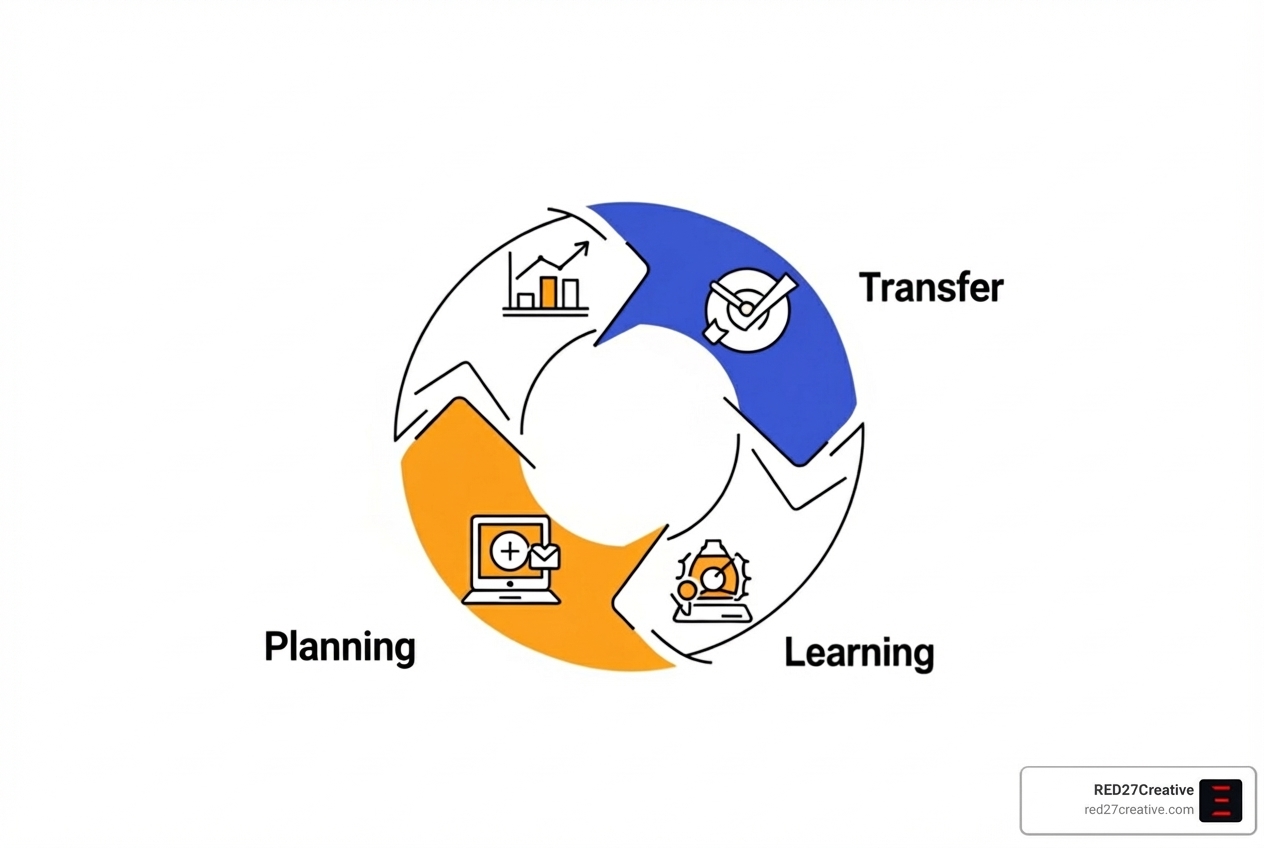
- Plan: Identify and prioritize high-impact actions from the wishlist and formulate a testable hypothesis (e.g., “Adding testimonials will increase conversions by improving trust”).
- Build: Implement the planned changes as experiments, such as A/B testing headlines, optimizing CTAs, or adding new content.
- Learn: Analyze experiment results using data from tools like Google Analytics and user feedback to understand what worked, what didn’t, and why.
- Transfer: Document and share key insights with your team to inform broader marketing and sales strategies.
This iterative process of making small, data-backed adjustments leads to compounding growth over time, ensuring your website remains relevant and effective at generating conversions. Our lead generation services are perfectly integrated with this continuous improvement model to ensure your website is always working harder for you. Learn more about RED27Creative’s lead generation services.
Measuring Success and Overcoming Challenges
Implementing a Growth focused web design strategy represents a significant shift from traditional web development. It requires a new mindset that accepts data, iteration, and continuous learning. But with this shift comes the power to truly understand and optimize your website’s performance.
Key Metrics for Measuring Success
To gauge effectiveness, we focus on key performance indicators (KPIs) that correlate with business objectives, not vanity metrics. These indicators of real growth and ROI include:
- Conversion Rates: Tracking the percentage of visitors who complete a desired action (e.g., form submission, purchase). This is a primary indicator of success.
- Lead Quality and Quantity: Measuring not just the number of leads but also their fit for your business. Agencies using GDD have reported 16.9% more leads.
- User Engagement: Analyzing metrics like time on page, bounce rate, and pages per session to gauge user experience.
- SEO Performance: Monitoring organic traffic and keyword rankings to measure visibility in search engines.
- Customer Lifetime Value (CLV): Assessing the long-term value of a customer, which is crucial for e-commerce and subscription models.
- Return on Investment (ROI): Calculating the financial return from the website investment to prove tangible business value.
Our advanced RED27Creative’s SEO services are designed to integrate seamlessly with your GDD strategy, ensuring that every website improvement also boosts your visibility and organic reach.
Common Challenges and How to Steer Them
Transitioning to this model can present some challenges, but they are manageable:
- Cultural Shift: Embracing a data-driven culture of experimentation where failed tests are seen as learning opportunities, not setbacks.
- Stakeholder Buy-in: Communicating the long-term value and ROI of a website that is “never finished” but continuously improving.
- Resource Allocation: Shifting from large, one-time project budgets to predictable retainers for ongoing optimization.
- Data Literacy: Ensuring the team can interpret and act on website data to inform decisions across the business.
Growth focused web design is best suited for businesses that:
- Are looking for consistent, month-over-month growth.
- Want a website that truly performs as a sales and marketing asset.
- Are tired of the “redesign headache” and want a more agile approach.
- Value data-driven decisions over guesswork.
- Are ready to invest in a long-term strategy for their online presence.
This includes B2B service companies, SaaS businesses, e-commerce sites, and startups—essentially any business that views its website as a critical tool for achieving growth.
Frequently Asked Questions about Growth-Focused Web Design
What is the main difference between growth-focused and traditional web design?
The primary difference is the process. Traditional design is a linear, one-time project based on assumptions, resulting in a static site. Growth focused web design is a cyclical, ongoing process that uses real user data to make iterative improvements, ensuring the site continuously evolves and performs better over time.
How does growth-focused design impact website costs?
Instead of a large, high-risk upfront investment, Growth focused web design spreads costs over time in a more predictable, retainer-based model. This approach minimizes initial financial risk and ensures your budget is consistently allocated toward high-impact improvements that generate a measurable return on investment.
How quickly can I see results with a growth-focused approach?
You’ll see initial results quickly with the launch of the “Launchpad” site, which is a better-performing version of your old site that goes live in 1-3 months. From there, significant, data-backed improvements are implemented in monthly cycles, leading to compounding growth in leads and conversions.
Transform Your Website into Your Best Growth Asset
A Growth focused web design website is more than just a digital presence—it’s a powerful engine for attracting visitors, building trust, and driving measurable results. By moving away from the outdated traditional model and embracing a data-driven, iterative approach, you create a sustainable asset that adapts and improves alongside your business.
At RED27Creative, we specialize in building these high-performance systems for businesses in Geneva, Batavia, Aurora, St. Charles, Plainfield, Oswego, Naperville, and Chicago. Our team of designers, developers, and SEO experts works to ensure your website is always optimized, always growing, and always aligned with your goals. Ready to cultivate your clicks and watch your business grow? Let’s build a website designed for growth.

Kiel Tredrea
https://red27creative.comTop Marketing Agency • Web, SEO & Leads • RED27Creative