Beyond the Homepage: A Guide to B2B and Enterprise Web Design
Why Your Digital Front Door Matters More Than Ever
B2B & Enterprise Web Design is the process of creating digital platforms that serve business audiences at scale—handling complex decision-making processes, multiple stakeholders, and high-volume traffic while building trust and driving measurable conversions.
Key elements of effective B2B & Enterprise Web Design include:
- Strategic messaging that speaks to outcomes, not just features
- Scalable architecture that supports growth and integrates with existing systems
- Trust-building elements like case studies, testimonials, and transparent pricing
- Clear user journeys designed for long, multi-stakeholder buying cycles
- Performance optimization for speed, security, and mobile responsiveness
- Lead generation systems that convert visitors into qualified prospects
The stakes have never been higher. Today, 29 percent of business is conducted online, and that number continues to climb. For B2B and enterprise organizations, your website isn’t just a digital brochure—it’s your most valuable marketing asset and often the first (and sometimes only) impression you’ll make on a potential customer.
Yet many enterprise websites fall short. Research shows that a poorly designed website can result in a 35% profit loss. When your site is slow, confusing, or fails to communicate value clearly, prospects leave—often to a competitor who got the fundamentals right.
The challenge is real: enterprise websites must handle massive amounts of content, serve diverse audiences across departments and geographies, integrate with complex backend systems, and meet strict security and compliance requirements. Nearly 66% of enterprise web development challenges result in project derailment due to underestimated technical complexity.
But when done right, your website becomes a revenue engine—attracting qualified leads, building credibility, supporting long sales cycles, and delivering measurable ROI.
I’m Kiel Tredrea, founder and president of RED27Creative, and over the past 20 years I’ve helped hundreds of businesses—from local service companies to national B2B brands—build websites that don’t just look good, but actually drive growth through strategic B2B & Enterprise Web Design that combines conversion optimization, user experience, and business strategy. In this guide, I’ll walk you through the principles, strategies, and technical considerations that separate high-performing enterprise websites from those that underdeliver.
The Enterprise Difference: Designing for Scale, Complexity, and Performance
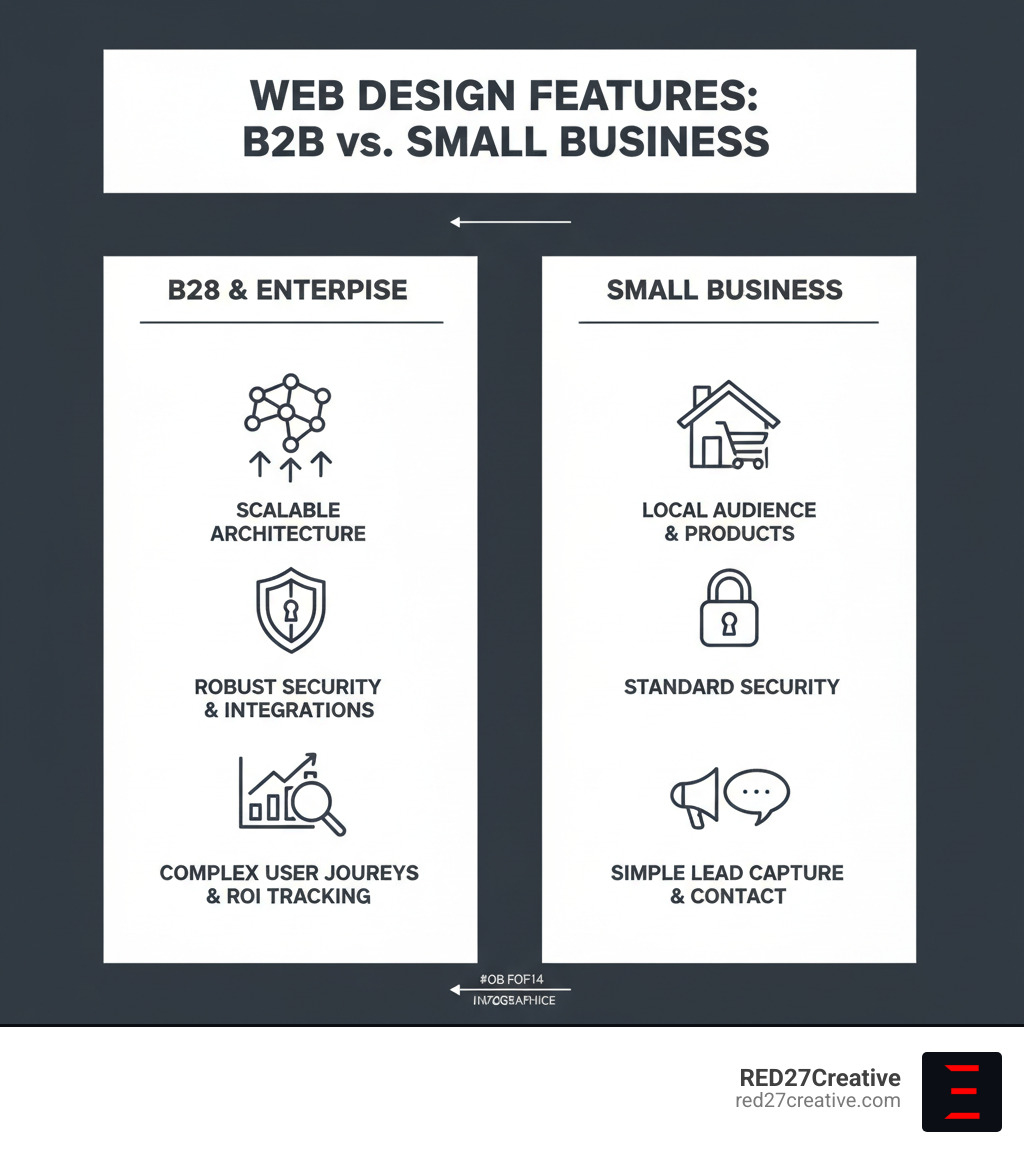
Here’s the truth: not all websites are created equal. What works for a local bakery or boutique consultant won’t cut it when you’re running a national B2B operation or managing a global enterprise with thousands of daily users.
The difference comes down to scale, complexity, and performance. Small business websites typically serve a focused audience with straightforward needs—maybe a dozen pages, a contact form, and some basic analytics. Enterprise websites operate in a completely different universe. They handle massive traffic volumes, process enormous amounts of user data, and must integrate seamlessly with critical business systems like CRM platforms, ERP software, and marketing automation tools.
Think of it this way: a small business site is a corner store, while an enterprise site is a global distribution center operating 24/7.
This complexity is why nearly 66% of enterprise web development challenges can derail projects. Organizations underestimate the technical demands, the coordination required across departments, and the infrastructure needed to support it all. At RED27Creative, we’ve seen these challenges firsthand, which is why our custom web design and development approach is built specifically for the enterprise environment—where getting it right the first time isn’t optional.
The Unique Challenges of Enterprise Web Design
Designing an enterprise website isn’t just about scaling up. It’s about navigating a completely different set of challenges that don’t exist at smaller scales.
Start with multiple stakeholders. You’re not designing for one decision-maker anymore. You’re coordinating with marketing, sales, IT, compliance, executive leadership, and often multiple divisions or product lines—each with their own goals, requirements, and opinions about what the website should accomplish.
Then there’s the global audience factor. Enterprise websites often serve customers and users across continents, which means dealing with localization, multilingual support, regional compliance requirements, and cultural considerations that affect everything from color choices to content strategy.
Legacy system integration is another beast entirely. Most enterprises have years (sometimes decades) of existing technology infrastructure that can’t simply be replaced. Your new website needs to talk to aging CRM systems, proprietary databases, and custom applications that were built before modern web standards even existed.
Add in strict compliance requirements—whether that’s GDPR for European customers, HIPAA for healthcare data, SOC 2 for security, or industry-specific regulations—and you’ve got a web project that requires legal review, security audits, and documentation at every turn.
Finally, maintaining brand consistency across divisions becomes exponentially harder when you’re managing hundreds or thousands of pages, multiple product lines, and regional offices that all want some degree of autonomy while staying true to the corporate identity.
These challenges are especially pronounced in specialized industries like manufacturing, requiring deep expertise in areas like technical specifications and distributor portals, which is reflected in our work with web design for manufacturing companies.
How Scale and Complexity Impact B2B & Enterprise Web Design
When you’re operating at enterprise scale, the technical infrastructure becomes mission-critical. We’re not talking about basic shared hosting anymore. We’re talking about robust cloud hosting architectures that can scale up or down based on demand, sophisticated load balancing to distribute traffic across multiple servers, advanced caching mechanisms that serve content faster by storing frequently accessed data, and optimized database structures designed to query millions of records without breaking a sweat.
But here’s what many organizations miss: throwing more servers at the problem isn’t a strategy. Real performance optimization requires understanding how every element of your site—from images to scripts to database queries—affects the user experience. It requires implementing content delivery networks (CDNs), optimizing code, compressing assets, and constantly monitoring performance metrics.
Why does this matter so much? Because every single second counts. Amazon famously calculated that a one-second slowdown could cost them $16 billion in annual sales. The principle holds for any enterprise: slow websites lose customers.
For B2B organizations, the impact is even more pronounced. Your prospects are busy professionals researching solutions during work hours. They’re comparing multiple vendors, often with tabs open to your competitors. If your site takes five seconds to load while your competitor’s loads in two, you’ve already lost ground before they’ve read a single word of your value proposition.
Performance isn’t just about speed, either. It’s about reliability—ensuring your site stays up during peak traffic, security—protecting sensitive business data from breaches, and data processing capability—handling form submissions, user accounts, and transactional data without errors or delays.
This is where B2B & Enterprise Web Design truly separates from standard website development. It’s not just about making something that looks good and loads fast. It’s about building a digital infrastructure that supports your entire business operation, scales with your growth, and continues performing reliably as demands increase.
At RED27Creative, we build this understanding into every project, because we know downtime isn’t just an inconvenience—it’s lost revenue and damaged credibility.
Core Principles of High-Converting B2B & Enterprise Web Design
Here’s the truth about B2B & Enterprise Web Design: conversion isn’t a single moment—it’s a journey. Unlike consumer purchases where someone might impulse-buy a pair of shoes, B2B decisions involve multiple stakeholders, lengthy evaluation periods, and significant financial commitments. Your website needs to support this complex process at every step.
The numbers tell the story. Research shows that 77% of B2B buyers describe their purchase journey as complex. That complexity means your website must work harder—not just to attract visitors, but to educate them, build confidence, and guide them toward becoming qualified leads. Everything we do in our B2B lead generation services is built around this understanding.
At RED27Creative, we focus on six core principles that drive real results: communicating clear value propositions, understanding buyer personas deeply, building unwavering trust, leveraging compelling social proof, simplifying the user journey, and creating robust lead generation mechanisms that actually convert.
Communicating Value and Building Trust
In B2B, nobody’s making snap decisions. Your prospects are solving real business problems—improving efficiency, reducing costs, meeting compliance requirements, or gaining competitive advantage. That means your website needs to immediately answer one critical question: “Why should we choose you?”
Your value proposition should be crystal clear within seconds of landing on your homepage. We’re not talking about vague promises or industry jargon—we mean specific, measurable outcomes that matter to your audience. What problem do you solve? How do you solve it better than anyone else? What results can they expect?
Many enterprise sites only highlight the core offering. The best ones go deeper, showcasing the complete value package—implementation support, training, long-term cost savings, and compliance benefits—which often tips the scales.
Companies that get this right, like some of the top SaaS platforms, showcase measurable outcomes front and center. They use ROI calculators that let prospects plug in their own numbers. They share detailed case studies showing real results from real customers. They feature testimonials that speak to specific pain points and solutions. Our visual branding solutions help present this value in ways that resonate emotionally while remaining thoroughly professional.
Trust isn’t built with claims—it’s built with proof. That’s where the strategic presentation of benefits and outcomes becomes your competitive advantage. When prospects can see themselves in your success stories and calculate their own potential ROI, you’ve moved from vendor to trusted partner.
Leveraging Social Proof and Humanizing Your Brand
Let’s talk about trust. An overwhelming 81% of people decide whether to do business with a brand based on its credibility. But here’s the thing about B2B buyers—they’re skeptical, and rightfully so. They’re not looking for marketing hype; they’re looking for validation from sources they trust.
This is where third-party social proof becomes invaluable. We’re talking about verified reviews from platforms like G2, Capterra, or Trustpilot—complete with clickable links so prospects can verify them independently. Industry awards and certifications carry weight because they represent objective evaluation by recognized authorities. When you display these credentials prominently, you’re not just bragging—you’re providing the external validation that B2B buyers demand.
But social proof isn’t enough. B2B is a people business, so humanize your brand. Even if 74% of B2B buyers prefer human service over chatbots, your site can convey accessibility with team bios and behind-the-scenes content that shows your company culture.
Highlight your after-sales support. Showcase comprehensive customer service options like 24/7 phone support, dedicated account managers, and extensive knowledge bases. This demonstrates a commitment to customer success beyond the initial sale.
Our content writing and editing services help you strike that perfect balance—professional and credible while remaining genuinely human and approachable.
Designing for the B2B Buyer: Demos, Pricing, and CTAs
B2B buyers need to see it to believe it. That’s why product demos and free trials are so powerful—they transform abstract promises into tangible experience. The best enterprise websites make it incredibly easy for prospects to get hands-on with their solutions. Extended free trials (some enterprise platforms offer 60 days or more) give decision-makers time to evaluate without pressure. In-depth demos, whether self-guided or scheduled with a specialist, let prospects explore features that matter most to their specific use case.
Explainer videos are also powerful, as 96% of video marketers report they boost product understanding. A concise, benefit-focused video can communicate value more effectively than paragraphs of text.
Now let’s talk about the elephant in the room: pricing pages. Here’s a sobering statistic—41% of businesses decide against a product due to pricing mismatch, and 81% of buyers expect easy access to pricing information. Yet many B2B sites hide their pricing behind “contact us” forms. While enterprise pricing often requires customization, transparency builds trust.
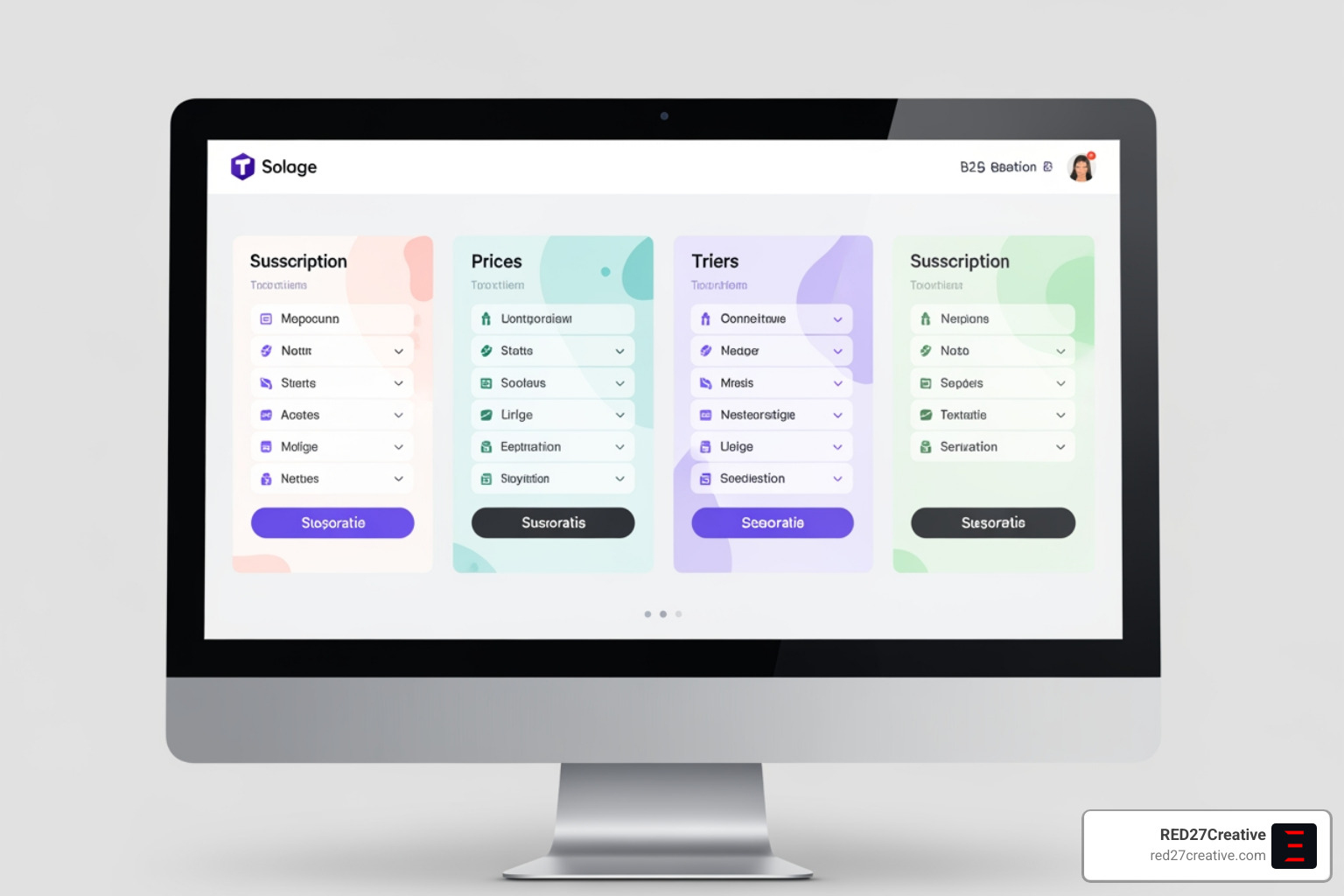
A well-designed pricing page uses clean, uncluttered layouts with tables or cards that make it easy to compare tiers at a glance. It clearly outlines what’s included at each level, highlights the most popular option, and explains any customization available for enterprise needs. Even if you can’t list exact numbers, you can provide pricing ranges or starting points that help prospects self-qualify.
Strategic CTAs (calls-to-action) tie everything together. They should be clear, action-oriented, and placed where they make sense in the user journey. “Schedule a Demo,” “Start Free Trial,” “Talk to Sales,” or “Download Case Study”—each serves a different stage of the buying process. The key is making them visible without being obnoxious.
Clean UI and UX aren’t optional—they’re essential. Avoid conversion killers like animated ads, confusing navigation, or intrusive chat windows that pop up every five seconds. Every element on your page should serve a purpose: inform, guide, or convert. When prospects can move smoothly from learning about your solution to taking the next step, you’ve created a lead generation system that works. That’s exactly what we focus on in B2B lead generation 101: how to attract and convert ideal buyers.
The Strategic & Technical Pillars of a Future-Proof Enterprise Website
Building a B2B & Enterprise Web Design that stands the test of time isn’t a “set it and forget it” project. It’s an ongoing commitment to strategic growth and technical excellence. Think of it like building a skyscraper—you need a solid foundation, flexible infrastructure, and systems that can adapt as your business evolves. Our responsive website development services are built around this long-term vision.
The enterprise websites that thrive five years from now are the ones being designed with adaptability, scalability, and performance baked into their DNA today. That means making smart choices about architecture, user experience, and technical optimization from day one.
Information Architecture and User Experience (UX)
A clear, intuitive information architecture is the backbone of any successful enterprise website. When you’re managing vast amounts of content, complex product lines, and diverse user groups, people need to find what they’re looking for quickly—or they’ll leave. Good IA isn’t just about organizing content logically; it’s about creating a mental model that matches how your users actually think and work.
This involves structuring content with controlled vocabularies and taxonomies, planning navigation systems that guide users effortlessly, and ensuring every page serves a clear purpose. Think of it as designing a well-organized library where every book has its place and finding what you need feels natural, not like solving a puzzle.
User Experience design in an enterprise context looks different from small business UX. While aesthetics matter—the aesthetic-usability effect shows that attractive products are perceived as more usable—functionality, data safety, and regulatory compliance take center stage. You’re designing for productivity, error reduction, and supporting complex business processes that might involve multiple approval stages or intricate workflows.
Enterprise sites must also serve multiple user types, from engineers needing technical specs to HR managers researching benefits. This requires role-based personalization and context-specific workflows to surface the right content for each user.
Our expertise in chatbot user experience design extends to broader UX strategy, where we focus on reducing friction in user journeys through streamlined workflows and intuitive interfaces that feel effortless to steer.
Building with a Flexible Design System and Composable Architecture
Consistency is everything for enterprise brands. A design system acts as your single source of truth for all digital touchpoints—a centralized library of reusable components, documented standards, and style guides that ensures your brand identity remains cohesive across every page, every department, and every new feature. It’s not just about looking consistent; it’s about operational efficiency.
When teams can pull from a library of pre-built, tested components, development cycles accelerate dramatically. This protects brand consistency and speeds up time-to-market for new initiatives without reinventing the wheel.
Modern enterprise websites are increasingly adopting composable architecture—a modular approach often described as building with “digital LEGOs.” Instead of a monolithic system where everything is tightly coupled, you’re assembling independent, specialized software modules that communicate via APIs. Each component does one thing exceptionally well, and they all work together seamlessly.
This offers unparalleled flexibility. You can swap out a CMS without a full rebuild or scale a single component to handle traffic. This approach makes your site adaptable to future changes, like integrating new AI tools or platforms.
For those looking to build on flexible, powerful platforms, our custom WordPress development ultimate guide provides valuable insights into creating scalable, composable systems.
Optimizing for Mobile, Performance, and Accessibility
Here’s a stat that should grab your attention: over 60% of organic search visits now occur on mobile. That makes responsive design absolutely non-negotiable for enterprise sites. Your website must adapt seamlessly to different screen sizes and devices, with mobile navigation that’s intuitive, content that’s readable without zooming, and interactions that work perfectly on a touchscreen.
This goes beyond just fitting content on small screens. Mobile users have different intents—often researching on the go or needing quick access to information. Your mobile experience must account for these use cases.
Performance optimization is equally critical. Google prioritizes mobile-friendly, fast-loading sites in its search rankings, and users are ruthlessly impatient. We focus on Core Web Vitals—Google’s metrics for user experience—to ensure your site delivers. This means optimizing images, minimizing code, leveraging browser caching, and ensuring your hosting infrastructure can handle traffic spikes without slowdowns.
Finally, there’s accessibility. Building user-friendly websites for all abilities isn’t just the right thing to do—it’s increasingly a legal requirement and a competitive advantage. This means adhering to Web Content Accessibility Guidelines (WCAG), which includes considerations like sufficient text contrast, descriptive alt text for images, keyboard navigation, and screen reader compatibility.
An accessible website demonstrates a commitment to all users, improves your brand’s reputation, and often improves usability for everyone—not just those with disabilities. Our SEO services always integrate these crucial performance and accessibility factors, because a site that’s fast, mobile-friendly, and accessible is a site that ranks well and converts better.
Frequently Asked Questions about B2B & Enterprise Web Design
What is the main difference between B2B and enterprise web design?
The main difference comes down to scale and complexity. While both types of websites focus on serving business audiences, enterprise web design operates at a completely different level. You’re managing vast amounts of content across multiple departments and global regions, integrating with complex backend systems, and meeting stringent security and compliance requirements. Think of it this way: a B2B website might serve a focused audience with a clear product offering, while an enterprise site needs to be everything to everyone—from procurement managers in Chicago to engineers in Singapore—all while maintaining brand consistency and meeting regulatory standards like GDPR or SOC 2.
How do you design a B2B website for lead generation?
Designing for B2B lead generation starts with understanding that your visitors are on a mission. They’re researching solutions, comparing options, and building a business case. Your job is to make that journey as smooth as possible. Start with a clear value proposition that immediately addresses their pain points. Place strategic calls-to-action where they naturally belong in the decision-making process. Build trust through case studies, testimonials, and transparent pricing. Offer valuable resources—like whitepapers or product demos—behind simple, non-intrusive forms. Most importantly, ensure the entire user journey guides prospects logically from awareness to consideration to conversion, removing friction at every step. Our B2B lead generation services are built on these proven principles.
Why is a design system important for an enterprise website?
A design system is your secret weapon for maintaining consistency and efficiency across a sprawling enterprise website. Imagine trying to coordinate dozens of team members building different sections of your site without a shared playbook—you’d end up with a disjointed mess. A design system provides a centralized library of reusable components, documented standards, and clear guidelines that ensure every page, every feature, and every new addition maintains your brand identity. It’s not just about looking good; it’s about speed and scalability. When your development team can pull from pre-built, approved components instead of starting from scratch, you accelerate launch timelines while ensuring a cohesive user experience. For large organizations managing multiple divisions, products, or global sites, this consistency becomes absolutely crucial for maintaining brand trust and operational efficiency.
Conclusion: Choosing the Right Partner for Growth
Building or redesigning a B2B & Enterprise Web Design isn’t just another project—it’s a strategic investment in your company’s future. And like any significant investment, the partner you choose makes all the difference between a website that merely exists and one that actively drives growth.
What should you look for? Start with proven expertise—not just in design, but in understanding the unique challenges of enterprise-scale projects. A strong portfolio matters, but so does a strategic approach that aligns with your specific business goals. You need a team that thinks beyond aesthetics, one that prioritizes technical capabilities, offers long-term support, and delivers data-driven results you can measure.
Here’s something worth noting: the 2023 Stack Overflow Developer Survey revealed that 63% of developers spent at least 30 minutes daily just troubleshooting issues. That’s a lot of wasted time and energy. This highlights why choosing partners with a reliable tech stack and deep technical knowledge is so crucial. The right team implements solutions that reduce friction, minimize headaches, and let your people focus on high-impact work instead of putting out fires.
At RED27Creative, we’ve spent over 20 years understanding these intricate needs. Based in Geneva, Illinois, we serve businesses throughout the Chicago metropolitan area—from Batavia and Aurora to St. Charles, Plainfield, Oswego, and Naperville. But our reach extends well beyond local borders. We work with B2B and enterprise clients who need websites that perform at scale.
We build data-driven systems that connect every part of your marketing—website, SEO, local presence, and lead generation—into one unified engine for growth. Our team of designers, developers, and SEO experts doesn’t just build websites; we build foundations that last. We work closely with you to create custom solutions that attract qualified leads, establish trust, and convert opportunities into measurable success.
Your website should be more than a digital placeholder. It should be a revenue driver, a trust builder, and a competitive advantage. If you’re ready to transform your online presence into something that truly works for your business, partner with a results-focused web design agency to build your foundation for growth.
Let’s make every click count. Let’s build something that grows with you.

Kiel Tredrea
https://red27creative.comTop Marketing Agency • Web, SEO & Leads • RED27Creative