Why Your Manufacturing Business Needs a Social Media Makeover

Why Manufacturing Social Media Management Is More Critical Than Ever
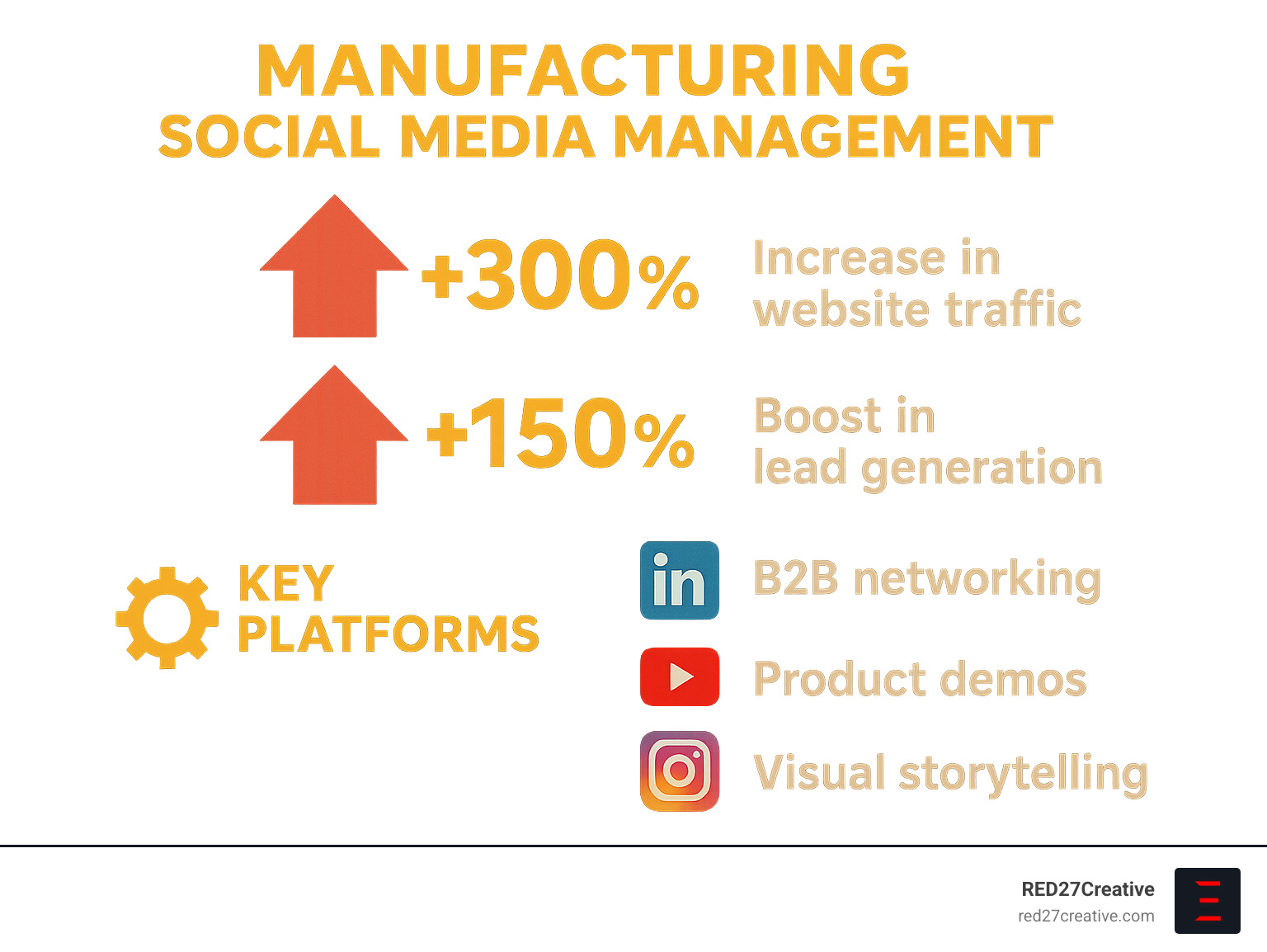
Manufacturing social media management is a strategic approach to building brand awareness, generating leads, and engaging B2B customers across social platforms. Here’s what you need to know:
Key Components:
- Platform Strategy – LinkedIn for B2B networking, YouTube for demos, Instagram for visual storytelling
- Content Planning – Product showcases, behind-the-scenes tours, thought leadership posts
- Lead Generation – Targeted campaigns that can boost leads by up to 150%
- Community Building – Real-time engagement and customer support
- Performance Tracking – Focus on conversion rates and ROI, not vanity metrics
When most people think of social media success stories, manufacturing companies rarely come to mind. But here’s the reality: over 70% of B2B buyers today are tech-savvy millennials who research suppliers on social platforms before making purchasing decisions.
The manufacturing sector is experiencing a digital change that’s reshaping how companies connect with customers. While 53% of Americans are more loyal to brands they follow on social media, only 43% of U.S. manufacturing companies have acceptd social platforms. This gap represents a massive opportunity.
The numbers don’t lie. Manufacturing companies with optimized social media strategies see up to 300% increases in website traffic and 150% boosts in lead generation. Video content – particularly behind-the-scenes factory tours and product demonstrations – generates 1200% more shares than static posts.
Yet many manufacturing executives still view social media as optional or irrelevant to their B2B operations. This mindset is costing them customers, market share, and competitive advantage in an increasingly digital marketplace.
I’m Kiel Tredrea, founder of RED27Creative, and I’ve spent over 20 years helping B2B companies develop high-impact digital marketing strategies that drive measurable revenue growth. My experience with manufacturing social media management has shown me that the companies embracing these platforms now are positioning themselves as industry leaders for the next decade.
Relevant articles related to Manufacturing social media management:
Why Social Media Matters for Modern Manufacturers
Picture this: Your potential customer is comparing two suppliers for a critical component. Both companies have similar capabilities and pricing. But one has an active LinkedIn presence showcasing their expertise, while the other has zero social media footprint. Which supplier feels more trustworthy and forward-thinking?
The manufacturing landscape has fundamentally shifted. Your customers aren’t just searching for suppliers on Google – they’re researching companies on LinkedIn, watching product demos on YouTube, and validating their choices through social proof before they ever pick up the phone.
This behavioral change is driven by a generational shift that many manufacturers are still catching up to. Today’s B2B decision-makers grew up with social media. These millennial decision-makers expect transparency, authenticity, and real-time communication from their business partners.
Here’s the uncomfortable truth: manufacturing companies that ignore social media are essentially invisible to these buyers. When your competitors are showcasing their expertise and building trust through consistent engagement, staying offline puts you at a severe disadvantage.
Business Impact & Key Benefits
The business case for manufacturing social media management isn’t just compelling – it’s backed by hard numbers that will make your CFO take notice.
Website traffic growth becomes exponential when you consistently share valuable content across social platforms. Manufacturing firms implementing comprehensive social strategies report up to 300% increases in organic website traffic. This isn’t just any traffic – it’s highly qualified visitors who already know your brand.
The 150% boost in lead generation comes from multiple touchpoints throughout the buyer journey. Social media serves as both an awareness channel and a direct lead capture mechanism. When prospects see your thought leadership posts and case studies, they’re pre-qualified before they even fill out a contact form.
But here’s what really matters: trust building. In an industry where relationships and reliability are everything, social media provides unprecedented opportunities to build trust before the first sales conversation.
Sales, Service & Reputation Support
Modern manufacturing social media management extends far beyond marketing campaigns. It’s become an integral part of how forward-thinking companies handle sales support, customer service, and reputation management.
Real-time customer support has revolutionized how manufacturers serve their clients. Over 67% of consumers now turn to social media for customer service, expecting quick responses and transparency.
Crisis response capabilities can make or break your reputation during challenging times. Social media provides a direct channel to communicate with stakeholders quickly and transparently during supply chain disruptions or quality concerns.
Satisfied customers become customer advocates when they share their positive experiences on social platforms. User-generated content drives 42% more trust than brand-created posts, making customer advocacy one of the most powerful growth drivers available.
Manufacturing Social Media Management Essentials
Getting manufacturing social media management right isn’t about copying what works for consumer brands. Your industrial customers have different needs, longer buying cycles, and specific platforms where they spend their time.
The secret lies in understanding your audience personas first. Manufacturing buyers aren’t impulse shoppers – they’re engineers, procurement managers, and executives who research thoroughly before making decisions. They want technical details, proof of performance, and evidence that you understand their industry challenges.
Platform selection makes or breaks your strategy. While your teenager might live on TikTok, your B2B customers are networking on LinkedIn, watching technical demos on YouTube, and participating in industry discussions on specialized forums.
Core Pillars of Manufacturing Social Media Management
Strategy alignment forms the foundation of effective social media efforts. Every post, comment, and campaign should connect directly to your business goals. Whether you’re launching a new product line or establishing thought leadership, your social media activities need clear strategic purpose.
Thought leadership separates industry leaders from followers. When your engineers share insights about emerging technologies or your executives discuss industry trends, you’re building credibility that leads to sales conversations.
Employee advocacy transforms your team into brand ambassadors. Your sales engineer’s LinkedIn post about solving a complex customer problem carries more weight than any corporate advertisement.
Balancing Scheduling & Real-Time Engagement
Smart manufacturing social media management combines the consistency of scheduled content with the authenticity of real-time engagement. Think of it like running a manufacturing line – you need reliable processes, but you also need skilled operators who can adapt when situations change.
Scheduling tools like Buffer and Hootsuite ensure your content flows consistently, even during busy periods. This consistency builds audience expectations and keeps your brand visible during important industry events.
But automation without human touch feels robotic. When someone asks a technical question, they expect thoughtful responses from real experts, not chatbot scripts.
Targeting & Community Building
Effective targeting goes deeper than basic demographics. Manufacturing success comes from understanding job titles, company sizes, specific pain points, and industry challenges.
LinkedIn groups and private networks offer goldmines for relationship building. Instead of broadcasting your message, these communities let you participate in meaningful discussions and demonstrate expertise naturally.
Platform Playbook & Content That Converts
Success in manufacturing social media management isn’t about being everywhere at once. It’s about understanding where your customers spend their time and creating content that truly speaks to their needs.
LinkedIn stands out as the heavyweight champion for manufacturing companies. With over 1 million active manufacturing professionals, it’s where your potential customers are actively researching suppliers.
YouTube serves double duty as both entertainment and education. Your prospects are searching for solutions to their manufacturing challenges.
Instagram might surprise you with its B2B potential. Manufacturing companies are using it to showcase their company culture and attract top talent.
LinkedIn for B2B Lead Generation
LinkedIn’s manufacturing audience is your ideal customer base. We’re talking about professionals aged 35-55, with 63% holding management positions or higher. These are the decision-makers who can actually say yes to your proposals.
Case studies are LinkedIn gold for manufacturers. When you share a detailed story about how you solved a complex production challenge, you’re demonstrating your problem-solving capabilities to prospects facing similar issues.
Carousel posts let you tell complex stories in digestible chunks. Instead of cramming everything into a single image, you can walk viewers through your manufacturing process or highlight multiple product features.
Video & Live Streaming Power Moves
Here’s a statistic that should grab your attention: 59% of senior executives prefer video over written content. That means your carefully crafted white papers might be losing to a simple product demonstration video.
Process demonstrations are your secret weapon. When prospects can actually see your quality standards and technical capabilities in action, they’re much more likely to trust you with their business.
Factory tours transform your manufacturing facility from a mysterious black box into a transparent, trustworthy operation.
Live webinars and Q&A sessions position your experts as thought leaders while providing immediate value.
Visual & Culture-Driven Posts

Visual storytelling breaks down the “boring manufacturing” stereotype that’s been holding the industry back for decades. High-quality photography and graphics don’t just make your content prettier – they make it more memorable and shareable.
Behind-the-scenes content gives your audience a genuine glimpse into your company culture and daily operations. People want to work with companies they like and trust.
Employee spotlights are engagement magnets because they create personal connections. When you feature your lead engineer explaining a complex process, you’re putting real faces to your brand.
Sustainability stories resonate powerfully with today’s environmentally conscious buyers. When you showcase your commitment to responsible manufacturing practices, you’re differentiating your brand in competitive markets.
Metrics, Mistakes & Make-or-Buy Decisions

Here’s the uncomfortable truth about manufacturing social media management: most companies are measuring all the wrong things. They get excited about follower counts and likes while missing the metrics that actually grow their business.
The difference? Focus on metrics that matter to your bottom line. Engagement rate shows how well your content resonates with your audience. Click-through rates reveal whether your posts drive valuable website traffic. Most importantly, conversion rates from social traffic tell you if your efforts are generating real business results.
Manufacturing Social Media Management KPIs
Effective manufacturing social media management measurement starts with connecting your social efforts to your existing business systems. Your Google Analytics, CRM, and marketing automation tools should all track where your leads and customers come from.
Click-through rate (CTR) tells you how compelling your content is. Manufacturing companies typically see their highest CTRs on educational posts about industry trends or problem-solving content.
Marketing qualified leads (MQL) volume from social channels shows whether you’re attracting the right audience. It’s not enough to drive traffic – you need visitors who match your ideal customer profile.
Return on investment (ROI) calculation for manufacturing social media requires patience. B2B sales cycles often stretch 6-18 months, so immediate ROI calculations miss the bigger picture.
Common Pitfalls & How to Avoid Them
The biggest mistake I see in manufacturing social media management is treating platforms like old-school advertising channels. Companies blast promotional content and wonder why no one engages.
Over-promotion kills your social media success faster than anything else. Your audience follows you for insights, education, and value – not constant sales pitches.
Inconsistent posting confuses both algorithms and audiences. Social media platforms reward consistent activity, and your audience expects regular updates.
In-House vs Outsourced: Which Wins?
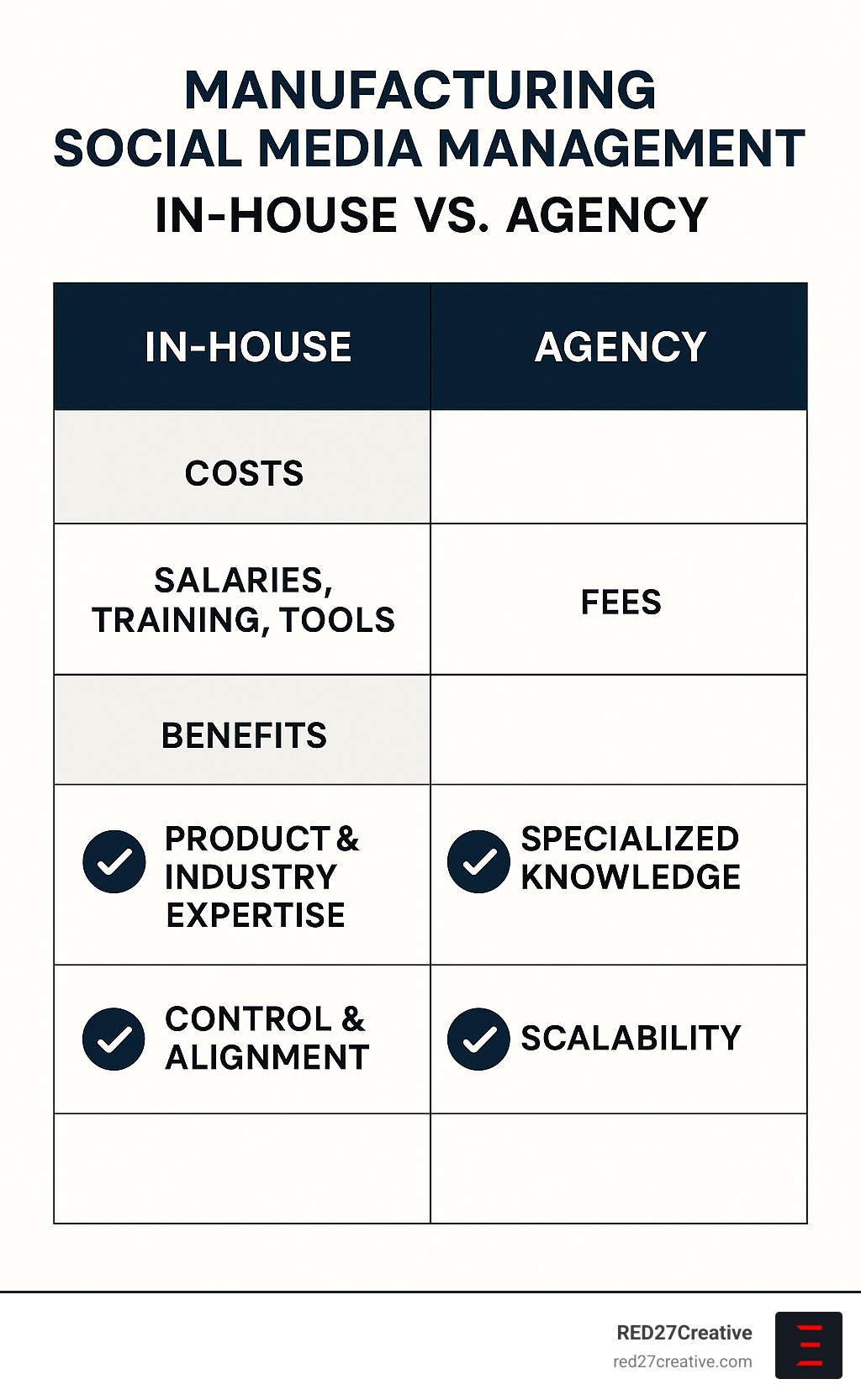
The “should we hire someone or work with an agency” question comes up in every manufacturing boardroom discussion about social media. The honest answer? It depends on your specific situation and goals.
In-house teams bring deep product knowledge and immediate access to your technical experts. When a customer asks a complex engineering question on LinkedIn, your internal team can get an authoritative answer quickly.
Agency partnerships bring specialized expertise and creative capabilities that most manufacturing companies can’t justify hiring full-time. Agencies work across multiple clients, bringing fresh perspectives and proven strategies.
Many successful manufacturers choose a hybrid approach that combines the best of both worlds. They keep strategy and subject matter expertise in-house while partnering with agencies for creative execution.
Frequently Asked Questions about Manufacturing Social Media Management
The world of manufacturing social media management can feel overwhelming, especially when you’re used to traditional marketing methods. Let me share the answers that have helped my clients make confident decisions about their social media strategies.
What platforms work best for manufacturers?
LinkedIn is your best friend in the manufacturing world. With over 1 million active manufacturing users, it’s where your customers are actually spending their time. About 63% of these users hold management positions, meaning you’re reaching decision-makers.
YouTube deserves serious consideration because it serves double duty. It’s both a place where people watch entertaining content and the world’s second-largest search engine. When someone searches “how does CNC machining work,” your educational videos can show up right alongside Google results.
Instagram might surprise you as a manufacturing platform. While it seems consumer-focused, it’s incredibly powerful for showcasing company culture and behind-the-scenes content.
The key is understanding that each platform serves a different purpose in your overall strategy. You don’t need to be everywhere, but you should be where your customers are looking for solutions.
How do I measure real ROI, not vanity metrics?
Real ROI measurement starts with connecting your social media efforts to revenue. Marketing qualified leads (MQLs) are your north star. How many people downloaded your technical guide after seeing your LinkedIn post? How many requested quotes after watching your YouTube demonstration?
Conversion rates tell the real story. Track what percentage of your social media visitors actually take meaningful actions on your website. Use Google Analytics to see which social platforms send the highest-quality traffic that converts into customers.
The trick is setting up proper tracking before you start posting. Connect your CRM system to your social media analytics so you can follow the complete journey from first social interaction to closed deal.
Should I outsource or keep management in-house?
The right choice depends on your specific situation, resources, and goals. In-house management works beautifully when you have someone who truly understands both your products and social media strategy.
Outsourcing makes sense when you need specialized expertise or want to scale quickly without hiring full-time staff. A good agency brings fresh perspectives, advanced tools, and experience working with multiple manufacturing companies.
Many successful manufacturers choose a hybrid approach. They keep strategy and industry expertise in-house while outsourcing creative execution and day-to-day management. This gives you the best of both worlds – deep product knowledge combined with professional social media skills.
Conclusion & Action Plan
The future of manufacturing is digital, and manufacturing social media management sits at the heart of this change. While your competitors hesitate on the sidelines, forward-thinking manufacturers are already capturing the attention of modern B2B buyers.
The numbers speak for themselves. Companies implementing comprehensive social strategies see 300% increases in website traffic and 150% boosts in lead generation. But beyond the metrics lies something even more valuable – the ability to build genuine relationships with customers before they ever pick up the phone.
Your journey starts with honest assessment. Look at your current social media presence with fresh eyes. Are you consistently sharing valuable content that addresses real customer challenges? Do your posts showcase the expertise that sets your company apart?
Strategy alignment comes next. Your social media efforts should serve your broader business goals, whether that’s expanding into new markets, launching innovative products, or establishing thought leadership in your sector.
Platform selection requires focus. Rather than spreading yourself thin across every social network, concentrate your efforts on the 2-3 platforms where your ideal customers spend their time. LinkedIn for B2B networking, YouTube for product demonstrations, and Instagram for behind-the-scenes storytelling typically deliver the strongest results.
Content planning transforms random posting into strategic communication. Develop a content calendar that balances educational value with promotional messaging. Your audience craves insights about industry trends and innovative solutions.
Measurement systems separate successful campaigns from expensive experiments. Focus on metrics that matter: marketing qualified leads, conversion rates, and actual revenue attribution. Vanity metrics might make you feel good, but they won’t grow your business.
Manufacturing social media management isn’t about following the latest trends or posting for the sake of posting. It’s about creating meaningful connections with the people who make purchasing decisions. It’s about being present when your ideal customers are researching solutions.
The question facing every manufacturing leader today isn’t whether social media works for their industry – it’s whether they can afford to remain invisible while their competitors establish digital dominance. Your future customers are already searching for solutions on social platforms. Make sure they find you first.

Kiel Tredrea
https://red27creative.comTop Marketing Agency • Web, SEO & Leads • RED27Creative