Unlock Your Website’s Potential: The Power of Data-Driven Design

Why Your Website Needs a Strategy, Not Just a Pretty Face
If you’ve invested in a beautiful website that doesn’t generate leads, you’re not alone. Most websites are built on opinions and trends, not evidence. Data driven web design changes this by using real user behavior and analytics to make informed decisions about your site’s layout, content, and functionality. It’s a strategic approach that turns your website into a revenue-generating machine.
Without data, you’re flying blind. The cost is staggering: research shows that every $1 invested in user experience returns $100—a 9,900% ROI. Yet many businesses leave this money on the table, assuming their visitors think and behave just like they do. Data proves otherwise. Your visitors have different goals and expectations, and the only way to understand them is through data.
The stakes are high. Mobile devices account for over half of all web traffic, and Google ranks your site based on its mobile version. A slow page or confusing navigation costs you rankings and revenue. Worse, fixing problems after launch costs 100 times more than addressing them during the design phase.
Data-driven design focuses creativity on what actually matters to your users and your business. It’s the difference between a website that wins design awards and a website that wins customers. At RED27Creative, we use data to build high-performing websites that combine SEO, conversion optimization, and strategic design into measurable growth systems.
Key Data driven web design vocabulary:
What is Data-Driven Web Design and Why Does It Matter?
Data driven web design is a strategic process that replaces assumptions with evidence. Instead of guessing what visitors want, you use real user data to make informed decisions about your website’s layout, content, and functionality. The goal isn’t just a website that looks great—it’s a website that works. One that generates leads, increases sales, and guides visitors toward actions that grow your business.
This approach is critical because designers and stakeholders often fall victim to the “false-consensus effect”—a bias where we assume others think and behave like us. Data provides an objective look at reality, showing you what’s actually happening on your site. It’s a conversation where users speak through their behavior, and you respond with design changes that remove friction and clarify messaging.
Data-Driven vs. Intuition-Based Design
Traditional web design often relies on a designer’s intuition or aesthetic trends. While creativity is essential, without data, you risk building a site that’s disconnected from what your visitors actually need. A design might look stunning, but if it doesn’t convert visitors into customers, it has failed its primary job.
Data driven web design follows a user-centered design philosophy. It validates creative ideas with hard evidence. Instead of debating which call-to-action button color will perform best, you run an A/B test and let the data decide. This shift from “I think” to “I know” gives data-driven businesses a powerful competitive edge.
The Core Benefits for Your Business
Adopting a data-driven approach delivers tangible benefits that contribute directly to business growth.
- Increased conversion rates: Identify and remove friction points in the user journey to guide more visitors toward your goals.
- Improved user experience: A site that’s easy to steer and meets user needs creates brand loyalty. A satisfied visitor converts and returns.
- Higher ROI on marketing spend: Data shows which channels bring qualified visitors, allowing you to allocate your budget for maximum impact. This directly influences your marketing strategy and consulting services.
- Reduced risk: Testing design changes before full implementation minimizes the risk of launching updates that harm performance.
- Continuous improvement: Data provides a constant feedback loop, changing your website from a static asset into an evolving engine for growth. This is a key part of our web design and development process.
In short, data-driven design turns your website into a measurable, improvable, revenue-generating asset.
The Building Blocks: Data Types and Sources
To build a website that performs, you need the right foundation: data. A complete picture requires two types of data: quantitative (the “what”) and qualitative (the “why”). You don’t need to be a statistician to use this data—you just need to know what each type tells you and where to find it.
Quantitative Data: The “What”
Quantitative data is the numbers side of the equation. It’s measurable, objective, and powerful for spotting patterns in user behavior. This data tells you what’s happening on your site.
- Website analytics tools like Google Analytics track page views, bounce rates, and traffic sources, giving you a high-level view of performance.
- Heatmaps and scroll maps from tools like Hotjar visually show where users click, how far they scroll, and what they ignore.
- A/B test results provide empirical proof that one version of a page outperforms another, removing guesswork from design decisions.
- Performance metrics from tools like Google PageSpeed Insights measure loading speed. A slow site hurts both user experience and Google rankings.
Qualitative Data: The “Why”
While quantitative data shows what is happening, qualitative data tells you why. This is the human side of the equation—the opinions, frustrations, and motivations that drive user behavior.
- User surveys from tools like Survey Monkey or Google Forms are a direct way to ask visitors about their experience and pain points.
- User interviews allow for deeper, one-on-one conversations to uncover insights that surveys might miss.
- Feedback forms placed on your site capture real-time thoughts from users as they experience your website.
- Session recordings from tools like Hotjar or Fullstory are like watching over a user’s shoulder, revealing exactly where they get confused or frustrated.
When you combine quantitative and qualitative data, you get the complete story. The numbers show you where the problems are, and the human feedback tells you how to fix them.
How to Implement a Data-Driven Web Design Strategy
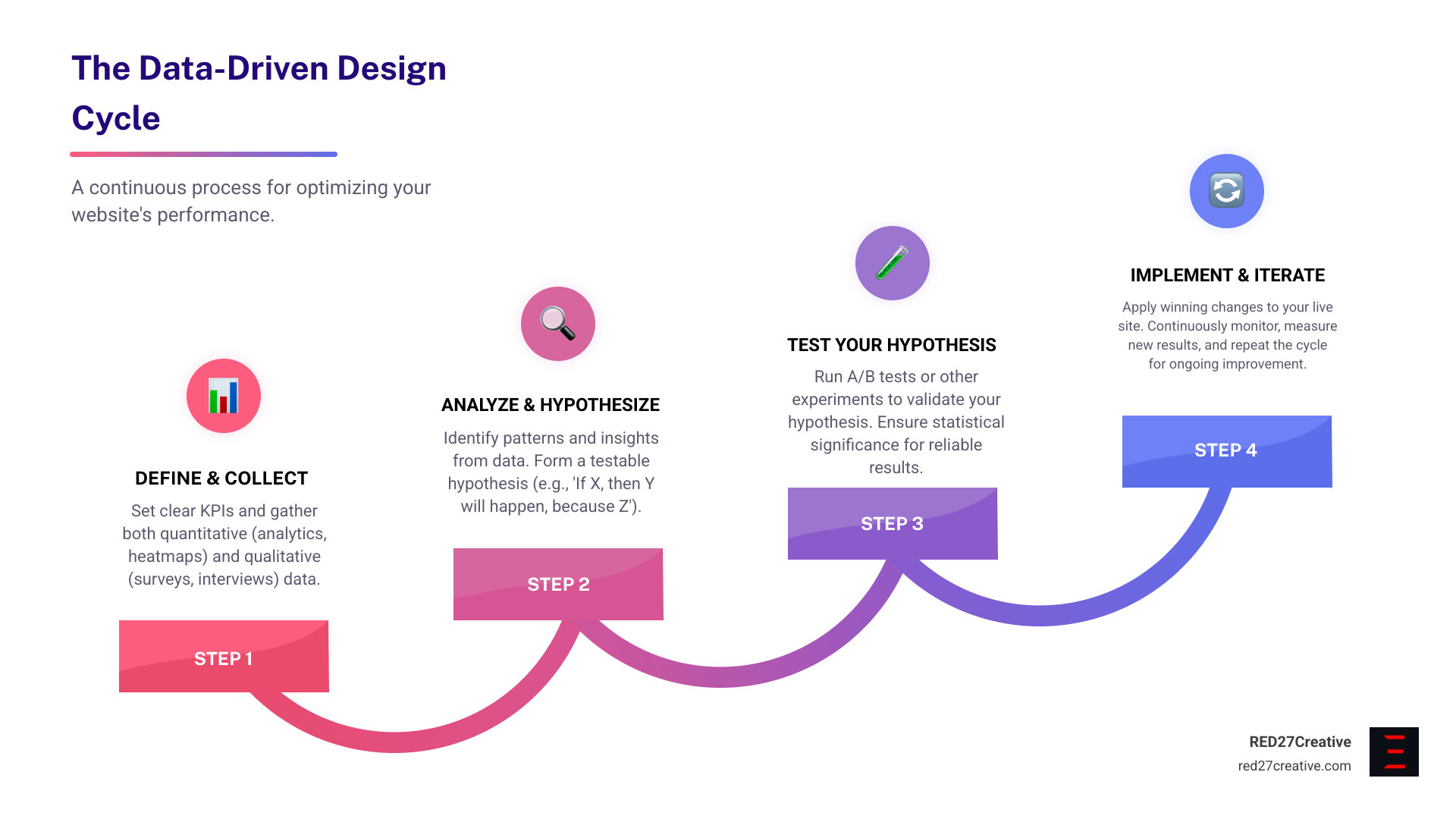
Data driven web design is a continuous cycle of improvement that keeps your website evolving with your audience. This iterative approach builds systems that get smarter over time.
Step 1: Define Goals and Collect Data
You can’t improve what you don’t measure. First, define your website’s goals (e.g., increase form submissions, reduce cart abandonment). These goals become your Key Performance Indicators (KPIs) and determine which data to collect.
Once you know what to measure, gather both quantitative and qualitative data. Look for red flags in your analytics, like high exit rates or ignored calls-to-action, to identify opportunities for improvement.
Step 2: Analyze Data and Form a Hypothesis
Look for patterns in your data that tell a story. For example, a high bounce rate combined with session recordings of confused scrolling suggests a usability problem.
Based on your analysis, form a testable hypothesis: “If we make [specific change], then [expected result] will happen, because [logical rationale].” For example: “If we move the contact form above the fold, form submissions will increase because users will see it immediately.”
Step 3: Test Your Hypothesis with A/B Testing
A/B testing is the scientific method applied to web design. Create two versions of a page: “A” (the control) and “B” (the variation). Split your traffic between them and measure which one performs better against your KPI.
Tools like Google Analytics for A/B testing, Optimizely, or VWO make it easy to run these experiments. Run tests long enough to achieve statistical significance, ensuring your results are reliable. A/B testing removes opinions from the equation—the data decides the winner.
Step 4: Implement, Measure, and Iterate
When a test proves successful, implement the winning change on your live site. But the work isn’t over. You must monitor performance over time to ensure the improvement holds. This ongoing monitoring is a core part of our SEO services and overall website design and development process.
Every test result generates new questions and new hypotheses. This is the cycle of data-driven design in action. Your website becomes a living asset that adapts to your users and gets better with age.
Key Elements of a Data-Driven Website
A true data driven web design requires a foundation built for continuous optimization. Here are the key elements that make a website ready for data-driven success.
A Flexible Content Management System (CMS)
Your website needs to be agile. When data reveals an opportunity, you can’t wait weeks for a developer to make a simple change. A flexible CMS like WordPress, Drupal, or HubSpot allows you to quickly update content, adjust CTAs, and run A/B tests. Our custom WordPress development services focus on building this flexibility from day one.
Robust Analytics and Tracking
A data-driven website tracks the entire user journey. This means setting up conversion tracking for goals, event tracking for interactions, and closed-loop analytics to connect website activity to actual customers. This shows you which marketing efforts lead to revenue, not just clicks.
Clear Calls to Action (CTAs)
Every page should have a purpose, guided by clear CTAs. Data shows you the truth about what works. We analyze CTA performance—placement, wording, and color—to ensure they capture attention and drive action. A CTA that blends in might look neat, but it’s useless if users can’t find it.
Mobile-First and Responsive Design
With mobile traffic dominating, mobile-first design is essential. Google ranks your site based on its mobile version, so a poor mobile experience hurts your visibility. Our responsive website development ensures your site performs flawlessly on any device with fast loading times and touch-friendly navigation.
Scalability and Security
Your website must grow with your business. Data helps plan for this growth by understanding traffic patterns and performance under load. Security is also critical. Monitoring security data helps identify vulnerabilities, protecting your business and building the user trust essential for conversions.
Tools and Technologies for Success
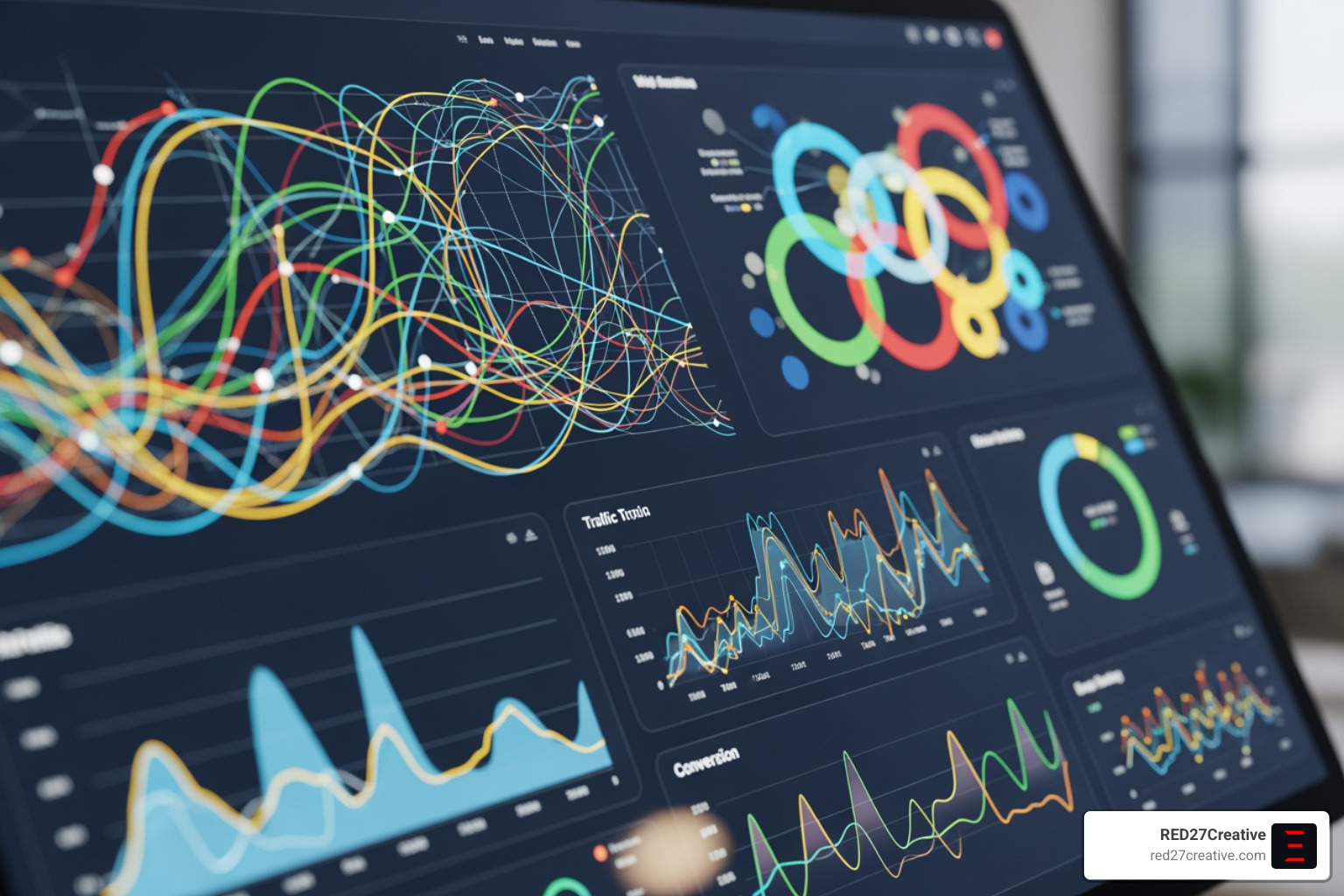
Building a data driven web design strategy requires the right tools to see what’s happening, understand why, and test your way to better results. Many of these platforms are accessible and offer free versions to get you started.
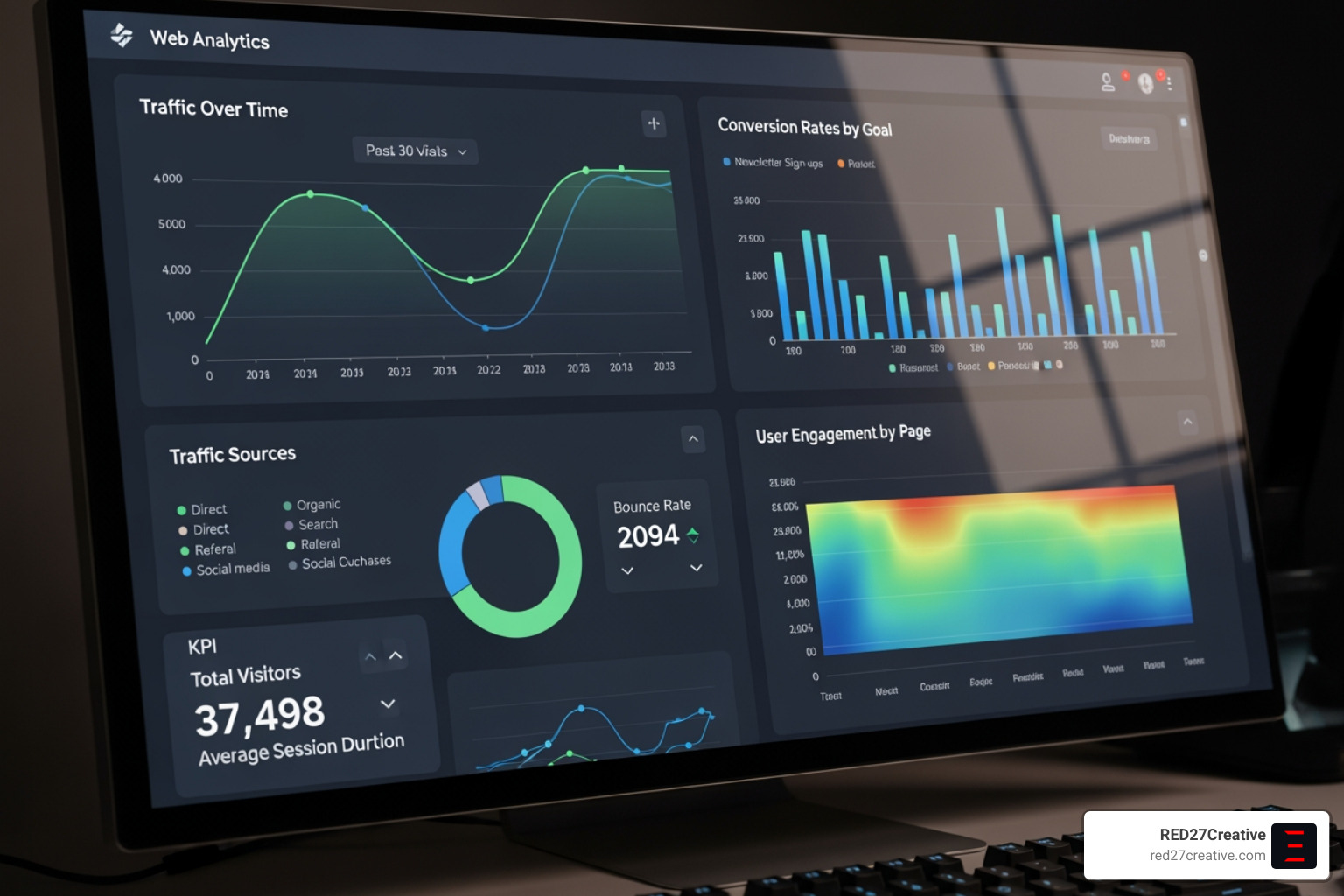
Google Analytics is the foundation for tracking user behavior, traffic sources, and conversion paths. It provides the quantitative backbone for nearly every decision, giving you a clear picture of how people move through your site.
But numbers don’t tell the full story. User behavior analytics tools like Hotjar and Crazy Egg show you how people interact with pages through heatmaps, scroll maps, and session recordings. These visual insights reveal where users click, get stuck, or lose interest, often highlighting issues that analytics alone can’t explain.
For A/B testing and optimization, dedicated platforms like Optimizely and VWO offer advanced capabilities for running complex experiments. They let you test multiple variations, segment your audience, and get statistically significant results faster, turning hypotheses into proof.
Don’t underestimate the power of asking users what they think. Survey tools like Survey Monkey and Google Forms make it easy to gather qualitative data. A well-timed survey can reveal insights that no amount of analytics will show you.
Speed matters. Website performance tools like Google PageSpeed Insights help diagnose loading issues. With over half of web traffic coming from mobile, and Google ranking based on mobile performance, a slow site costs you rankings and revenue.
Finally, your content management system is the engine for optimization. Flexible platforms like WordPress, HubSpot, Drupal, and Craft CMS allow you to implement changes quickly based on data. Our custom WordPress development services are built around this principle of flexibility.
The right tools don’t just collect data—they help you turn that data into growth.
The Future: AI, Machine Learning, and Personalization
The landscape of data driven web design is evolving rapidly, with artificial intelligence leading the charge. What once took weeks of manual analysis can now happen in real-time, adapting to each user as they browse.
AI-powered analytics can dig deeper than traditional tools, uncovering hidden connections in your data to predict what users need before they even know it. This allows you to position content and offers at the perfect moment.
The real magic is hyper-personalization. Like Netflix or Amazon, your website can dynamically adjust its content, layout, and offers for each visitor based on their behavior. This creates a unique experience that dramatically boosts engagement and conversions.
Automated testing further accelerates optimization. AI-powered platforms can test thousands of variations of headlines, images, and CTAs simultaneously, finding the winning combination in days instead of months.
These aren’t distant possibilities; they are tools we are already integrating into our marketing services. Businesses that adapt to these technologies now will be the ones that dominate their markets tomorrow.
Overcoming Challenges and Gaining Buy-in
Implementing data driven web design sounds great in theory, but it comes with challenges. From skeptical stakeholders to data overload, these problems are manageable if you know how to approach them.
Common Challenges and How to Overcome Them
- Data Overload: It’s easy to get lost in hundreds of metrics. The solution is to establish clear KPIs first. Focus only on the data that measures what truly matters to your business goals, like leads or sales.
- Data Bias: If you only survey existing customers, you’re getting a skewed picture. Combat this by diversifying your data sources to capture feedback from different demographics, devices, and stages of the customer journey.
- Privacy Concerns: With regulations like GDPR and CCPA, you need explicit consent and transparent policies. We build privacy into every website’s foundation to ensure data collection is ethical and compliant.
- “Data Kills Creativity”: This is a myth. Data doesn’t stifle creativity; it focuses it. By identifying the right problems to solve, data gives your creative team the freedom to innovate where it will have the most impact.
Presenting Data-Driven Insights to Stakeholders
Getting buy-in from your team or leadership requires telling a compelling story that connects data to business outcomes.
- Visualize everything. A chart showing a 35% conversion increase is more persuasive than a spreadsheet.
- Connect insights to business goals. Don’t just report a lower bounce rate; explain how it translates to more qualified leads.
- Tell stories with data. Frame the data around the user’s experience to create empathy and make the insights memorable.
- Use both quantitative and qualitative evidence. Back up the “what” (numbers) with the “why” (user quotes) to build an airtight case for change.
Real-World Success Stories
The true power of data driven web design is in its measurable results. Leading companies across industries use data to outperform their competitors.
- Netflix is the gold standard for hyper-personalization. It analyzes billions of data points—from viewing history to the time of day you watch—to create a unique experience for each user, resulting in industry-leading retention rates.
- Amazon constantly runs hundreds of A/B tests to optimize everything from page layouts to button placement. Its famous “customers who bought this also bought” feature is driven by sophisticated data analysis and generates a significant portion of its revenue.
- Google uses data to refine every aspect of its products. Its mobile-first indexing initiative, which prioritizes mobile sites for ranking, was a direct result of analyzing user behavior and forced the entire industry to adopt mobile-optimized strategies.
- HubSpot practices what it preaches, using data to double conversion rates on its landing pages. By analyzing what prospects were searching for, they created content and designs that spoke directly to user needs.
These principles apply to any business, from global enterprises to local companies in Geneva IL. Data removes guesswork and replaces it with evidence, telling you what changes will actually move the needle for your business.

Frequently Asked Questions about Data-Driven Web Design
What is the main difference between data-driven and data-informed design?
Data-driven design strictly follows what data dictates. In contrast, data-informed design uses data as a critical input but also considers designer experience, intuition, and business goals. Most successful strategies use a data-informed approach, combining objective evidence with the nuance of human expertise to achieve the best results.
How much data do I need to start?
You can start with whatever data you have right now. Even basic analytics from a new website provides a valuable baseline. The key is to begin collecting data immediately rather than waiting for a perfect dataset. As your traffic grows, your insights will become more robust and reliable.
Can data-driven design hurt creativity?
No, data focuses creativity. It provides clear goals and constraints, allowing designers to channel their energy into solving real user problems that have a measurable impact. Instead of guessing what looks good, creativity is applied with purpose to develop innovative solutions that are both beautiful and effective.
What are Key Performance Indicators (KPIs) in web design?
KPIs are the measurable values that show how effectively your website is achieving its goals. Common examples include conversion rate, bounce rate, time on site, and pages per session. The right KPIs depend on your business objectives, such as lead generation for a service business or sales for an e-commerce site.
How does data-driven design contribute to continuous improvement?
Data-driven design creates an ongoing feedback loop. Each change is tested and measured, leading to new insights and hypotheses. This iterative cycle ensures your website constantly adapts to changing user needs and market trends, as outlined in our website design and development process, preventing it from becoming stagnant and irrelevant over time.
Build a Website That Works for You
Shifting to a data driven web design mindset is the most effective way to ensure your website contributes to your bottom line. This approach transforms your site from a static expense into a dynamic, lead-generating asset that continuously adapts and improves based on real user behavior.
You no longer have to guess if your homepage resonates or if your contact form is too complex. Instead, you listen to what your users are telling you through their actions and respond with meaningful improvements. This creates a powerful, compounding engine for business growth.
Ready to open up your website’s full potential? At RED27Creative, we specialize in building data-driven systems that turn traffic into measurable results. Our web design services combine over 20 years of experience with proven methodologies to create a unified growth engine.
For businesses in Geneva, Aurora, Naperville, Chicago, and throughout Illinois, we are your partner in building an effective online presence. We create websites that don’t just look amazing—they deliver real, sustainable growth. Let’s build your website on evidence, not assumptions.

Kiel Tredrea
https://red27creative.comTop Marketing Agency • Web, SEO & Leads • RED27Creative