Beyond Pretty Pixels: What Makes a Website Truly Convert?
Why Most Websites Fail to Convert (And How to Fix Yours)
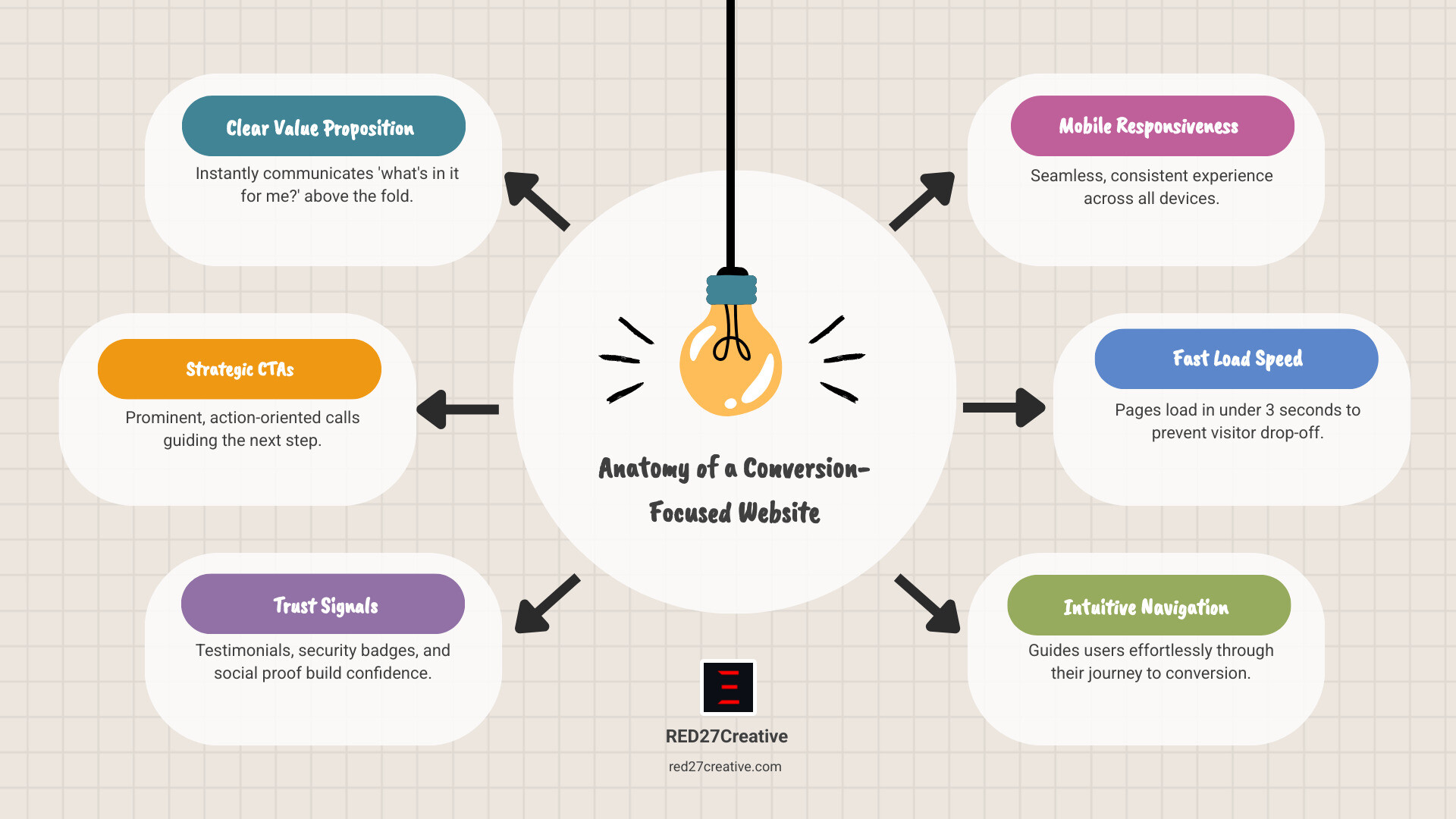
Conversion focused websites are designed to turn visitors into customers, leads, or subscribers by prioritizing strategic elements like clear value propositions, persuasive calls-to-action, fast load times, intuitive navigation, and trust signals—rather than just visual appeal.
Key characteristics of conversion-focused websites:
- Clear value proposition that answers “What’s in it for me?” within seconds
- Strategic CTAs with contrasting colors and action-oriented copy
- Fast page speed (under 3 seconds) to prevent visitor drop-off
- Mobile-responsive design for seamless experience across all devices
- Trust signals including testimonials, reviews, and security badges
- Intuitive navigation that guides users toward conversion goals
- Data-driven optimization through A/B testing and user behavior analysis
Here’s the uncomfortable truth: most businesses invest thousands in beautiful website designs that generate almost no revenue. The average website conversion rate sits between 2.35% and 5.31%—meaning 97 out of 100 visitors leave without taking action. That’s not a design problem. That’s a strategy problem.
A conversion-focused website doesn’t just look professional. It answers visitor questions instantly, removes friction from the user journey, and guides people toward a clear next step. It combines psychology, usability, and persuasion into a system that turns traffic into measurable business growth.
The difference between a pretty website and a profitable one comes down to understanding what visitors need, when they need it, and how to remove every barrier between their arrival and their conversion. That means faster load times, clearer messaging, mobile optimization, and strategic placement of trust signals—all working together as one unified system.
I’m Kiel Tredrea, founder and president of RED27Creative, and I’ve spent over 20 years helping businesses build conversion focused websites that generate qualified leads and drive consistent revenue growth. My team and I specialize in creating marketing systems that connect web design, SEO, and lead generation into one measurable, performance-driven framework.
Important Conversion focused websites terms:
The Foundation: Core Principles of Conversion-Focused Web Design
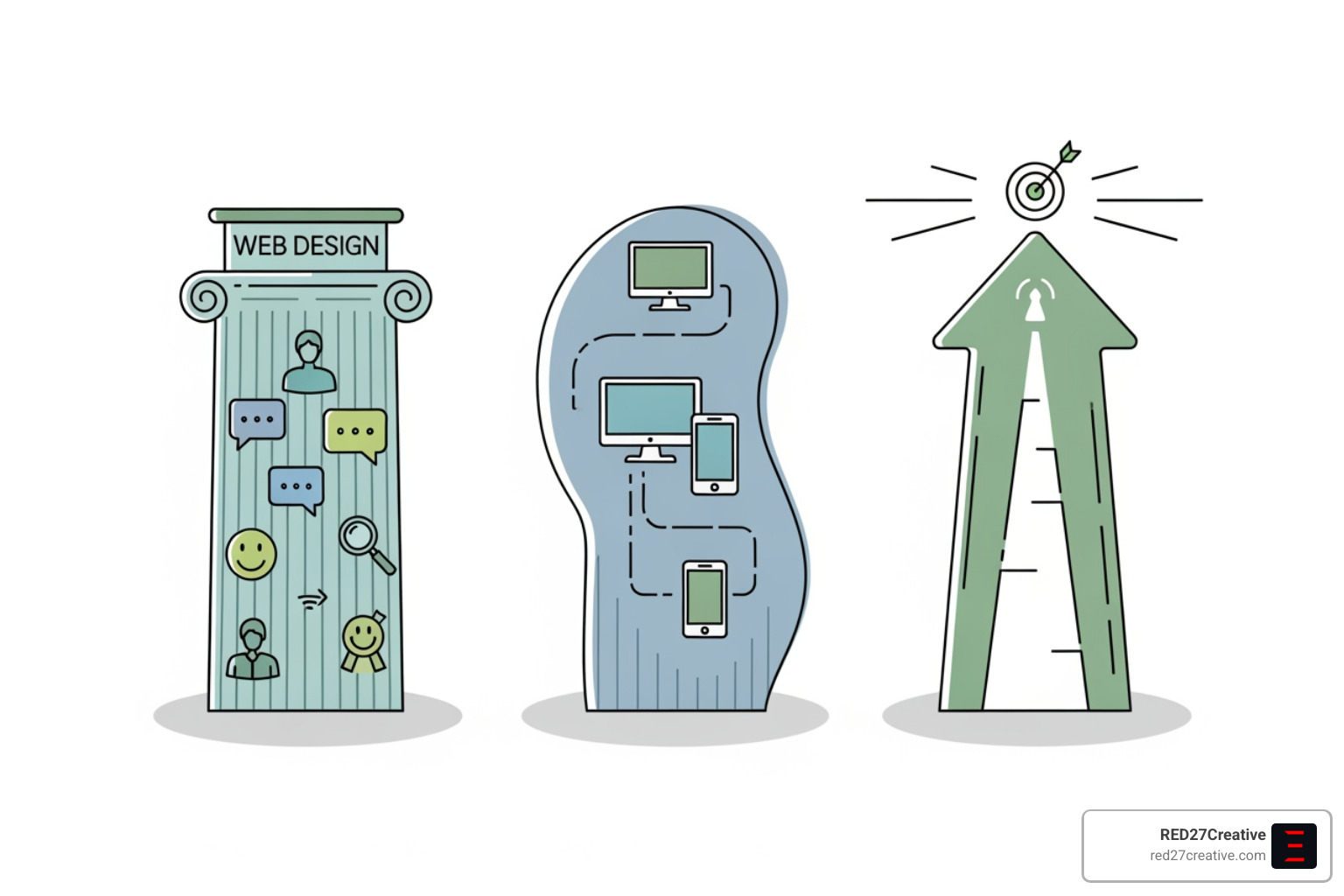
A truly conversion focused website isn’t about winning design awards; it’s about solving problems for visitors and guiding them to a clear next step. At RED27Creative, our framework is built on three core principles: user-centricity, human-centered design, and data-driven optimization. User-centricity means understanding visitor intent and providing a clear path forward. Human-centered design reduces the mental effort needed to use your site by prioritizing clarity, simplicity, and intuitive navigation. This demands clear messaging and a user flow that anticipates questions and guides people toward their goals. Finally, data-driven optimization ensures decisions aren’t based on assumptions. We use A/B testing and user behavior analysis to test, measure, and refine every element, turning good websites into high-performing conversion machines. Learn more about how we apply this methodology in our guide on The Impact of Data Driven Marketing Strategies.
Here’s how the three pillars of conversion-focused design work together:
| Feature/Goal | Usable Website | Responsive Website | High-Converting Website |
|---|---|---|---|
| Primary Goal | Easy to use, efficient, satisfying | Adapts to all screen sizes, consistent experience | Drives specific user actions (leads, sales) |
| Key Elements | Clear navigation, relevant content, fast load time | Fluid grids, flexible media, media queries | Clear value prop, noticeable CTAs, trust signals |
| User Experience | Intuitive, low friction, goal completion | Seamless across devices, no pinching/zooming | Persuasive, anxiety-reducing, action-oriented |
| Measurement | Task completion rate, error rate, satisfaction score | Mobile traffic, bounce rate on mobile, accessibility | Conversion rate, ROI, lead quality, sales volume |
| Outcome | Positive user experience, return visits | Broad audience reach, consistent brand image | Business growth, increased revenue, measurable results |
Defining Usability: The Path of Least Resistance
Usability in action is when a website just works—information is clear, navigation makes sense, and tasks are completed without frustration. A usable website removes barriers between visitors and their goals.
Intuitive navigation and clear structure are the foundation. Menus should be logical, labels unambiguous, and information organized the way your audience thinks. Relevant content presented in scannable formats is just as important. Combined with fast page load times, this creates an effortless experience.
Every extra click or confusing label creates friction. Our job is to eliminate that friction, because when usability is done right, conversions follow naturally. This philosophy drives everything we do in our Website Design and Development Services.
Understanding Responsiveness: A Seamless Experience on Every Device
With over 50% of web visits now come from mobile devices, a flawless mobile experience is non-negotiable. If your site fails on mobile, you’re losing revenue.
Mobile-first design is the baseline expectation. A responsive website adapts its layout and content to any screen size, delivering a consistent experience on desktops, tablets, and smartphones. This is achieved using fluid grids, flexible images, and media queries to ensure your site looks great and functions perfectly everywhere.
A seamless responsive experience builds trust and removes a key barrier to conversion. Our Responsive Website Development service ensures your site performs consistently across every device.
The Blueprint for Conversion: Essential Elements of a High-Converting Website
Once your website is usable and responsive, the real magic begins. This is where we transform a functional site into a conversion focused website that actively guides visitors toward becoming customers. It’s about strategically placing the right components to create a clear path to action.
Think of your homepage as your digital storefront. Within seconds, every element must work together to build trust, communicate value, and make the next step obvious. When these elements work in harmony, visitors don’t just browse—they engage, trust, and convert.
Here are 5 must-have elements on a high-converting homepage: A clear value proposition that immediately communicates what problem you solve, a prominent call-to-action that invites visitors to take the next logical step, trust signals like testimonials and client logos to build credibility, engaging visuals that support your message, and simplified navigation for easy access to key information. Together, they create a trustworthy, action-oriented experience.
Crafting a Crystal-Clear Value Proposition
Your value proposition is the most important message on your site, answering the visitor’s question: “What’s in it for me?” It must be crystal clear and visible above the fold.
We focus on headline clarity that communicates benefits over features. For example, instead of “24/7 customer support” (a feature), use “Get help whenever you need it” (a benefit). Differentiation is also crucial. What makes you unique? Whether it’s specialized expertise or faster turnaround, this distinction must be front and center. When visitors understand what you offer and why you’re different, they’re more likely to explore. A strong Brand Building Website starts with a value proposition that resonates with its target audience and positions your business as the obvious solution.
Designing Calls-to-Action (CTAs) That Drive Results
A call-to-action (CTA) is your invitation for visitors to take the next step. To ensure they aren’t ignored, we design CTAs that demand attention using contrasting colors to stand out and action-oriented copy like “Get Your Free Strategy Session” instead of “Submit.” Strategic placement is also key, putting CTAs above the fold and where visitors are ready to act.
We use A/B testing to experiment with colors, copy, and placement to find what works best. We also reduce user anxiety with low-risk phrasing (“No credit card required”) and create urgency with limited-time offers to encourage immediate action. This rigorous testing approach also drives our PPC ROI Optimization work.
Optimizing Structure and Navigation for Conversion
Your site’s structure is a roadmap; if it’s confusing, visitors leave. We build logical information architecture that groups content intuitively and minimizes clicks to important pages. Clear menu labels like “Services” instead of “Solutions” eliminate guesswork, while breadcrumbs show visitors their location within the site. For larger sites, a prominent search bar is essential, and the footer navigation provides a secondary path to key pages.
The goal is to guide the user journey without frustration. When navigation is effortless, visitors focus on your message, not your interface. Our Website Design and Development Process prioritizes this logical structure to ensure visitors can find what they need and take action without friction.
The Engine Room: How Speed, Design, and Trust Fuel Conversions

Even with a clear value proposition and great CTAs, a slow or untrustworthy website will fail. The real magic of a conversion focused website happens behind the scenes—in page speed, strategic design, and trust signals. These elements are the difference between a visitor who stays and one who leaves in frustration, so let’s look at how they keep visitors engaged and ready to convert.
Why Speed Is Non-Negotiable for Conversion
Since 40% of users leave if a site takes more than 3 seconds to load, speed is non-negotiable. A slow site means lost customers before they even see your offer. Site speed directly impacts bounce rates, conversion rates, and even Google rankings, as visitors expect instant gratification, especially on mobile.
We tackle this with strategic optimization like image compression and browser caching. We also minimize redirects and streamline code, using tools like GTmetrix to identify and fix bottlenecks. When pages load in under three seconds, visitors stay engaged and are more likely to convert. Fast loading times are essential to our SEO Services and support broader marketing goals.
The Role of Appealing Design and Strategic Visuals
Design isn’t just decoration; it’s a strategic tool. A conversion focused website uses strategic visuals to guide the eye, reinforce your message, and make conversion feel natural. Clean layouts with white space help visitors focus, while high-quality, authentic imagery builds trust. Video content can also significantly increase conversions.
We use visual hierarchy—bold headlines, contrasting CTAs—to direct attention to the most important information. Brand consistency in colors, fonts, and style across every page builds recognition and trust. Our approach, central to our Visual Branding Solutions, proves that beautiful and functional design can and should coexist.
Building Trust: The Currency of Conversion
In the digital world, trust is earned. Visitors need to feel confident you are legitimate and credible, or they won’t convert. We build trust with key signals like testimonials, reviews, and case studies that provide social proof and reduce visitor anxiety. Security badges (like SSL certificates) and client logos from recognizable brands boost credibility and reassure visitors their information is safe.
We also foster authenticity and transparency with real team photos and clear communication. When visitors sense authenticity, they relax and convert. Our own Testimonials page demonstrates this principle, showcasing real results that build the trust that turns prospects into partners.
Frequently Asked Questions about Conversion-Focused Websites
People often ask us about conversion rates, optimization strategies, and whether design and performance can coexist. These are excellent questions that get to the heart of what makes a conversion focused website truly effective. Let’s address the most common concerns we hear from business owners who want their websites to generate real results.
What is a good website conversion rate?
The short answer? It depends on your industry and business model. While the average conversion rate across all industries sits between 2% and 5%, that’s just a starting point. E-commerce sites typically see conversion rates between 1% and 4%, while B2B websites often achieve 2% to 10%. SaaS companies offering free trials might see 3% to 5% conversion rates.
Here’s what matters most: your own baseline. We focus on understanding where you are today and building a strategy to improve that number consistently over time. A 2% conversion rate that grows to 4% can double your revenue without spending another dollar on traffic. That’s the power of optimization and ongoing testing.
How do I know what to optimize on my website?
Start with your data. We dig into your website analytics to identify high-traffic pages that aren’t converting as well as they should. These are your biggest opportunities—pages where people are already showing interest but not taking action.
Next, we observe actual user behavior using tools like heatmaps and session recordings. These show us where visitors click, how far they scroll, and where they get stuck or confused. This reveals friction points that analytics alone can’t capture. From there, we prioritize what to test and optimize, focusing on changes that will have the biggest impact on your conversion rate and overall business goals.
Can a website be both beautiful and high-converting?
Absolutely, and it should be. The best websites don’t force you to choose between aesthetics and performance—they use beautiful design to improve the user experience and guide visitors toward conversion. Clean layouts, high-quality visuals, and thoughtful use of white space all improve usability and build trust.
When design is strategic, it makes the user journey more enjoyable and intuitive. Beautiful design draws people in, while clear messaging and well-placed CTAs move them toward action. At RED27Creative, we believe that conversion focused websites should look professional and feel effortless to use. Beauty and function aren’t opposites—they’re partners in creating websites that generate real business results.
From Clicks to Customers: Your Next Steps
Here’s the truth about building a conversion focused website: it’s never really “finished.” Conversion optimization isn’t a one-time project you can check off your list—it’s an ongoing process of understanding your audience, refining your message, and continuously improving based on real data. This commitment to iterative improvement is what separates websites that merely exist from those that actively drive business profit and deliver genuine customer value.
Think of your website as a living system. User behavior changes. Technology evolves. Your business grows. The most successful companies treat their websites as strategic assets that require regular attention, testing, and optimization. Every small improvement—whether it’s tweaking a headline, adjusting a CTA color, or speeding up page load by half a second—compounds over time into significant gains in leads, sales, and revenue.
At RED27Creative, we’ve spent over 20 years helping businesses transform their websites from passive digital brochures into active sales machines. Based in Geneva, Illinois, and serving the wider Chicagoland area including Aurora, Naperville, and St. Charles, we specialize in building data-driven marketing systems that connect every piece of your online presence. Our approach integrates web design, SEO, local listings management, and lead generation into one unified engine for growth—because when everything works together, the results multiply.
We don’t just build beautiful websites and walk away. We partner with you for long-term success, continuously monitoring performance, identifying opportunities, and implementing improvements that keep your conversion rates climbing. Our team of designers, developers, and SEO experts brings decades of combined experience to every project, ensuring your website doesn’t just meet industry standards—it exceeds them.
Whether you’re starting from scratch or looking to optimize an existing site, the path forward is clear: focus on strategy first, prioritize user experience, build trust at every touchpoint, and let data guide your decisions. When you commit to this approach, your website becomes more than just a digital presence. It becomes your most reliable source of qualified leads and measurable business growth.
Ready to turn your website into a lead generation machine? Let’s build something that delivers real results. Explore our Marketing Strategy and Consulting Services and find how we can help you attract visitors, build trust, and convert opportunities into consistent, measurable success.

Kiel Tredrea
https://red27creative.comTop Marketing Agency • Web, SEO & Leads • RED27Creative