The Demand Game: How B2B Businesses Win More Leads

Why Your B2B Playbook Needs a Demand-First Strategy
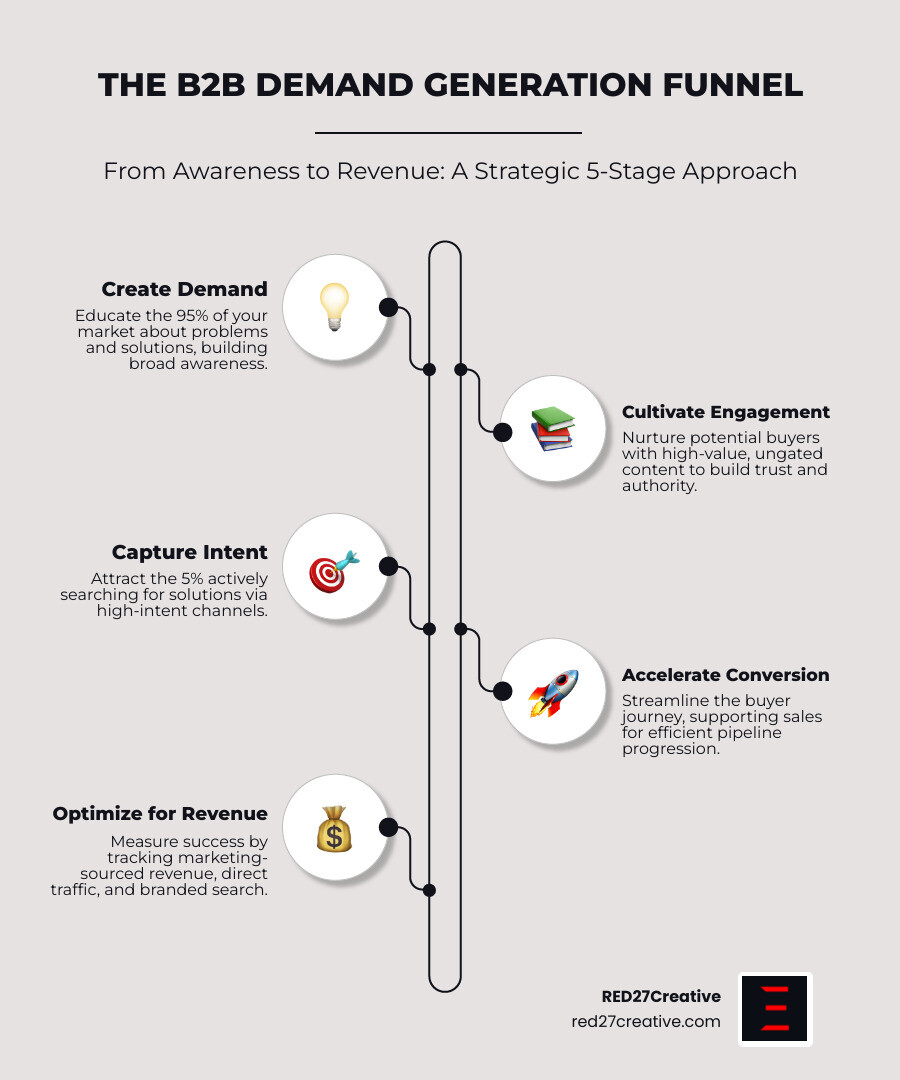
Demand generation for B2B is a holistic marketing approach that creates awareness and interest in your products or services across the entire buyer’s journey—from initial problem recognition through purchase and beyond. Unlike traditional lead generation, which focuses on capturing contact information from ready-to-buy prospects, demand generation builds long-term brand authority and trust with the 95% of your market that isn’t actively shopping right now.
Key Components of B2B Demand Generation:
- Demand Creation – Educating audiences about problems they may not know they have
- Demand Capture – Attracting the 5% actively searching for solutions
- Pipeline Acceleration – Supporting sales relationships through the decision process
- Sales & Marketing Alignment – Shared goals and unified revenue metrics
- Content-Driven Authority – Ungated, educational resources that build trust
Here’s the uncomfortable truth: most B2B companies are stuck chasing the same 5% of in-market buyers while their competitors do exactly the same thing. Research from the Ehrenberg-Bass Institute shows that 95% of your potential buyers aren’t ready to purchase at any given time. They’re not filling out your forms. They’re not requesting demos. They’re quietly researching, often in spaces you can’t measure—what marketers call the “dark funnel.”
Meanwhile, the B2B buyer journey has fundamentally changed. Buyers now spend only 17% of their time with potential suppliers, and when comparing multiple vendors, they might spend just 5-6% with any single sales rep. The rest? They’re doing independent research, meeting with buying groups, and making decisions long before they ever talk to your team.
This shift demands a new approach. You can’t win by simply optimizing your contact form or running more ads to the same small pool of active buyers. You need a strategy that builds awareness and trust with your entire addressable market—one that positions your brand as the obvious choice when those buyers are finally ready.
That’s where demand generation comes in. It’s not about generating more leads faster. It’s about creating a sustainable engine that educates your market, builds authority, and ensures your brand is top-of-mind when buying intent emerges. It combines content marketing, SEO, social engagement, and strategic distribution to create demand where none existed—and capture it when it does.
I’m Kiel Tredrea, founder of RED27Creative, and over the past 20+ years, I’ve helped hundreds of B2B businesses shift from short-term lead chasing to long-term Demand generation for B2B systems that drive predictable, scalable growth. This guide will show you how to build one for your business.
Learn more about Demand generation for B2B:
Demand Generation vs. Lead Generation: Understanding the Key Differences
It’s easy to confuse Demand generation for B2B with traditional lead generation. While both are crucial for business growth, their goals and methodologies differ significantly. Understanding this distinction is the first step toward building a truly effective marketing strategy.
Lead generation focuses on converting existing interest into contact information. It’s about attracting prospects who are already aware of a problem and actively searching for a solution. Tactics often involve gated content, demo requests, and other direct calls-to-action designed to fill the top of the sales funnel with immediate leads.
Demand generation, however, is a broader, more strategic approach. It aims to build brand awareness and nurture relationships throughout the entire buyer’s journey, even before a prospect recognizes a need. This involves creating and distributing valuable content to educate the market, positioning your business as a trusted authority, and influencing future buying decisions.
We can break demand generation into two core components:
- Demand Creation: This focuses on the vast majority of your market—the 95% who aren’t actively looking for a solution. The goal here is to educate them about problems they might not even realize they have, introduce new ways of thinking, and make them aware of your brand as a potential solution. This is about building long-term memory structures and brand affinity.
- Demand Capture: This targets the 5% of your market that is currently in-market and actively searching for a solution. Here, the focus shifts to ensuring your brand is visible and accessible in high-intent channels, like Google searches or review sites, when buyers are ready to engage.
The modern B2B buyer journey is complex. According to Gartner, B2B buyers spend only 17% of their buying journey with potential suppliers. This means the vast majority of their research and decision-making happens independently, often in what we call the ‘dark funnel.’

The ‘dark funnel’ refers to the hidden activity a buyer undertakes when researching and purchasing a new product or service. These activities—like conversations with peers, reading industry reports, or browsing forums—are largely untraceable by traditional attribution models. Demand generation for B2B strategies address this by creating a pervasive brand presence and delivering value in these unmeasurable spaces, ensuring your brand is top-of-mind when buyers eventually emerge into measurable channels.
Here’s a quick comparison to highlight the differences:
| Feature | Lead Generation | Demand Generation |
|---|---|---|
| Primary Goal | Capture immediate leads for sales | Create and nurture long-term interest, build brand authority, and influence future buying decisions |
| Audience Focus | In-market buyers (5%) with immediate need | Entire addressable market (both in-market and out-of-market buyers) |
| Time Horizon | Short-term results | Long-term, sustainable growth |
| Key Tactics | Gated content, demo requests, contact forms, direct outreach | Ungated educational content (blogs, webinars, podcasts), social media engagement, brand building, SEO, community participation, influencer marketing |
| Content Type | Product-focused, conversion-oriented | Value-driven, educational, problem/solution-focused, thought leadership |
| Metrics | MQLs, SQLs, conversion rates | Brand awareness, website traffic, social engagement, branded search volume, pipeline velocity, marketing-sourced revenue, customer lifetime value (CLV) |
| Sales Role | Close deals with qualified leads | Collaborate with marketing to nurture prospects, provide insights, and engage consultatively |
| Funnel Stage | Middle to bottom of funnel | Top to bottom of funnel (holistic) |
| Attribution | Direct, last-touch focused | Multi-touch, self-reported attribution, brand lift |
The shift from a pure lead generation focus to a demand generation mindset requires a fundamental change in how we approach marketing. It’s about playing the long game, building trust, and becoming an invaluable resource for your target audience. This is particularly vital in markets like Geneva, Naperville, and Chicago, IL, where B2B buyers are increasingly sophisticated.
The 5 Pillars of an Unbeatable Demand Generation for B2B Strategy
Building a robust Demand generation for B2B strategy requires a structured approach. We’ve identified five essential pillars that form the foundation of an effective system, ensuring you’re not just generating leads, but driving sustainable revenue growth.

Pillar 1: Aligning Sales and Marketing for a Unified Front
For demand generation to truly thrive, sales and marketing cannot operate in silos. They must be a unified force, working towards shared revenue goals. This means aligning on Ideal Customer Profiles (ICPs), messaging, and the lead qualification process.
Marketing generates interest and nurtures prospects, while sales provides invaluable feedback on lead quality and market insights. Regular communication and shared KPIs, like pipeline velocity and marketing-sourced revenue, are crucial. We help businesses in areas like Aurora and St. Charles, IL, bridge this gap by establishing clear feedback loops and sales enablement resources. Our Marketing Strategy and Consulting Services are designed to foster this critical alignment.
Pillar 2: Defining Your Ideal Customer Profile (ICP)
Who are you trying to reach? Without a precise Ideal Customer Profile (ICP), your demand generation efforts will be scattered and ineffective. An ICP goes beyond basic demographics; it digs into the “who,” “what,” and “why” of your best customers.
When defining your ICP, we consider five key factors:
- Pains: The critical problems your solution addresses.
- Gains: The desired results or outcomes your customers seek.
- Shifts: Changes in their business or market that make them open to new solutions.
- Blockers: Objections or frictions that might hinder adoption.
- Motivators: The drivers that urge them to move forward, whether it’s ROI or testimonials.
This deep understanding, driven by data analysis, ensures your messaging and content resonate with the right audience. It’s how we help companies in Plainfield and Oswego, IL, focus their efforts for maximum impact. Learn more about The Impact of Data-Driven Marketing Strategies in refining your audience.
Pillar 3: Building a High-Value Content Engine for B2B Demand Generation
Content is the fuel for demand generation. It’s how you educate your market, build trust, and establish authority. The key is to create high-value, educational content that solves problems and provides insights, rather than overtly selling.
Focus on ungated resources like blog posts, whitepapers, webinars, and podcasts that address your ICP’s pain points and answer their questions. This positions your brand as a helpful expert, not just a vendor. For manufacturers in Illinois, for example, content that explains complex processes or industry trends can be incredibly valuable. Our Content Marketing for Manufacturers expertise helps create compelling narratives.
Pillar 4: Mastering Your Distribution Channels
Even the best content won’t generate demand if no one sees it. A robust distribution strategy is crucial to get your message in front of your target audience. This involves a multi-channel approach, leveraging platforms where your ICP spends their time.
Key channels include:
- SEO: Optimizing your website and content to rank for relevant keywords, attracting organic traffic from buyers actively searching for solutions.
- Social Media: Particularly LinkedIn for B2B, to share content, engage in industry discussions, and build a community around your brand.
- PPC: Targeted paid campaigns that capture demand from high-intent keywords or reach specific audiences.
- Email Nurturing: Building engaged lists and delivering personalized content to move prospects through the funnel.
We strategize with businesses across Chicagoland, including Batavia and Geneva, IL, on mastering these channels. Dive deeper into optimizing your online presence with our B2B SEO Strategies.
Pillar 5: Optimizing for Conversion and Revenue
The final pillar focuses on ensuring that when demand is created and captured, it effectively converts into pipeline and revenue. This isn’t just about the “submit” button; it’s about the entire experience leading up to and after that point.
Key optimization areas include:
- Website UX: A seamless, intuitive website experience that guides visitors to the information they need and makes it easy to engage.
- High-Intent CTAs: Clear, compelling calls-to-action that align with the visitor’s intent at each stage of their journey.
- Sales Handoff: A smooth, efficient process for transitioning qualified prospects from marketing to sales, including tools like scheduling widgets to reduce leakage.
Optimizing your website for conversion is paramount, and we specialize in creating Website Conversion Rate Optimization strategies that turn visitors into valuable opportunities for businesses throughout Illinois.
Proven Tactics to Create and Capture High-Quality Demand
Once your foundational pillars are in place, it’s time to deploy specific tactics that bring your Demand generation for B2B strategy to life. These are the engines that will drive awareness, engagement, and ultimately, revenue.
Content Marketing That Educates, Not Sells
Content marketing is at the heart of demand generation. Its primary role is to educate, not immediately convert. By providing valuable insights, you build trust and position your brand as a thought leader.
- Blogs: Regularly publishing in-depth articles that address your audience’s pain points and questions. These build website authority and enable rankings for commercial intent keywords, even if direct conversions are low.
- Whitepapers & E-books: Offering comprehensive guides on industry challenges or solutions. These establish expertise and can be used to nurture prospects.
- Webinars & Podcasts: Hosting live or on-demand sessions that provide educational value. Webinars are engagement powerhouses, fostering direct interaction.
- Case Studies: Showcasing how your solutions have helped other businesses succeed, providing powerful social proof.
Ungated content often performs better for demand creation, as buyers are wary of exchanging contact information for content due to the expectation of unwanted sales pitches.
Integrating Account-Based Marketing (ABM)
Account-Based Marketing (ABM) is a powerful complement to a broader demand generation strategy. While demand generation creates widespread interest, ABM allows for hyper-focused engagement with high-value target accounts.
The process involves:
- Defining Your ICP: As discussed in Pillar 2, this is crucial for identifying your ideal accounts.
- Revenue Analysis & Segmentation: Analyzing past successes to pinpoint industries and segments with the best product-market fit.
- Target Account List Refinement: Marketing recommends and sales validates a precise list of key accounts.
- Personalized Engagement: Tailoring content and campaigns specifically for the needs and challenges of each target account.
By integrating ABM, you ensure that high-potential accounts receive personalized attention, moving them through the funnel more efficiently. Our Inbound B2B Lead Generation Services often leverage ABM principles for targeted growth.
Leveraging Social Media for Authority and Reach
Social media, particularly platforms like LinkedIn, is indispensable for Demand generation for B2B. It’s where industry professionals connect, share insights, and find new solutions.
- LinkedIn Engagement: Share valuable content, participate in relevant discussions, and engage with industry influencers. This builds brand visibility and thought leadership.
- Community Building: Foster online communities around your brand or industry challenges. This creates a space for genuine interaction and trust-building.
- Influencer Collaboration: Partner with respected voices in your industry to amplify your message and gain credibility. This is especially effective for building trust when you’re not yet deeply embedded in a specific vertical.
More than half of marketers specializing in B2B strategies have generated leads from their social media feeds, and that number is expected to rise. For businesses in Chicago and its surrounding areas, a strong LinkedIn presence is a must. Explore our specialized B2B LinkedIn Lead Generation Service.
Measuring Success: The KPIs That Truly Matter for B2B Demand Generation
In Demand generation for B2B, success isn’t just about the number of leads generated; it’s about the quality of those leads and their contribution to actual revenue. We focus on metrics that reflect long-term growth and pipeline health.
Key Performance Indicators (KPIs) we track include:
- Marketing Qualified Leads (MQLs) & Sales Qualified Leads (SQLs): While demand generation moves beyond a sole focus on leads, tracking the progression from MQL to SQL remains important for understanding funnel efficiency. However, the emphasis shifts to “high-intent” MQLs that are truly ready for sales engagement.
- Pipeline Velocity: How quickly opportunities move through your sales pipeline. Faster velocity often indicates more effective nurturing and qualification.
- Marketing-Sourced Revenue: The portion of overall revenue directly attributable to marketing campaigns. This is the ultimate measure of demand generation’s impact.
- Customer Lifetime Value (CLV): The total revenue a business can expect from a customer throughout their relationship. Effective demand generation attracts higher-value customers, leading to a higher CLV.
- Branded Search Volume: An increase in searches for your company name or products indicates growing brand awareness and recall.
- Direct Traffic: More visitors coming directly to your site (typing your URL) is a strong sign of brand recognition and trust.
- Social Engagement & Audience Growth: Measures the reach and interaction with your content on social platforms.
- Self-Reported Attribution: Directly asking prospects “How did you hear about us?” on high-intent forms provides invaluable qualitative data on what’s truly driving demand, especially in the dark funnel.
By focusing on these revenue-aligned metrics, we gain a clear picture of our Demand generation for B2B efforts’ effectiveness. Research from the Ehrenberg-Bass Institute highlights that long-term brand building (a core of demand generation) has a greater impact on sales over the long run than immediate sales activation.
The Future of Demand: Adapting Your Strategy for AI and Beyond
The landscape of Demand generation for B2B is constantly evolving, with Artificial Intelligence (AI) rapidly becoming a game-changer. Businesses that adapt their strategies to leverage AI will gain a significant competitive edge.
AI can transform demand generation in several ways:
- Personalization at Scale: AI-powered tools can analyze vast amounts of data to understand individual buyer preferences and behaviors, allowing for hyper-personalized content and outreach. This means delivering the right message to the right person at the right time, whether they’re in Geneva, Naperville, or Chicago, IL.
- Predictive Analytics: AI can predict which prospects are most likely to convert, helping marketers prioritize efforts and allocate resources more efficiently. This moves beyond reactive marketing to proactive engagement.
- Content Creation & Optimization: AI can assist in generating content ideas, drafting copy, and optimizing existing content for better performance. This allows marketing teams to produce high-quality, relevant content at an unprecedented pace.
- Messaging for AI Buyers: In the AI era, messaging needs to be adapted for both executive buyers and end-users. AI is often a feature, not the value proposition itself. We must focus on how AI solves urgent, unmet needs and delivers tangible benefits.
Companies like Fal.ai and Vapi illustrate how AI startups use product-led growth (PLG) and an API-first approach to scale rapidly, achieving widespread adoption and significant revenue growth by focusing on user experience and value. This highlights the importance of frictionless engagement and clear value propositions.
We’re already integrating AI into our strategies for clients, from using AI chatbots for lead qualification to leveraging AI-powered analytics for deeper insights. Find how AI in Marketing Transforms Business Growth and explore the potential of AI Chatbot Lead Generation for your business. The future of demand generation is intelligent, agile, and deeply connected to customer needs.
Frequently Asked Questions about B2B Demand Generation
What is the first step in creating a B2B demand generation strategy?
The first step is a fundamental shift in mindset, followed by deeply understanding your Ideal Customer Profile (ICP). This involves analyzing your best customers to identify their pain points, needs, and behaviors. This data-driven foundation informs your messaging, content, and channel strategy, ensuring your efforts resonate with the right audience.
How long does it take to see results from demand generation?
Demand generation is a long-term strategy, not a quick fix. While you can see early indicators like increased website traffic or social engagement within a few months, significant impacts on pipeline and revenue typically take 6-12 months. The goal is to build sustainable growth, not just generate short-term leads.
Can small businesses use demand generation effectively?
Absolutely. Small businesses can be highly effective by focusing on a niche audience and creating high-value, educational content that establishes authority. Instead of competing on budget, they can win by being the most trusted resource in their specific market, leveraging organic channels like SEO, content, and social media.
Conclusion: Shift Your Focus from Chasing Leads to Creating Demand
The B2B marketing landscape has irrevocably changed. Relying solely on traditional lead generation is no longer enough to guarantee sustained growth. The most successful B2B businesses, from Chicago to Geneva, IL, are embracing a comprehensive approach to Demand generation for B2B that focuses on building long-term brand authority, educating their market, and ensuring they are the first choice when buyers are ready.
At RED27Creative, we understand that true business growth comes from a strategy driven by purpose and focused on results that last. We build data-driven systems that unite your marketing efforts into one powerful engine, attracting visitors, building trust, and converting opportunities into measurable success.
Ready to build a marketing engine that drives real growth? Explore our Lead Generation Services to see how we can help you create and capture demand.

Kiel Tredrea
https://red27creative.comTop Marketing Agency • Web, SEO & Leads • RED27Creative