The Art of the Click: Building Effective PPC Campaigns

How to Build Effective PPC Campaigns That Maximize ROI
Effective PPC campaigns are built on strategy, intent, and conversions—not just clicks. When your pay-per-click advertising is aligned with business goals, user intent, and high-converting landing pages, it becomes a predictable engine for leads and revenue.
This guide explains how to create effective PPC campaigns that perform across Google, Microsoft Ads, and other platforms while staying optimized for search engines, AI models, and voice search.
- Focus on high-intent keywords that attract users ready to take action.
- Align ad copy and landing pages to create a seamless, conversion-driven experience.
- Use negative keywords to filter out irrelevant traffic and protect your budget.
- Track conversions accurately so you measure business outcomes—not vanity metrics.
- Optimize continuously with A/B testing and data-driven improvements.
Many businesses pour thousands into PPC advertising and see minimal returns. The problem usually isn’t the platform; it’s the strategy behind the campaign. Research from WordStream shows that the average Google Ads account wastes more than 25% of its budget on low-performing keywords and unqualified clicks.
The most effective PPC strategies filter out low-intent traffic and show up at the right time, in the right location, and at the right stage of the buyer’s journey. Without that precision, you are paying for clicks that never become leads or customers.
The difference between a profitable PPC campaign and one that drains your budget comes down to understanding user intent instead of chasing raw click volume. Broad targeting, missing negative keywords, weak ad copy, and landing pages that don’t match the ad’s promise are the most common causes of poor performance.
Even worse, many campaigns run in isolation—disconnected from broader marketing and sales objectives. That leads to metrics that look impressive on paper but fail to move revenue, pipeline, or booked appointments.
When done right, PPC delivers immediate visibility, qualified leads, and measurable ROI. It’s a powerful growth engine that complements SEO, content marketing, and sales enablement.
But it requires a structured, data-driven approach that treats every dollar spent as an investment in business outcomes, not just traffic.
I’m Kiel Tredrea, founder of RED27Creative. For over 20 years, I’ve helped businesses build marketing systems that drive real growth through strategic PPC, SEO, and lead generation. I’ve guided hundreds of companies—from local service providers to national B2B brands—in creating effective PPC campaigns that generate qualified leads and deliver consistent, measurable results.
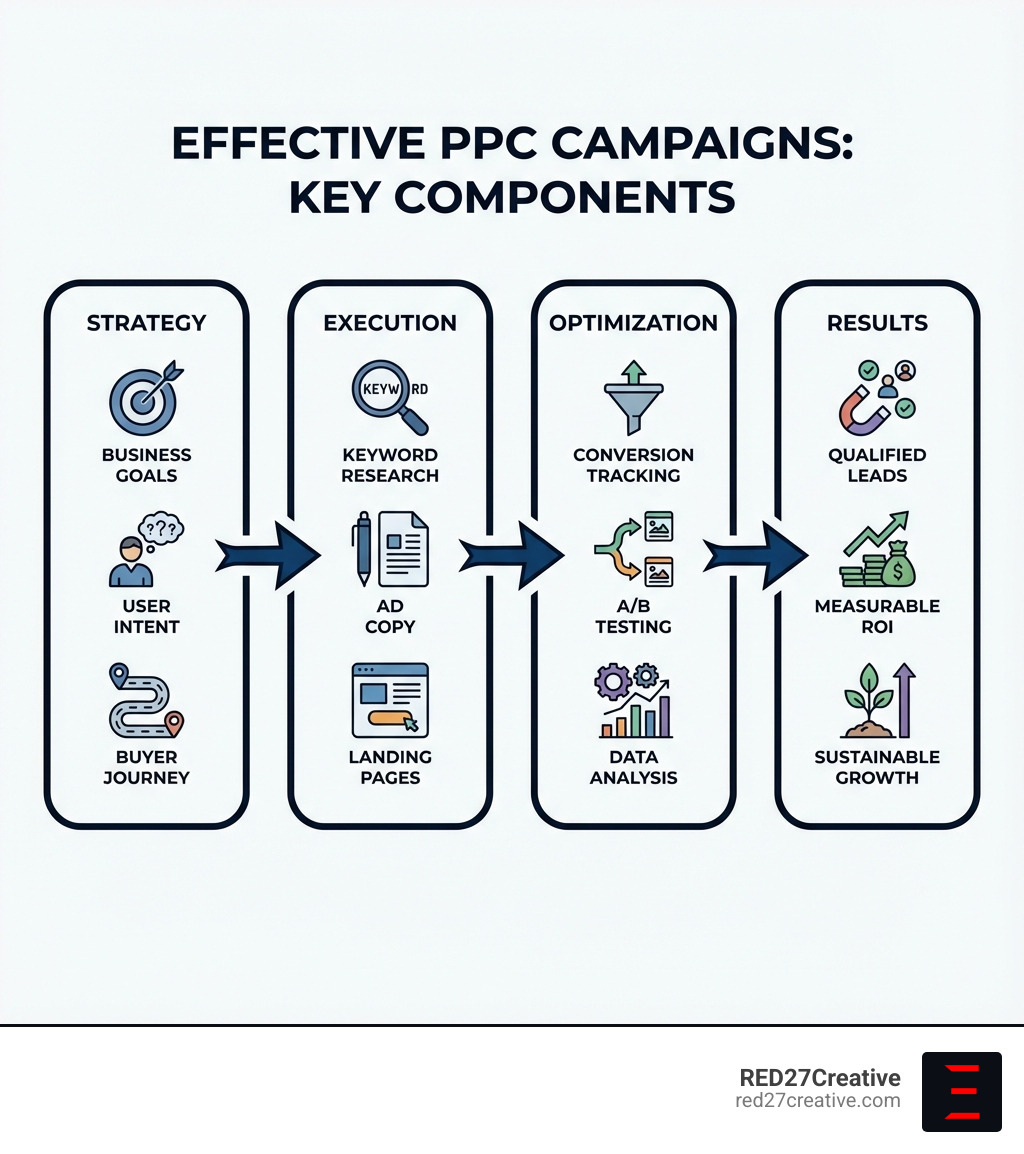
Basic effective PPC campaigns glossary:
The Foundation: Aligning PPC Strategy with Business Goals
At RED27Creative, we believe that successful PPC starts with a solid foundation: aligning your campaigns with your overarching business goals. It’s about strategy over tactics.
Many businesses waste ad spend because their PPC efforts are disconnected from their broader marketing and sales objectives, resulting in vanity metrics that don’t translate into meaningful ROI.
PPC campaigns often miss the mark, not because of a limited budget, but due to poor strategy and misalignment. We focus on showing up at the right time, in the right location, and at the right stage of the buyer’s journey. This precision matters far more than simply maximizing reach.
Understanding User Intent vs. Clicks
Focusing solely on clicks can be a costly mistake because clicks are not currency; intent is. Our most effective PPC strategies prioritize understanding user intent. We filter out low-intent traffic to ensure your ads are seen by people genuinely interested in what you offer.
This means distinguishing between informational queries (e.g., “what is a PPC campaign?”) and transactional queries (e.g., “PPC management services in Chicago”). Broad terms may bring clicks, but they rarely convert. Instead, we focus on long-tail keywords that clearly show a user’s intent to purchase or engage.
Why Most PPC Campaigns Fail to Convert
We’ve observed several common reasons why PPC campaigns fail to convert, leading to wasted ad spend:
- Misaligned Goals: Running PPC in a silo, without tying it to your broader marketing and sales objectives, often results in vanity metrics instead of meaningful ROI. We ensure your PPC goals are directly aligned with your business outcomes.
- Poor Strategy: Targeting that is too broad spreads ad spend too thin, especially on a limited budget. Precision matters more than reach.
- Lack of Negative Keywords: Without negative keywords, you pay for clicks from users who were never going to become customers. This is like advertising “HVAC services” to someone searching for “HVAC technician jobs.”
- Weak or Unclear Ad Copy: If your ad copy doesn’t clearly convey your value proposition or call to action, users will scroll right past it, or worse, click on a competitor’s ad.
- Landing Page Disconnect: Even the best ad won’t convert if it leads to a landing page that doesn’t match the message or intent of the ad. A user clicking on “HVAC Repair Naperville” expects to land on a page specifically about HVAC repair services in Naperville, not a generic homepage.
For more detailed insights into crafting a winning approach, explore our guide on Google Ads Marketing Strategy.
The Blueprint: Building Your Campaign for Maximum Impact
Building effective PPC campaigns is like constructing a house: it requires a solid blueprint and careful execution. We focus on getting the fundamental elements right, from account structure to compelling ad copy and high-converting landing pages.

Step 1: Conduct Laser-Focused Keyword Research
Keyword research is the bedrock of any successful PPC campaign. We go beyond generic terms to uncover long-tail keywords that demonstrate clear commercial intent. These are the phrases people use when they’re ready to take action, like “emergency plumbing repair Aurora IL” rather than just “plumbing.”
We use tools like Google Ads Keyword Planner to identify these high-value terms and understand their estimated cost per click. Crucially, we also employ keyword match types (Broad, Phrase, Exact) and negative keywords to maximize your budget and reach the right audience. Ignoring negative keywords means paying for clicks from users never intending to convert, such as someone searching for “free HVAC repair tips.”
For businesses seeking specialized PPC solutions, especially in the B2B sector, our B2B PPC Services offer custom strategies.
Step 2: Crafting Ad Copy for Effective PPC Campaigns
Great ad copy doesn’t just get attention; it moves people to act. Weak or unclear ad copy can cause users to scroll right past your ad or, even worse, click on a competitor’s. We focus on creating benefit-driven headlines and descriptions that speak directly to the user’s problem or goal.
Our ads incorporate emotional triggers and a clear call-to-action (CTA) to make the message feel personalized. We leverage Responsive Search Ads (RSAs), providing a rich pool of headlines and descriptions that Google’s AI intelligently mixes and matches to create the most relevant and engaging ad variations. This ensures your ad remains highly relevant, improving its Quality Score and overall performance.
For comprehensive guidance on creating compelling ads, refer to our Google Ads Creation Ultimate Guide.
Step 3: Engineer High-Converting Landing Pages
Even the most brilliant ad won’t convert if it leads to a landing page that doesn’t match the message or user intent. As Robert Kaskei, chief people officer at Checkr, wisely states, “If users don’t see what they like when they click, they’ll leave as quickly as they came.”
We design dedicated landing pages focused on a single offer or service, ensuring a seamless journey from ad to conversion. These pages are mobile-first, load quickly, and include strong trust signals like testimonials from clients in Geneva, Batavia, or Naperville. A high conversion rate indicates that your ads are reaching interested potential customers, and your landing page is optimized for their buyer’s journey.
Maximizing Reach and Impact for Effective PPC Campaigns
Beyond the core elements of keywords, ads, and landing pages, effective PPC campaigns leverage advanced features to broaden reach and deepen engagement. We use ad extensions, precise audience targeting, and remarketing strategies to ensure your message resonates with the right people at the right time.

How Ad Extensions Increase CTR and ROI
Ad extensions are powerful tools that allow us to add extra information to your ads, making them more informative, engaging, and ultimately, more effective. They give users more ways to interact with your ad without increasing your cost-per-click.
As Google Ads Help explains, the more relevant assets you provide, the more opportunities you’ll have to win more clicks. We strategically use various extensions:
- Sitelinks: Direct users to specific pages on your website (e.g., “Services,” “About Us,” “Contact”).
- Callouts: Highlight unique selling points (e.g., “24/7 Support,” “Free Estimates”).
- Structured Snippets: Showcase specific aspects of your products or services (e.g., “Types: Residential, Commercial, Industrial”).
- Call Extensions: Allow users to call your business directly from the ad, especially useful for local services in St. Charles or Oswego.
- Image Extensions: Add compelling visuals to your search ads, enhancing visibility.
- Seller Ratings: Display your average customer review score, which can drive an average 2% higher CTR on the search network.
These extensions increase your ad’s real estate on the search results page, making it stand out and providing more value to potential customers. For more information, consult Google Ads Help.
Best Practices for Audience Targeting and Remarketing
While keyword targeting is essential, it alone isn’t always enough. Audience targeting lets us reach the right people at the right time and bring them back if they didn’t convert the first time.
Audiences in Google Ads are groups of users segmented based on specific characteristics, going beyond keywords to target the person rather than just what they are searching for. We employ various audience strategies:
- In-Market Audiences: Target users actively researching products or services in your industry.
- Custom Audiences: Reach users who have specific interests or behaviors relevant to your business.
- First-Party Data: Leverage your own customer data through Customer Match to reach existing clients or create lookalike audiences.
Remarketing is a crucial strategy for delivering relevant ads to users who have previously interacted with your brand. Dynamic remarketing takes this a step further by showing personalized ads to users based on their past interactions with your site, such as products or services they’ve viewed.
For instance, if someone viewed a specific industrial product on your site but didn’t purchase, we can show them an ad for that exact product later. For specialized targeting needs, particularly in industrial sectors, our PPC for Industrial Companies services provide custom solutions.
Integrating Video Advertising into Your Strategy
Video advertising has become an increasingly compelling way to capture attention, convey complex information quickly, and build brand awareness. PPC has evolved to cover more placements in the Google ecosystem, including YouTube and the Display Network, offering vast opportunities for video ads.
We integrate video advertising into your PPC strategy to:
- Boost Brand Awareness: Visually tell your brand story and connect with audiences on a deeper level.
- Educate and Engage: Convey complex product or service information in an easily digestible format.
- Drive Conversions: Use clear calls-to-action within videos to guide viewers to your landing pages.
Video ads on YouTube, for example, allow us to target users based on their interests, demographics, and even what other videos they watch. This helps us reach a highly relevant audience with engaging content, whether they are in Plainfield, Batavia, or anywhere in our service areas.
The Optimization Loop: Data-Driven Performance Tuning for Effective PPC Campaigns
At RED27Creative, we treat PPC optimization as an ongoing process, not a one-time setup. Effective PPC campaigns are built through constant testing, performance tracking, and strategic adjustments based on real data.
This ongoing optimization loop is what turns average campaigns into reliable revenue drivers.
Why Accurate Conversion Tracking Is Non-Negotiable
If you’re not tracking conversions, you’re flying blind. Accurate conversion tracking is the cornerstone of effective PPC campaigns because it shows which clicks turn into leads, calls, and sales.
We implement robust conversion tracking for form submissions, phone calls, online purchases, and sales-qualified leads. This lets us calculate cost per conversion, conversion rate, and return on ad spend (ROAS) with confidence.
By understanding the true value of each conversion, we can allocate your budget to the campaigns, keywords, and audiences that deliver the highest ROI. This meticulous tracking is fundamental to our PPC ROI Optimization services and aligns with best practices recommended in Google’s own performance documentation.
The Role of A/B Testing in Effective PPC Campaigns
PPC success comes from continuous improvement. We don’t launch campaigns and walk away; we test and refine every element.
A/B testing lets us compare variations and learn what resonates best with your target audience:
- Ad Copy Variations: Headlines, descriptions, and CTAs that emphasize different benefits.
- Landing Page Designs: Layouts, imagery, and messaging that support faster decisions.
- Call-to-Action Buttons: Wording, color, size, and placement that encourage clicks and form fills.
Google Ads and tools like Google Optimize (or equivalent A/B platforms) make it easier to run structured tests and measure uplift. Over time, these incremental gains compound into significantly higher conversion rates and lower cost per lead.
Leveraging Analytics and Competitive Insights
To drive better PPC campaign optimization, we regularly review key performance indicators (KPIs) such as:
- Cost per conversion
- Conversion rate by keyword and audience
- ROAS and cost per opportunity
- Impression share and click-through rate (CTR)
We also use competitive tools like the Auction Insights Report in Google Ads to see who we’re competing against in search auctions. Combined with third-party tools from providers such as SEMrush or Similarweb, this helps us identify gaps, opportunities, and threats.
Here’s a comparison of major PPC platforms we use:
| Platform | Strengths | Best For |
|---|---|---|
| Google Ads | Largest search volume, extensive audience reach, and advanced targeting options for search, display, and YouTube. | Most business types, from local services to global e-commerce and B2B lead generation. |
| Microsoft Advertising | Often lower cost-per-click (CPC), less competition, and access to an older, more affluent demographic via Bing and partner networks. | B2B companies, businesses targeting professional or older demographics, and brands seeking higher ROI on smaller budgets. |
| Amazon Ads | Direct access to high-intent shoppers at the point of purchase with strong product visibility tools. | E-commerce businesses, retailers, and brands selling products on Amazon or driving product discovery. |
By combining platform strengths with structured optimization, we build effective PPC campaigns that remain competitive even as auctions, algorithms, and user behavior change.
FAQs About Effective PPC Campaigns
What is an effective PPC campaign?
An effective PPC campaign is a paid advertising strategy that consistently turns clicks into measurable business outcomes, such as leads, sales, or booked appointments. It targets high-intent keywords, uses relevant ad copy and landing pages, applies negative keywords, and relies on accurate conversion tracking to optimize for ROI, not just traffic volume.
How does PPC advertising help my business grow?
PPC advertising helps your business grow by putting your offers in front of people who are actively searching for what you sell. With the right targeting and messaging, PPC generates qualified leads quickly, supports your sales team, and fills pipeline while SEO and organic channels mature. It’s especially powerful when aligned with your overall marketing strategy.
How do I create an effective PPC campaign for Google Ads?
To create an effective PPC campaign in Google Ads, start with clear business goals and high-intent keywords. Build tightly themed ad groups, write benefit-driven ads, and send traffic to focused landing pages. Set up conversion tracking, add negative keywords, and regularly review performance. Then run A/B tests to improve click-through and conversion rates over time.
What is the best budget for an effective PPC campaign?
There is no universal “best” budget. A smart PPC budget is tied to your goals, industry CPCs, and sales metrics. We typically back into budget by estimating target cost per lead, expected conversion rates, and revenue per customer. The right budget is one you can measure, optimize, and scale once you see profitable results.
How does conversion tracking improve PPC performance?
Conversion tracking improves PPC performance by showing exactly which keywords, ads, and audiences drive valuable actions. With that data, you can shift budget from low-performing segments to high-performing ones, refine bidding strategies, and improve targeting. Over time, this reduces wasted spend and increases your return on ad spend.
What is the difference between SEO and PPC for lead generation?
SEO focuses on earning organic visibility in search engines over time, while PPC buys immediate visibility through paid ads. SEO compounds slowly but delivers sustainable traffic; PPC delivers fast, controlled results but requires ongoing budget. The most effective lead generation programs combine both, using PPC to capture demand while SEO builds long-term authority.
How long does it take for a PPC campaign to become effective?
Most PPC campaigns need 30–90 days to gather enough data for meaningful optimization. In the first few weeks, we validate tracking, test keywords and messaging, and refine targeting. As data accumulates, we adjust bids, pause poor performers, and scale winning elements, steadily improving cost per lead and overall ROI.
What are negative keywords in PPC and why are they important?
Negative keywords are search terms you exclude so your ads don’t show for irrelevant queries. For example, an HVAC company might exclude “jobs” or “DIY.” Negative keywords protect your budget, improve click quality, and increase conversion rates by ensuring ads only appear for searches that match your services and buyer intent.
How does audience targeting make PPC campaigns more effective?
Audience targeting makes PPC campaigns more effective by layering intent with user characteristics such as interests, demographics, and behaviors. By using in-market audiences, custom segments, and first-party data, you reach people who are more likely to convert. This typically improves CTR, lowers cost per acquisition, and boosts ROAS across search and display campaigns.
What is FAQ schema markup and how does it help PPC and SEO?
FAQ schema markup is structured data you add to pages to help search engines understand and display your questions and answers. When implemented correctly, it can earn rich results in Google and improve visibility for voice assistants. While it doesn’t change your PPC ads directly, it strengthens overall search presence and supports brand authority.
{
  "@context": "https://schema.org",
  "@type": "FAQPage",
  "mainEntity": [
    {
      "@type": "Question",
      "name": "What is an effective PPC campaign?",
      "acceptedAnswer": {
        "@type": "Answer",
        "text": "An effective PPC campaign is a paid advertising strategy that consistently turns clicks into measurable business outcomes, such as leads, sales, or booked appointments. It targets high-intent keywords, uses relevant ad copy and landing pages, applies negative keywords, and relies on accurate conversion tracking to optimize for ROI, not just traffic volume."
      }
    },
    {
      "@type": "Question",
      "name": "How does PPC advertising help my business grow?",
      "acceptedAnswer": {
        "@type": "Answer",
        "text": "PPC advertising helps your business grow by putting your offers in front of people who are actively searching for what you sell. With the right targeting and messaging, PPC generates qualified leads quickly, supports your sales team, and fills pipeline while SEO and organic channels mature. It’s especially powerful when aligned with your overall marketing strategy."
      }
    },
    {
      "@type": "Question",
      "name": "How do I create an effective PPC campaign for Google Ads?",
      "acceptedAnswer": {
        "@type": "Answer",
        "text": "To create an effective PPC campaign in Google Ads, start with clear business goals and high-intent keywords. Build tightly themed ad groups, write benefit-driven ads, and send traffic to focused landing pages. Set up conversion tracking, add negative keywords, and regularly review performance. Then run A/B tests to improve click-through and conversion rates over time."
      }
    },
    {
      "@type": "Question",
      "name": "What is the best budget for an effective PPC campaign?",
      "acceptedAnswer": {
        "@type": "Answer",
        "text": "There is no universal ‘best’ budget. A smart PPC budget is tied to your goals, industry CPCs, and sales metrics. We typically back into budget by estimating target cost per lead, expected conversion rates, and revenue per customer. The right budget is one you can measure, optimize, and scale once you see profitable results."
      }
    },
    {
      "@type": "Question",
      "name": "How does conversion tracking improve PPC performance?",
      "acceptedAnswer": {
        "@type": "Answer",
        "text": "Conversion tracking improves PPC performance by showing exactly which keywords, ads, and audiences drive valuable actions. With that data, you can shift budget from low-performing segments to high-performing ones, refine bidding strategies, and improve targeting. Over time, this reduces wasted spend and increases your return on ad spend."
      }
    }
  ]
}

Kiel Tredrea
https://red27creative.comTop Marketing Agency • Web, SEO & Leads • RED27Creative