How to Craft HVAC Landing Pages That Don’t Suck

How to Craft HVAC Landing Pages That Don’t Suck
Why Most HVAC Landing Pages Fail to Convert Visitors into Customers
HVAC landing page design is the difference between wasting your advertising budget and turning every click into a paying customer. Most HVAC companies make the same critical mistakes: cluttered layouts, weak headlines, and unclear calls to action that confuse visitors instead of converting them.
Essential HVAC Landing Page Elements:
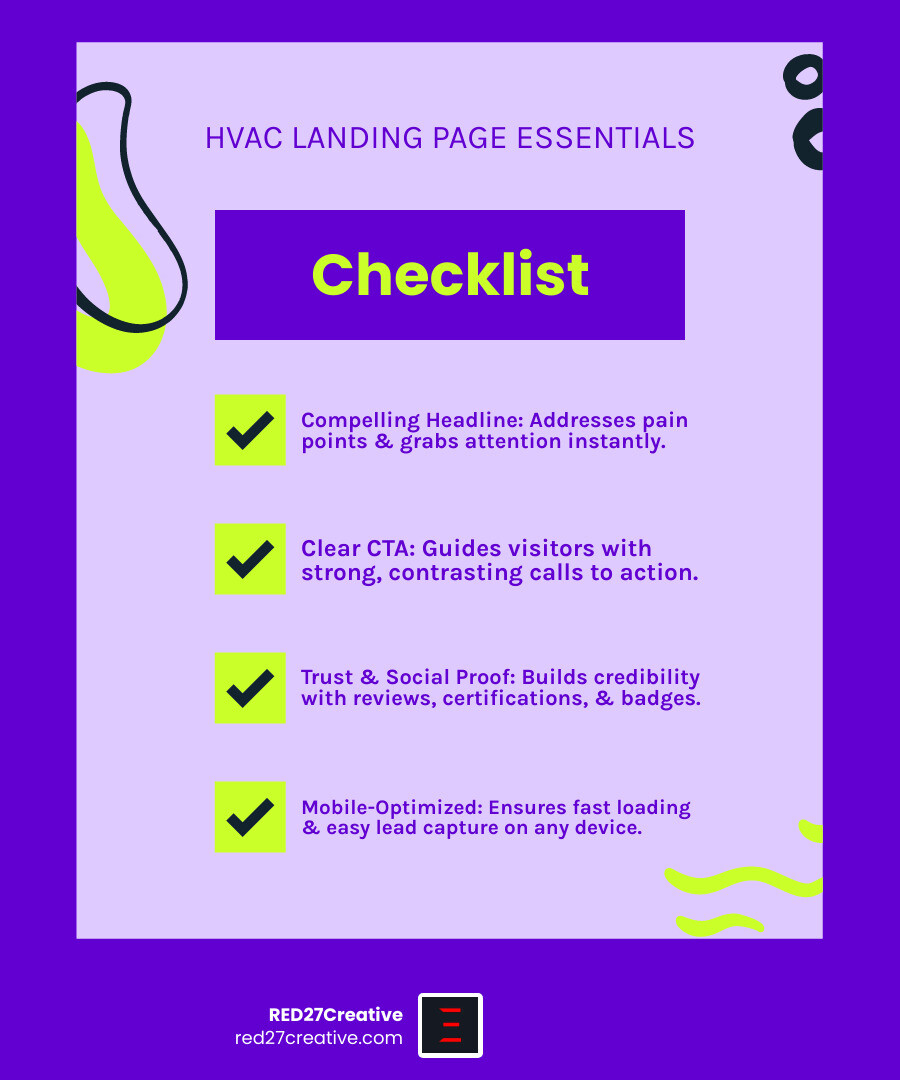
- Compelling headline that addresses customer pain points
- Clear call-to-action with contrasting button colors
- Social proof including reviews and certifications
- Mobile-responsive design for fast loading
- Trust signals like NATE certifications and BBB ratings
- Local SEO elements with service area mentions
- Simple contact forms above the fold
The stakes are high. With more than seven million monthly searches for HVAC services and Google estimating a return of $8 for every $1 spent on Google Ads, your landing page determines whether those clicks become profitable leads or expensive dead ends.
Research shows that 82% of customers read online reviews before booking a service, while 85% of internet users engage more with pages that include photos and videos. Yet many HVAC companies still rely on generic, text-heavy pages that fail to build trust or drive action.
I’m Kiel Tredrea. With more than 20 years of experience, I help businesses master HVAC landing page design using conversion-focused strategies that turn advertising into revenue. My approach combines proven design principles with industry insights to create high-performing landing pages.
Quick HVAC landing page design terms:
- best advertising for hvac business
- hvac advertisements
- how to grow a heating and air conditioning business
The Foundation: What Is an HVAC Landing Page and Why Does It Matter?
Think of an HVAC landing page design as your digital sales rep who never takes a coffee break. While your main website is a comprehensive company brochure, a landing page has one job: convert visitors into leads with laser-focused precision.
Here’s the bottom line: when a potential customer clicks your “Emergency AC Repair” ad, they need immediate answers and a simple way to get help. They don’t want to search your entire website. A well-crafted landing page delivers exactly that.
The magic is in the simplicity. A landing page strips away distractions and guides visitors down a single path toward one specific action. Whether that’s scheduling a consultation, requesting a quote, or booking service, everything on the page supports that one goal.
Many HVAC companies make a costly mistake: they send expensive ad traffic to their homepage. This is like inviting someone to dinner but not telling them where the table is.
Landing Page vs. Your Main Website
Your main website is like a hardware store – it has everything, but finding what you need takes time. A landing page is a specialist who arrives with the right tool for your specific problem.
The distinct purpose makes all the difference. Your website homepage welcomes everyone with navigation menus, company history, and multiple service options. It’s designed for exploration and building brand awareness.
Your landing page, on the other hand, has no navigation menu to distract visitors. There’s one clear message, one compelling offer, and one obvious next step. This focused approach dramatically reduces bounce rates because visitors aren’t overwhelmed.
Here’s how they stack up side by side:
| Feature | HVAC Landing Page | HVAC Website Homepage |
|---|---|---|
| Primary Goal | Lead generation, specific conversion | General information, brand building, multiple purposes |
| Navigation | Minimal or none (focused) | Full navigation menu, multiple paths |
| Content Focus | Single offer, specific service, campaign-driven | Broad overview of services, company history, blog |
| Distractions | Minimized | Many, designed for exploration |
| Call to Action | Clear, prominent, singular | Multiple, varied |
| Tracking | Highly specific, campaign-level | General site analytics |
| Conversion Rate | Typically higher due to focus | Generally lower for specific campaign goals |
The higher conversion intent comes from this focused approach. When visitors land on a page that directly addresses their specific need – emergency repair, system installation, or maintenance contract – they’re more likely to take action.
Residential vs. Commercial Landing Pages
Not all HVAC customers think alike, and your HVAC landing page design should reflect these differences. Homeowners and business decision-makers have different motivations, pain points, and decision-making processes.
Residential customers are driven by emotion and immediate comfort. Your copy should be empathetic, focusing on benefits like peace of mind, quick response times, and family comfort. Trust signals like family-owned business status, guarantees, and testimonials from local families are key, as they want to know you’ll be on time and respect their home.
Commercial customers think in terms of ROI, system uptime, and long-term reliability. Your landing pages should be professional and data-driven, highlighting certifications, complex system expertise, and preventative maintenance benefits to prove you can handle large-scale projects and minimize costly downtime.
The service scale also differs. A residential page might focus on a single home unit, while a commercial page addresses rooftop systems or facility-wide maintenance contracts.
B2B lead capture often involves longer sales cycles. While residential customers might call immediately, commercial prospects typically want detailed consultations and written proposals before making a decision.
The bottom line? Your HVAC landing page design must speak directly to your audience’s mindset, whether it’s a stressed homeowner or a facilities manager planning a budget.
Building Blocks: The Essential Elements of a High-Converting HVAC Landing Page
Think of your HVAC landing page design as a well-tuned heating system-every component must work together perfectly. If one element is off, the whole system suffers. The difference between a converting page and a failing one lies in these fundamental building blocks.
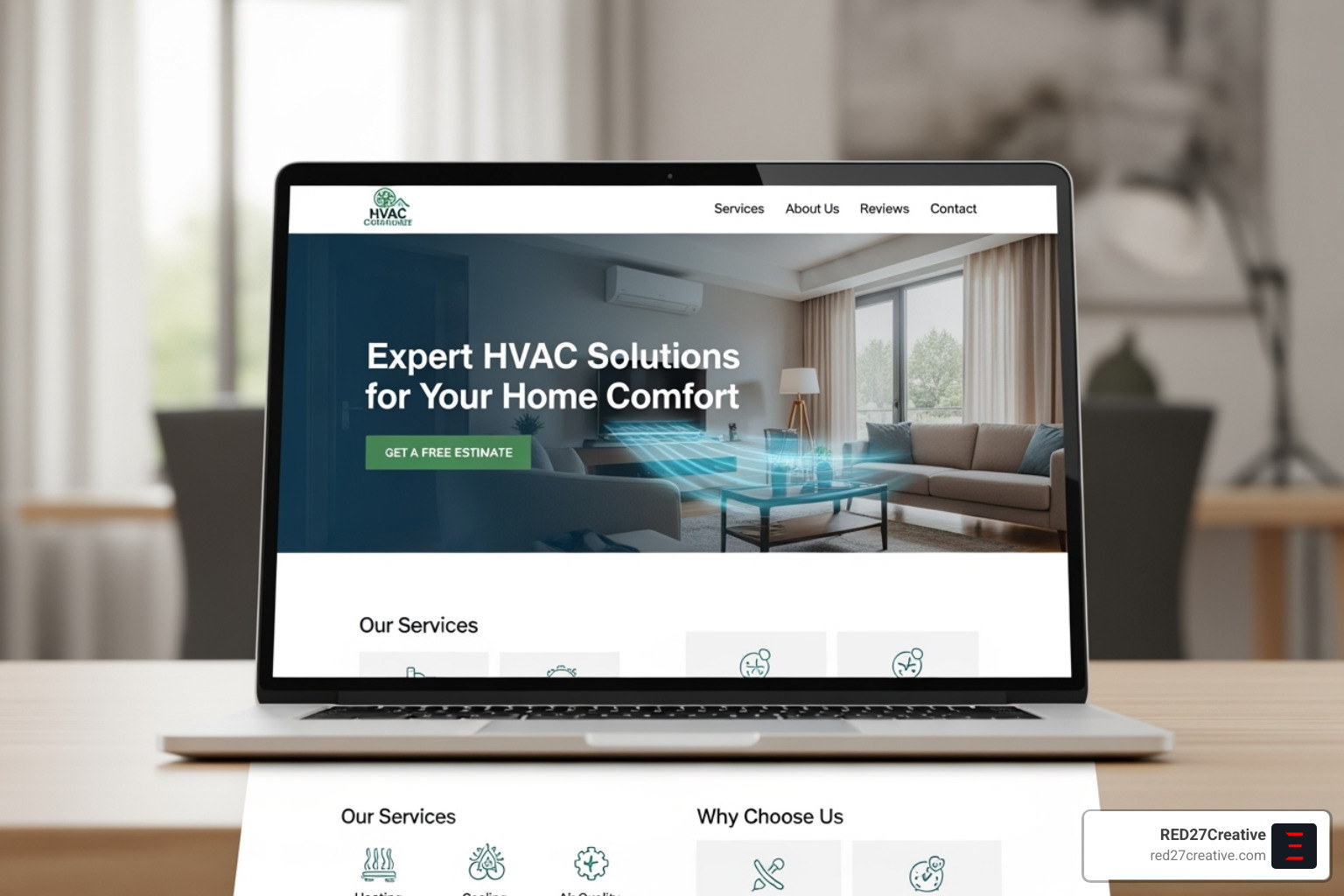
Successful HVAC landing pages offer something compelling up front, establish trust immediately, and make it crystal clear what action to take. The key is weaving these elements into a cohesive, trustworthy experience that feels natural.
Crafting Irresistible Headlines and Copy
Your headline is often the only thing people read before deciding to stay or leave. Generic headlines like “HVAC Services” are conversion killers. Instead, speak directly to your customer’s immediate pain point or desired outcome.
Benefit-driven headlines promise a solution. “Stop Sweating Through Another Sleepless Night” is more effective than “Air Conditioning Repair.” It creates urgency that generic headlines lack.
Once your headline hooks them, your body copy must deliver. Write like you’re talking to a neighbor. Short paragraphs keep readers engaged, while scannable text with clear subheadings and bullet points helps them find information quickly.
Focus on problem-solving language. Instead of saying, “We’ve been in business for 20 years,” try, “Work with seasoned professionals who’ve seen every HVAC challenge imaginable.”
Building Trust with Social Proof and Credentials
A sobering reality: 82% of customers read online reviews before booking a service. This means most potential customers are actively looking for proof that you’re trustworthy.
Customer testimonials are your secret weapon, but only if they feel authentic. Real names, locations, and photos make them believable. Even better are video reviews-they’re powerful because people can see and hear genuine emotion. Research shows that 85% of users engage more with video content, making video testimonials a conversion goldmine.
Industry certifications like NATE or ACCA are trust signals that tell customers you’re an expert. Display these prominently, along with BBB ratings and any local awards you’ve earned. These credentials build confidence before you even speak to a prospect.
Star ratings from Google or Yelp should be front and center.
Driving Action with Powerful CTAs and Visuals
Your Call to Action (CTA) is the moment of truth. Action-oriented verbs like “Schedule,” “Get,” or “Call” create urgency. “Schedule Your Repair Now” beats “Contact Us” every time.
Contrasting button colors make your CTA impossible to miss. If your page is blue and white, make the button bright orange or green. Position your primary CTA above the fold where visitors see it immediately, and repeat it throughout the page. Multiple CTAs are fine as long as they all point to the same goal.
High-quality images transform your landing page. Team photos humanize your brand, while service videos showing your team in action build confidence and demonstrate expertise.
Skip the generic stock photos. Show your real trucks, your actual team, and genuine before-and-after shots of your work. Authenticity builds trust, and trust drives conversions.
Mastering Your HVAC Landing Page Design and User Experience (UX)
Your HVAC landing page design is your digital storefront. It must be clean, welcoming, and easy to steer. The best landing pages feel effortless, but they are built on strategic thinking.
When visitors land on your page, they should immediately understand your offer and how to take action. Accept white space to give your content room to breathe. Use consistent branding that matches your other marketing materials, so customers feel they’re in the right place.
Your layout should guide the eye naturally from your headline to your call-to-action button. Brand consistency builds trust, while readable fonts and a logical flow keep people engaged.
Optimizing for Mobile and Speed
More than half of your potential customers are on their phones, likely with a broken AC. If your landing page isn’t mobile-friendly, you’re losing these frustrated customers before they can even call you.
Responsive design is essential. Your page needs to automatically adjust to look great on a smartphone, tablet, or desktop. This mobile-first approach ensures your most important elements, like your phone number and contact form, are easily accessible.
Page speed is equally critical. A one-second delay in loading can significantly hurt conversions. When someone’s dealing with a broken furnace, they don’t have patience for slow websites. Google’s Core Web Vitals also factor into search rankings, so faster pages help you get found.
The fix involves optimizing images, cleaning up code, and ensuring your hosting can handle traffic spikes.
Integrating Local SEO into Your HVAC Landing Page Design
Your HVAC business lives and dies by local search. When someone’s air conditioner breaks, they need someone who can be there today. That’s why weaving local SEO elements into your HVAC landing page design is so powerful.
Clearly mention your service areas in your content. Be specific about the communities you cover, not just “the Chicago area.” Use natural, city-specific keywords in headlines and copy, like “Emergency AC Repair in Naperville.”
Your local phone number should be prominent and clickable on mobile devices. A familiar area code is reassuring during an emergency. An embedded Google Map showing your coverage area adds another layer of local credibility.
Customer reviews that mention locations are particularly valuable. Seeing testimonials from people in their own neighborhood builds immediate trust and relevance.
This local optimization works with your Google Business Profile to help you dominate local search results.
From Launch to Leads: Optimizing, Testing, and Measuring Success
Launching your HVAC landing page is just the start. The real work is in continuous optimization, testing, and measurement. This process ensures your page evolves to meet user needs and maximize your ROI.
Message consistency is critical. Your landing page must align with the ad that brought the user. If your ad promises a “Free AC Inspection,” the page can’t focus on “New Furnace Installations.” This mismatch confuses visitors and loses conversions. This “message matching” builds trust.
Using Analytics and A/B Testing to Refine Your HVAC Landing Page Design
Understanding how users interact with your page is vital.
- Heatmaps: Tools like Hotjar visually show where users click, scroll, and focus their attention. This is invaluable for identifying what’s working.
- Scroll Maps: These show how far down users scroll, indicating if your important content is being seen.
- Conversion Tracking: Set up goals in Google Analytics to track how many visitors complete your desired action (e.g., form submissions, phone calls).
- A/B Testing: This is the ultimate optimization tool. A/B testing involves creating two versions of your page (A and B) with one key difference, like the headline or CTA button. You show each version to visitors to see which performs better. This data-driven approach removes guesswork. Getting a landing page right often requires several months of testing.
By leveraging these analytics and testing methods, you can continually refine your HVAC landing page design.
Common Mistakes to Avoid
Avoiding common pitfalls is as important as implementing best practices:
- Vague Headlines: “HVAC Services” tells a visitor nothing. Be specific and benefit-driven.
- Weak CTAs: Generic buttons like “Submit” don’t inspire action. Use compelling, action-oriented language.
- Cluttered Design: Too much text or too many images overwhelm visitors. Keep it clean and focused.
- Slow Load Speed: Visitors lose interest if your page loads slowly. Optimize your images and code.
- No Social Proof: Without testimonials or reviews, visitors have no reason to trust you.
- Inconsistent Messaging: If your ad and landing page say different things, you’ll lose credibility.
- Too Many Form Fields: Only ask for essential information. Every extra field reduces conversions.
- No Mobile Optimization: A page that isn’t mobile-friendly will turn away a large portion of your audience.
- Lack of Clear Value Proposition: Why should someone choose you? Make your unique selling points obvious.
By avoiding these mistakes, you can significantly improve your landing page’s ability to convert visitors into leads.
Frequently Asked Questions about HVAC Landing Page Design
Here are answers to common questions about creating an HVAC landing page design that converts ad clicks into customers.
What is the primary purpose of an HVAC landing page?
Its primary purpose is to convert a visitor from a specific marketing campaign (e.g., an “Emergency AC Repair” ad) into a qualified lead. Unlike a homepage, a landing page is laser-focused on a single service. It eliminates distractions like navigation menus and competing offers, providing one clear path from the visitor’s problem to your solution.
What are the 3 most essential elements of a high-converting HVAC landing page?
Three elements consistently separate the winners from the money-wasters.
First is a compelling, benefit-driven headline that speaks to the visitor’s immediate pain point. “AC Died? We’ll Have You Cool Again in 2 Hours” is far more effective than “HVAC Services Available.”
Second is clear social proof like customer reviews, star ratings, and industry certifications (e.g., NATE). With 82% of customers reading reviews first, this builds immediate trust.
Third is a prominent, action-oriented call to action (CTA). Use urgent language like “Get Your Free Quote Now” instead of “Submit,” and make the button impossible to miss with a contrasting color above the fold.
How do I measure the success of my landing page?
Your conversion rate—the percentage of visitors who call or fill out a form—is the ultimate metric. Successful HVAC pages often convert at 3-8%. Also track bounce rate, time on page, and cost per lead for a complete picture. The real magic is in A/B testing. Continuously test elements like headlines and testimonials to improve performance. A landing page should be a living sales tool that you regularly refine with data, not a ‘set it and forget it’ page.
Conclusion
Creating a HVAC landing page design that converts isn’t just about pretty graphics-it’s about understanding your customers’ needs and guiding them to a decision with clarity.
We’ve explored how compelling headlines, social proof, and strategic design can make your digital advertising profitable. The difference between a 2% and 8% conversion rate can make or break your campaigns.
Effective HVAC landing page design is simple. Strip away distractions, solve real problems, and make it easy for customers to act. Your phone will ring more, your calendar will fill up, and your business will grow.
This isn’t a “set it and forget it” strategy. The most successful HVAC companies treat their landing pages as living tools that evolve based on customer behavior. They test headlines, adjust calls to action, and continuously refine their approach based on data.
We’ve seen the right landing page strategy transform businesses across the Chicago suburbs. Companies that struggled to get leads now have predictable, scalable systems for growth.
The investment in professional HVAC landing page design pays dividends that compound over time. Every converted visitor becomes a customer, and every satisfied customer becomes a source of referrals and positive reviews, making future marketing even more effective.
Ready to stop watching your advertising budget disappear? Let’s work together to create landing pages that turn every click into revenue. Partner with an expert HVAC Marketing Agency and find what’s possible when your digital marketing actually works as hard as you do.

Kiel Tredrea
https://red27creative.comTop Marketing Agency • Web, SEO & Leads • RED27Creative