Industrial Marketing Services for Manufacturers: A Comprehensive List

The Industrial Marketing Landscape for Manufacturers
Industrial marketing services for manufacturers are specialized strategies designed to help manufacturing companies generate qualified leads, improve online visibility, and drive growth in today’s digital landscape.
Key industrial marketing services manufacturers need:
- Search Engine Optimization (SEO) – Technical site optimization and keyword targeting
- Conversion-Focused Website Design – Engineering-friendly interfaces with technical documentation
- Content Marketing – Whitepapers, case studies, and technical guides
- Account-Based Marketing (ABM) – Targeted outreach to ideal customer profiles
- Marketing Automation & CRM – Lead scoring and nurturing workflows
- Data-Driven Lead Generation – PPC, LinkedIn advertising, and measurable campaigns
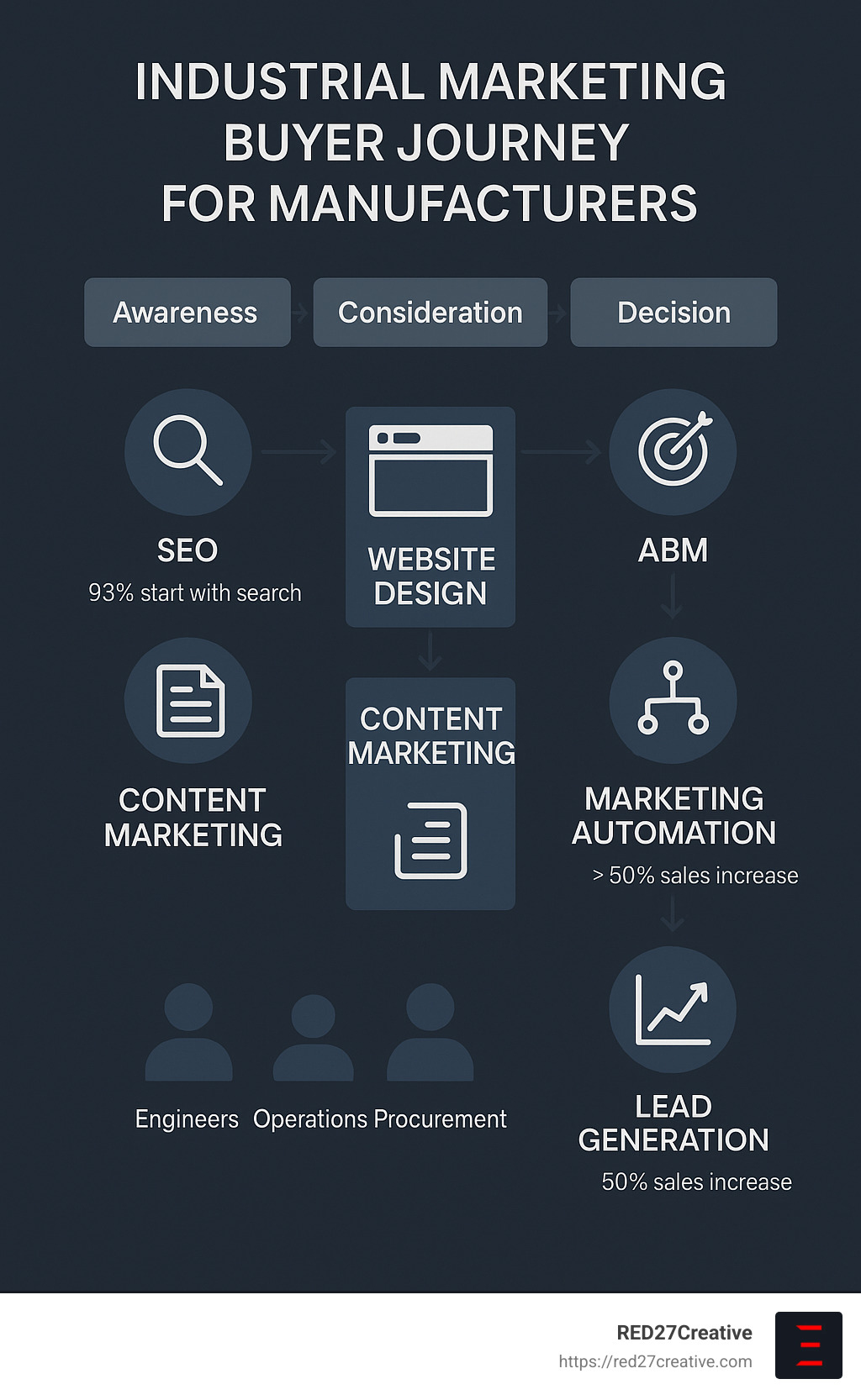
Manufacturing marketing requires a fundamentally different approach than consumer marketing. With 93% of all purchases beginning with a search engine and B2B personas making up to 12 searches before engaging with a site, manufacturers need specialized strategies that address the unique challenges of industrial sales cycles.
Only 25% of manufacturers report satisfaction with their current marketing strategy, while 42% are not thrilled and 30% are entirely dissatisfied. This disconnect highlights the need for marketing partners who truly understand the industrial landscape.
“Manufacturers often have small marketing departments, so when they look for a marketing agency, they’re really looking for a partner, an extension of their team.”
The industrial buying journey involves multiple stakeholders – from engineers and operations managers to procurement specialists. Each requires different information at different stages:
- Engineers need detailed technical specifications, tolerances, and capabilities
- Operations focus on reliability, implementation, and support
- Procurement prioritize pricing, terms, and delivery timelines
I’m Kiel Tredrea, founder of RED27Creative with over 20 years of experience developing and implementing industrial marketing services for manufacturers that drive measurable growth and establish market leadership through strategic digital initiatives.
Industrial marketing services for manufacturers word guide:
– PPC for industrial companies
– lead generation for manufacturing companies
– manufacturing digital marketing services
1. Search Engine Optimization (SEO) & Technical Site Health
Picture this: an engineer sits down at their desk, opens their browser, and types in a specific technical query. Where does your manufacturing company appear in those search results? If you’re not on page one, you might as well be invisible.
In today’s digital marketplace, SEO isn’t just a nice-to-have for manufacturers—it’s the foundation of your entire online presence. When done right, it connects your capabilities with the exact people looking for them, at precisely the moment they need you.
Why SEO Matters for Industrial Buyers
The way industrial buyers search online is fundamentally different from consumer behavior, and understanding these differences is crucial:
Engineers and procurement specialists typically conduct at least 12 searches before they’ll even consider engaging with your website. They’re thorough, methodical, and leave no stone unturned.
Their searches tend to be incredibly specific—think along the lines of “316L stainless steel fabrication with 0.005″ tolerance” rather than just “metal fabrication.” They know exactly what they need and use search engines to find it.
The industrial sales cycle stretches over weeks or months, not minutes or days. Buyers might return to search for your capabilities multiple times during their decision-making process.
And here’s the kicker—for each potential purchase, multiple stakeholders from the same company conduct separate searches, each looking at your solution through their unique lens.
I recently spoke with a manufacturing client who told me, “After launching our technical SEO program, we saw a 197% increase in quotes in Q1 compared to the previous year. The average value of quotes has also grown significantly.” That’s the power of being found when it matters most.
Best Practices & Metrics
Effective industrial marketing services for manufacturers should include these SEO fundamentals:
Start with the technical foundations—optimize your Core Web Vitals for speed and user experience, ensure your site works flawlessly on mobile (yes, engineers use phones too!), and make sure search engines can properly crawl and index all your content.
Build your website as a “Single Source of Truth” for potential buyers. This means organizing your content to answer every possible question a buyer might have, creating dedicated pages for each capability and industry you serve, and designing clear navigation paths for different buyer personas.
Implement Industrial Schema Markup to help search engines understand your technical content. This structured data format makes your specifications, certifications, and capabilities machine-readable, which can significantly improve how you appear in search results.
Don’t guess what your buyers are searching for—know it through thorough keyword research and content gap analysis. Identify high-intent technical terms, map keywords to different stages of the buyer journey, and analyze where your competitors rank to find opportunities they’ve missed.
Develop quality backlinks through industry directories like Thomasnet, relationships with trade publications, and by creating genuinely useful technical resources that others want to link to.
When measuring SEO success, look beyond just traffic numbers. Focus on:
– Your visibility in search results for target keywords
– Growth in organic traffic to technical specification pages
– RFQ form submissions that originated from organic search
– Conversion rates from search visitors to inquiries
– Revenue that can be attributed to organic search channels
One manufacturing client in Chicago experienced a 60% increase in qualified leads after we implemented a comprehensive SEO strategy focused specifically on their capabilities and industries. Their website transformed from a digital brochure into a lead-generating machine that works 24/7.
The beauty of good SEO is that it builds momentum over time. While paid ads stop the moment you stop paying, a well-optimized site continues attracting the right prospects month after month, creating a sustainable pipeline of opportunities.
According to research from Think with Google, B2B buyers are conducting more detailed research than ever before, with 71% starting with generic searches. This makes technical SEO even more critical for manufacturers looking to capture this research-heavy traffic.
More info about SEO Marketing Services
2. Conversion-Focused Website Design & UX
Have you ever visited a manufacturing website that felt like a digital filing cabinet? Too many industrial websites overwhelm visitors with technical jargon while making it nearly impossible to find what they’re actually looking for. A truly effective manufacturing website blends technical depth with intuitive user experience – creating a digital space where engineers feel right at home.
Essential Features Engineers Expect
When an engineer lands on your website, they’re on a mission. They need specific information, and they need it quickly. Through our partnerships with manufacturers across Illinois, we’ve finded what makes technical visitors convert:
Engineers absolutely need to see detailed capabilities and specifications front and center. This means showcasing your in-house equipment with actual specs (not just pretty pictures), clearly displaying your tolerance ranges, and being transparent about what materials you work with – and just as importantly, what you don’t.
Technical documentation is non-negotiable. Engineers expect downloadable CAD files they can immediately work with, comprehensive material data sheets, and easy access to your compliance certifications like ISO or AS9100. One manufacturing client told us, “After adding downloadable CAD files to our product pages, our quote requests jumped 35% in just two months.”
Nothing builds credibility like visual proof of your capabilities. Skip the generic stock photos! Real photos of your actual work, videos of your manufacturing processes, and before/after examples of complex projects tell engineers you’re the real deal.
Finally, make the path to contact crystal clear with multiple conversion options. Engineers appreciate service-specific RFQ forms (not generic “contact us” forms), multiple ways to reach you, and capability-specific call-to-action buttons on every technical page.
As one of our Chicago-based clients shared: “After redesigning our website to focus on the technical details engineers need, we saw our RFQ quality improve dramatically. Prospects were coming to us much more informed and with more specific requests.”
Optimizing for Mobile & Voice Search
While many assume engineers only research on desktops during business hours, the reality has shifted dramatically. Today’s technical buyers often begin their search on mobile devices and increasingly use voice search for quick fact-finding.
Modern industrial marketing services for manufacturers must account for these evolving behaviors through thoughtful mobile optimization. This means creating responsive designs that don’t sacrifice technical detail accessibility when viewed on smaller screens. Your RFQ forms should be touchscreen-friendly (no tiny checkboxes!), and loading times must be lightning-fast – even for technical specifications and drawings.
Voice search optimization is equally important. We implement structured data to increase your chances of appearing in featured snippets, create FAQ sections that address common technical questions in conversational language, and ensure all images have descriptive alt text explaining technical specifications.
The contrast between old-school manufacturing websites and conversion-optimized ones is stark:
| Brochure Website | Conversion-Optimized Site |
|---|---|
| Generic company overview | Capability-specific landing pages |
| General contact form | Service-specific RFQ forms |
| Stock photography | Actual work samples and videos |
| Basic “About Us” content | Detailed equipment lists and tolerances |
| PDF catalogs only | Interactive specification tools |
| Limited technical content | Comprehensive resource library |
The impact of getting this right can be transformative. One of our manufacturing clients in Aurora, IL achieved a 200% year-over-year revenue growth after implementing a conversion-focused website redesign with proper technical documentation and streamlined RFQ processes.
When your website speaks directly to the technical buyer’s needs, you’re not just another vendor – you become a trusted resource they’ll return to again and again.
3. Content Marketing & Technical Thought Leadership
Let’s face it – engineers don’t want fluffy marketing speak. They want substance, precision, and valuable information they can actually use. That’s why content marketing for manufacturers requires a completely different approach than your typical B2C content strategy.
When done right, technical content becomes your most powerful sales tool – establishing your expertise, answering critical questions, and building trust long before a prospect ever contacts your sales team.
Building Trust with Engineers
Engineers are naturally skeptical (it’s literally part of their training). They’re taught to question, verify, and validate – which means your content needs to stand up to their scrutiny.
What works? Technical depth and accuracy is non-negotiable. Content should ideally be written or reviewed by someone with engineering expertise who understands the precise terminology and industry standards. When we create content for our manufacturing clients, we ensure every specification is accurate and every claim is substantiated.
Problem-solving content resonates particularly well. Engineers are, at their core, problem solvers. Case studies that walk through real technical challenges with detailed methodologies and measurable outcomes demonstrate that you understand their world. One of our clients in Geneva, IL created a detailed material selection guide for high-temperature applications that not only generated 500+ qualified leads in six months but directly resulted in $1.2M in new business.
Educational value is your secret weapon. How-to guides that help with specification development, comparison charts for material selection, and troubleshooting resources for common manufacturing issues position your company as a trusted advisor rather than just another vendor.
The most effective types of content we’ve developed for our industrial marketing services for manufacturers include:
- Technical whitepapers that dive deep into manufacturing processes or material considerations
- Case studies documenting specific projects with real problems and measurable solutions
- Technical guides offering step-by-step instructions for complex specification challenges
- Webinars where your engineers can demonstrate expertise and answer questions live
- Data sheets providing comprehensive specifications in an easily-digestible format
Distribution Channels
Even the most brilliant whitepaper won’t generate leads if nobody sees it. Strategic distribution is just as important as content creation.
LinkedIn has become the go-to platform for industrial professionals. Beyond posting from your company page, we’ve seen tremendous success implementing employee advocacy programs where your technical team members share content with their own professional networks. The engagement rates on personal shares typically outperform company posts by 3-5x.
Industry-specific platforms like Thomasnet, trade publications, and specialized forums are where serious buyers go for information. One manufacturer we work with contributes regular articles to their industry association publication, establishing themselves as the go-to expert in their niche.
Email segmentation allows you to deliver the right content to the right person. An engineer needs different information than a procurement specialist. We help our clients develop segmented content streams based on industry, role, and stage in the buying process.
Search-optimized resource centers on your website create a destination that engineers return to again and again. Organize content by industry, application, and material, making it easy for visitors to find exactly what they need. Progressive profiling for high-value downloads helps you learn more about your visitors while providing them valuable information.
“Manufacturers often have small marketing departments, so when they look for a marketing agency, they’re really looking for a partner, an extension of their team.”
The power of technical content is perfectly captured by one of our manufacturing clients: “With Thomas running our lead generation efforts and marketing, our sales increased by 60% in just one year. Thomas maximized our company exposure, drove a record number of qualified leads, and helped us turn these opportunities directly into sales dollars.” – CJ Winter, New York
Consistency matters as much as quality. We recommend developing at least one major technical content piece quarterly, supported by more frequent blog posts and social updates. This steady drumbeat of expertise keeps you top-of-mind when purchase decisions arise.
More info about Content Marketing for Manufacturers
4. Account-Based Marketing (ABM) & Targeted Outreach
Let’s face it – not all prospects are created equal for manufacturers. Some potential clients represent game-changing opportunities while others might not be the right fit. That’s where Account-Based Marketing comes in – a powerful approach within industrial marketing services for manufacturers that helps you focus your valuable resources on the accounts most likely to become your best customers.
Think of ABM as precision manufacturing for your marketing – instead of mass producing generic messages, you’re crafting custom solutions for specific high-value targets.
Selecting & Prioritizing Key Accounts
Finding the right accounts to target is like sourcing the perfect raw material – it requires careful selection and evaluation:
Firmographic fit forms your foundation. Look at industries that align perfectly with your manufacturing specialties, company size thresholds that match your ideal customer, geographic proximity to your facilities, and growth trajectories that suggest expanding needs.
Behavioral signals tell you who’s already showing interest. When a prospect repeatedly visits your CNC machining capabilities page, downloads your technical specs, or engages with your LinkedIn content about materials innovation – they’re raising their hand. These warm signals help prioritize your ABM efforts.
Intent data gives you X-ray vision into research happening outside your website. When a company starts researching topics related to your solutions or engaging with competitors, it signals they’re actively in-market. One manufacturing client finded a major opportunity simply by tracking a prospect’s sudden increase in research around precision metal fabrication.
Opportunity potential helps you quantify the value beyond just the initial order. Consider lifetime value, expansion potential into other divisions, and strategic benefits like becoming a reference account in a new industry vertical.
I remember working with a precision machining client in Naperville who used these exact criteria to identify just 25 target accounts. Within 12 months, they’d generated $9M in pipeline opportunities from this focused approach – far more efficient than trying to market to everyone.
Multi-Touch Tactics That Work
Once you’ve identified those perfect-fit accounts, it’s time to coordinate a thoughtful, multi-channel approach that feels less like marketing and more like helpful attention:
Personalized content makes all the difference. Rather than sending generic capability brochures, develop materials that speak directly to each account’s specific challenges. One of our clients created custom landing pages for their top 10 target accounts, featuring applications and case studies from the prospect’s specific industry – resulting in a 4X higher engagement rate than generic pages.
Coordinated outreach channels ensure your message reaches the entire buying committee. While the engineer might be researching on your website, the procurement team is active on LinkedIn, and the operations lead responds best to direct contact. By coordinating LinkedIn advertising, personalized email sequences, physical capability samples, and one-to-one video messages, you create a surround-sound effect that’s hard to ignore.
Sales and marketing alignment is absolutely crucial. When these teams work in silos, ABM falls apart. The most successful manufacturers we work with have regular account strategy sessions where marketing shares engagement data and sales provides feedback on messaging effectiveness. This collaboration ensures everyone is telling the same story at the right time.
Measurement beyond basic metrics helps refine your approach. Track account engagement scoring (not just clicks), pipeline influence (not just direct attribution), and time-to-first-meeting reduction. These nuanced metrics provide a clearer picture of ABM effectiveness.
A manufacturing client in Aurora implemented what they called “capability showcase boxes” – custom-designed packages containing material samples and a personalized QR code linking to industry-specific application videos. This high-touch approach achieved a remarkable 32% response rate and generated 15 new opportunities from previously unresponsive accounts.
ABB Baldor provides another impressive example, generating $500,000 in new product orders in their first year after implementing ABM strategies and developing a B2B e-commerce platform custom to their highest-value accounts.
The beauty of ABM for manufacturers is that it mirrors what you already do best – delivering precision-engineered solutions to specific customer needs, just applied to your marketing approach.
5. Marketing Automation & CRM Alignment
In today’s complex industrial sales environment, keeping track of multiple stakeholders and lengthy sales cycles can be overwhelming. That’s where marketing automation and CRM integration shine – they’re not just nice-to-have tools, but essential components of effective industrial marketing services for manufacturers.
Think of automation as your digital sales assistant, working 24/7 to nurture leads while your team focuses on high-value conversations. When implemented correctly, these systems create a seamless experience for both your team and your prospects.
Setting Up Scalable Workflows
The journey from stranger to customer isn’t a straight line in manufacturing – it’s more like a winding road with multiple decision-makers and touchpoints along the way. Your automation system needs to account for this complexity.
Starting with initial engagement workflows makes perfect sense. When a new prospect downloads a technical specification or visits your site, a custom welcome sequence can introduce your capabilities without overwhelming them. I’ve seen manufacturers have great success with progressive profiling – gathering small pieces of information over time rather than demanding everything upfront.
Behavioral triggers are where the magic really happens. When an engineer spends time on your tolerance specifications page or downloads a whitepaper about a specific material, that’s valuable intelligence. One of our clients set up automated alerts when prospects viewed competitor comparison pages – allowing sales reps to reach out at exactly the right moment with relevant information.
The sales handoff process is often where leads fall through the cracks. Proper lead scoring based on both engagement (what they’re doing) and fit (who they are) ensures sales only receives qualified prospects. As one manufacturing client told me, “Before automation, our sales team wasted hours chasing unqualified leads. Now they focus exclusively on prospects who are actually ready to talk.”
Even after the sale, post-sale nurturing keeps the relationship growing. Customer onboarding sequences, satisfaction check-ins, and strategic cross-sell campaigns can dramatically increase lifetime value. One manufacturer we worked with in St. Charles implemented automated technical update notifications that resulted in 35% more repeat business.
For any of these workflows to function properly, your data needs to be clean and structured. This means standardizing contact properties, creating consistent industry and application taxonomies, and establishing clear definitions for buying stages. Think of this as building the foundation before constructing the house.
Measuring Pipeline Impact
The true power of marketing automation isn’t just in the efficiency it creates – it’s in the insights it provides about what’s actually working.
Conversion metrics tell you where prospects are getting stuck in your funnel. Are leads qualifying but not converting to opportunities? That might indicate a disconnect between marketing messaging and sales conversations. One manufacturer finded their MQL to SQL conversion rate was only 15% – after aligning their content more closely with sales conversations, they increased that to 42%.
Velocity measurements reveal how quickly prospects move through your pipeline. Manufacturing sales cycles are naturally longer, but automation can help identify unnecessary delays. The manufacturer in St. Charles I mentioned earlier reduced their sales cycle by 37% while simultaneously increasing their average deal size by 28% – proving that faster doesn’t have to mean smaller.
Attribution modeling helps you understand which marketing activities are truly driving revenue. Is that trade show generating quality leads, or would those budget dollars be better spent on technical content? Multi-touch attribution is especially important in manufacturing, where prospects might interact with your brand dozens of times before reaching out.
Revenue impact reporting connects all these dots to show marketing’s contribution to the bottom line. Pipeline influenced by marketing, customer acquisition costs by channel, and lifetime value metrics provide a complete picture of performance. As one client put it, “For the first time, we can confidently show our leadership team exactly how marketing is driving revenue growth.”
“After launching a new website and integrated marketing strategy with automation workflows, Duroair Technologies achieved 200% year-over-year revenue growth.”
The key to success with automation isn’t trying to build everything at once. Start with 2-3 core workflows that address your biggest pain points, then expand as your team becomes comfortable with the system. This measured approach ensures adoption and maintains data quality as you grow.
More info about Marketing Automation for Manufacturing
6. Data-Driven Lead Generation & Paid Media
While organic strategies build a solid foundation, the reality for most manufacturers is that you need leads flowing in now, not just six months from now. That’s where strategic paid media comes into play as an essential component of industrial marketing services for manufacturers.
Think of paid media as the accelerator pedal for your marketing engine. When done right, it delivers qualified prospects while your organic efforts gain momentum.
Aligning Paid & Organic Efforts
The magic happens when your paid and organic strategies work together as partners rather than separate initiatives. Here’s how we approach this integration for our manufacturing clients:
Keyword Intent Alignment makes every dollar work harder. We analyze which organic keywords are already converting well for you, then strategically bid on terms where your organic ranking needs support. For each campaign, we create dedicated landing pages that speak directly to the searcher’s intent – whether they’re looking for precision machining capabilities or specialized material fabrication.
One manufacturing client in Elgin told us, “We’d been throwing money at generic terms like ‘metal fabrication’ for years. When we shifted to bidding on specific capability terms with custom landing pages, our cost per lead dropped by 62% while quality improved dramatically.”
Remarketing Integration keeps your company top-of-mind during lengthy research phases. We develop capability-focused ad creative that follows up with website visitors based on exactly what they showed interest in. A visitor who spent time on your CNC capabilities page will see different ads than someone researching your powder coating services.
Channel Selection matters tremendously in the industrial space. While Google Ads captures high-intent search traffic, LinkedIn allows us to target specific job titles within your ideal customer profile. For complex processes that benefit from visual explanation, YouTube pre-roll ads can showcase your capabilities to technical audiences.
Budget Allocation isn’t static – it breathes with your business cycles. We adjust spending based on seasonal industry patterns, amplify visibility during new capability launches, and can quickly respond to competitive movements. This dynamic approach ensures you’re never wasting budget during slow periods or missing opportunities during peak demand.
KPIs & Continuous Improvement
The days of “set it and forget it” campaigns are long gone. Today’s industrial marketing services for manufacturers require rigorous measurement and ongoing refinement:
Performance Metrics tell the real story beyond simple click counts. We track cost per lead by source, but more importantly, we measure lead quality scores, return on ad spend (ROAS), and actual pipeline influence. One precision components manufacturer we work with tracks their campaigns all the way to closed revenue, allowing us to identify which specific ads and landing pages generate the highest-value customers.
Testing Methodology keeps campaigns fresh and effective. We regularly test different messaging approaches, industrial imagery, technical specifications in ad copy, and landing page layouts. One client saw conversion rates jump 28% simply by featuring their ISO certifications more prominently in their ads.
Quality Improvement Processes close the loop between marketing and sales. Regular feedback sessions with your sales team help us understand which leads are turning into actual opportunities, allowing us to refine targeting and messaging. This continuous feedback loop is crucial – as one client put it, “Not all RFQs are created equal, and now our marketing team understands exactly what makes a lead valuable to us.”
Scaling Strategies help you grow systematically. Once we identify your highest-performing segments, we can expand geographically, add related capabilities, or increase sophistication with sequential messaging campaigns that nurture prospects through their buying journey.
The results can be transformative. A custom machining company in Plainfield shared: “We set a record for quotes in Q1, increasing them by 197% over the previous year. The average value of quotes has grown substantially, and we’ve even received orders on the same day as the initial inquiry. Our sales team can’t believe how many quality opportunities they have now.”
The key difference between mediocre and exceptional paid media for manufacturers is specificity. Generic campaigns rarely perform well in the industrial space. Your prospects are looking for precise capabilities and solutions to technical challenges – your campaigns should speak directly to those needs.
More info about Lead Generation for Manufacturing Companies
Frequently Asked Questions about industrial marketing services for manufacturers
What is industrial marketing and how does it differ from general B2B marketing?
When we talk about industrial marketing, we’re not just talking about any business-to-business promotion. We’re talking about a specialized approach that addresses the unique challenges of manufacturing, construction, and industrial operations.
Unlike general B2B marketing, industrial marketing tackles significantly higher levels of technical complexity. Your industrial products aren’t impulse buys—they’re sophisticated solutions that engineers need to understand down to the last specification. That’s why we create content that speaks their language.
The decision-making process also looks completely different. While a typical B2B purchase might involve one or two decision-makers, industrial purchases often require buy-in from engineers, operations managers, and procurement specialists—each with their own priorities and concerns.
And patience is definitely a virtue in this space! Industrial sales cycles typically stretch 6-12 months or longer, compared to the shorter timelines in general B2B. These aren’t small investments, after all. When a company is considering your industrial solution, they’re making a significant commitment with real operational consequences.
Even the marketing channels differ, with industrial buyers frequenting specialized platforms like Thomasnet and industry trade publications rather than general business media.
This is why effective industrial marketing services for manufacturers require specialized knowledge that general marketers simply don’t have—intimate familiarity with manufacturing processes, technical specifications, and the specific challenges your customers face every day.
Which metrics prove my manufacturing marketing campaigns are successful?
Let’s be honest—impressions and page views are nice, but they don’t pay the bills. What really matters is how your marketing activities connect to actual business outcomes.
When we talk about successful industrial marketing services for manufacturers, we’re looking at metrics that directly impact your bottom line:
On the lead generation front, we track not just the quantity but the quality of leads coming through each channel. How many qualified prospects are you getting, what does each one cost you, and are they actually worth pursuing? We also look at how engineers are engaging with your technical content—are they downloading those detailed spec sheets and white papers?
But leads alone aren’t enough. The real magic happens when marketing activities create tangible sales impact. We measure increases in quote requests (both volume and value), track how marketing influences your sales pipeline, and monitor whether your sales team is closing deals faster and more frequently thanks to marketing support.
Your digital performance indicators tell us how well your online presence is working. Are technical buyers finding the specific capability pages they need? Are you ranking for the specialized keywords your ideal customers are searching for? Is your email content resonating with different industry segments?
Most importantly, we connect everything back to revenue. What’s your customer acquisition cost? How does that compare to customer lifetime value? What’s the direct revenue attribution to marketing activities? And which channels are giving you the best return on investment?
These metrics tell the real story of success—not vanity metrics that look good in reports but don’t reflect actual business growth.
How do ABM and automation integrate with existing industrial sales processes?
The best marketing technologies improve your sales processes rather than replacing them. When we implement Account-Based Marketing and automation for manufacturers, we’re looking to make your existing systems work better, not force your team to abandon what’s working.
Sales and marketing alignment is the foundation. Your marketing and sales teams should jointly select target accounts, share access to engagement data, coordinate outreach timing, and collaborate on content development. This partnership approach ensures everyone is working toward the same goals.
The technical process integration happens behind the scenes. We connect your marketing automation platform with your CRM for seamless data flow, implement automated lead scoring and routing based on your team’s definition of a qualified lead, track activities across both systems, and create unified dashboards so everyone sees the same information.
The real value comes from workflow improvements that make your sales team more effective. Imagine your reps receiving automated intelligence briefs before customer meetings, having follow-up sequences that run without manual intervention, getting content recommendations custom to each prospect’s interests, and receiving real-time alerts when high-priority accounts engage with your website.
Finally, we establish a measurement framework that creates shared accountability. Sales and marketing agree on common KPIs, jointly own pipeline metrics, meet regularly to review performance, and continuously refine the approach based on results.
The most successful implementations start small and grow organically. We begin by documenting your current sales process and identifying specific friction points where automation and ABM can add the most value. This targeted approach ensures your team accepts the new tools rather than feeling forced to adopt an entirely new system.
“After implementing our integrated ABM program, our sales team stopped seeing marketing as lead generators and started seeing them as true partners in the revenue process. Now they actually ask for marketing’s help with key accounts.” – Manufacturing Sales Director
AI-driven marketing tools are powerful, but they’re most effective when they complement your team’s expertise rather than trying to replace it.
Conclusion
The industrial marketing landscape is evolving at breakneck speed, and manufacturers who aren’t adapting their marketing strategies are finding themselves increasingly invisible to potential buyers. In this digital-first world, implementing comprehensive industrial marketing services for manufacturers isn’t just a nice-to-have—it’s become essential for survival and growth.
Here at RED27Creative, we’ve walked alongside manufacturers through these changing times. We’ve spent years in the trenches with industrial clients across Chicago, Aurora, Geneva, Batavia, St. Charles, Plainfield, Oswego, and Naperville. We understand the unique challenges you face because we’ve helped solve them time and again.
What makes our approach different? We’re obsessed with results you can actually measure:
We help manufacturers see more qualified leads flowing into their pipeline. Our clients report shorter sales cycles that convert at higher rates. And most importantly, we’re focused on improving your marketing ROI in ways that directly impact your bottom line and drive revenue growth.
Think of our approach as a finely-tuned machine with six essential components working together:
First, we build a solid foundation with technical SEO and site health improvements that make your manufacturing expertise visible to search engines. Then we create conversion-focused website designs that speak directly to engineers and procurement teams. We develop technical content marketing that establishes your thought leadership and answers the exact questions your prospects are asking.
For manufacturers with high-value opportunities, our account-based marketing strategies target ideal customers with laser precision. We implement marketing automation and CRM alignment to nurture leads efficiently through long sales cycles. And our data-driven lead generation campaigns deliver immediate results while we build long-term organic growth.
The manufacturers who are thriving today aren’t just embracing digital change on their shop floors—they’re bringing that same innovative spirit to their marketing efforts. With the right partner by your side, your industrial marketing can become a powerful engine for growth that helps you claim leadership in your market.
Are you ready to transform how your manufacturing company connects with prospects and customers? Let’s talk about how our specialized industrial marketing services for manufacturers can drive measurable growth for your business. We’re not just another marketing agency—we’re the partner you’ve been looking for.

Kiel Tredrea
https://red27creative.comTop Marketing Agency • Web, SEO & Leads • RED27Creative