How Manufacturers Can Win Big with Local SEO

Why Local Search is a Game-Changer for Manufacturers
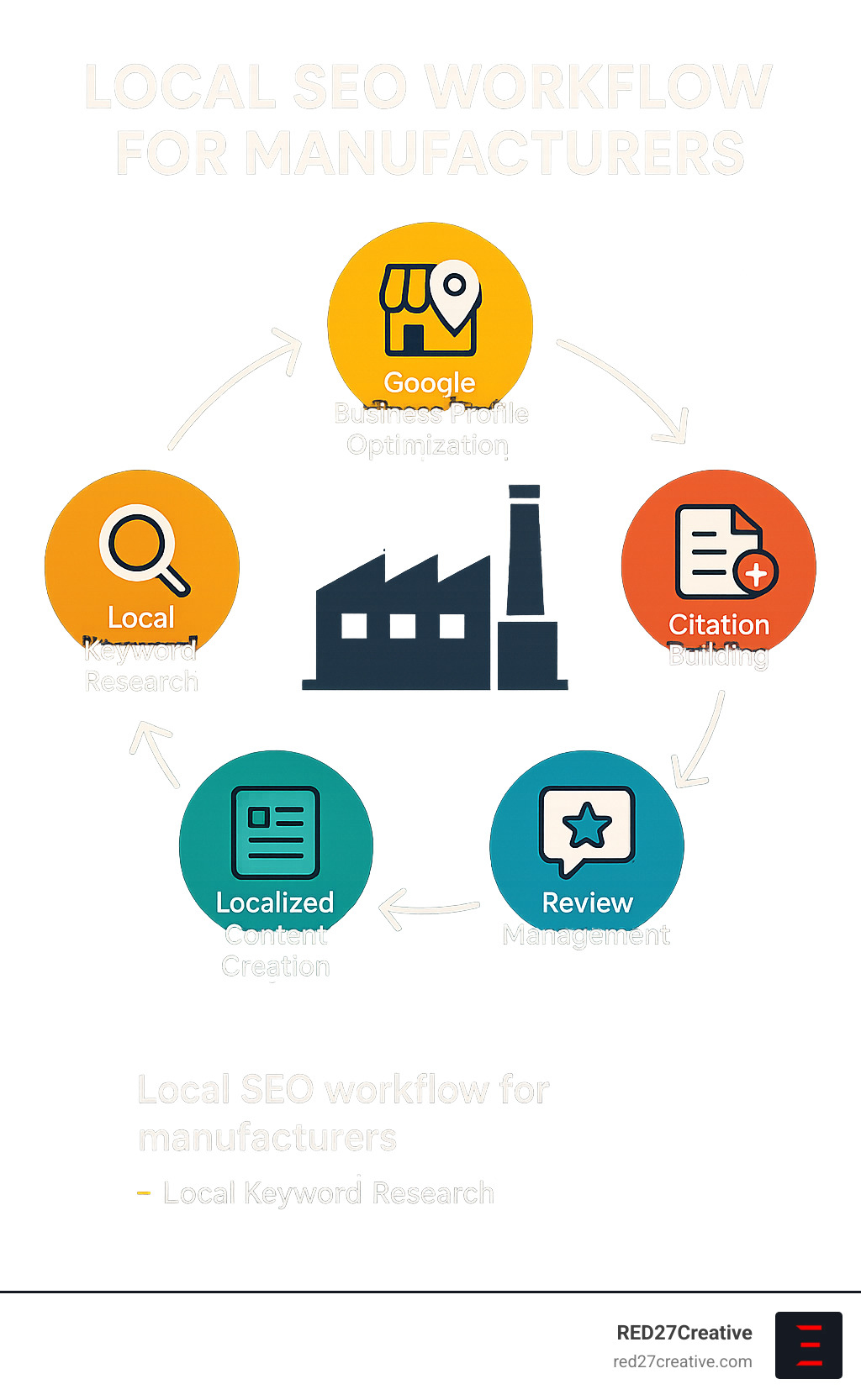
Local SEO for manufacturers is a specialized digital marketing strategy that helps manufacturing businesses increase their visibility in location-based search results. If you’re looking to attract more qualified leads from your region, here’s what you need to know:
- Claim and optimize your Google Business Profile with accurate NAP (Name, Address, Phone) information
- Target location-specific keywords like “metal fabrication in [your city]”
- Build local citations across industry directories and chambers of commerce
- Generate and respond to customer reviews to build trust signals
- Create localized content that addresses regional needs and capabilities
Manufacturing companies face unique challenges in the digital marketplace. While 84% of people searching for manufacturing services start online, many factories and production facilities miss out on valuable leads because they overlook the power of local search optimization.
Unlike traditional SEO, local SEO focuses on helping your manufacturing business appear in the coveted “Map Pack” – those three prominent business listings that appear with a map when someone searches for services in their area. For manufacturers, this visibility is critical as B2B buyers increasingly use location-based searches to find nearby suppliers, reducing logistics costs and enabling facility visits.
The impact can be substantial – one case study showed a 60% increase in quote requests after implementing targeted local SEO strategies for a manufacturing company.
My name is Kiel Tredrea, and as the founder of RED27Creative with over 20 years of experience developing high-impact marketing strategies, I’ve helped numerous manufacturing companies implement local SEO for manufacturers to drive qualified leads and outrank larger competitors in their service areas.
Local seo for manufacturers terms to know:
– advantages of search engine optimization
– international seo for manufacturers
– seo for food manufacturing companies
Understanding Local SEO for Manufacturers
When that procurement manager needs a new supplier or an engineer is hunting for a specialized manufacturing partner, where do they turn first? Their search bar. Today’s B2B buyers conduct an average of 12 searches before reaching out to any specific manufacturer. Let’s dig into what this means for your shop floor.
What Is Local SEO & How Does It Work?
Local SEO for manufacturers is like having your facility highlighted on a digital map that procurement teams actually use. It’s the art and science of making your manufacturing business more visible to potential clients searching for your specific services in your geographic area.
Think of local SEO as working on three key principles – like a three-legged stool for your online visibility. First, there’s proximity – how close is your facility to the person searching? Second comes relevance – does your business actually offer what they need? And third is prominence – has your company established enough trust signals online?
When someone types “precision machining in Aurora IL” into Google, these factors determine whether your business appears in those coveted top spots. The foundation of this visibility? NAP consistency – ensuring your Name, Address, and Phone number match exactly across every online platform where you’re listed. It seems simple, but you’d be surprised how many manufacturers get this wrong, confusing both potential customers and search engines.
Why Local SEO Beats Traditional SEO for Regional Plants
Traditional SEO might help you rank for “custom metal fabrication,” but local SEO for manufacturers helps you rank for “custom metal fabrication in Chicago” – and that difference is huge.
I’ve seen this with manufacturing clients. When someone searches with local intent, they’re typically further along in their buying journey. They’re not just researching – they’re looking to engage with actual suppliers in their area. These hyper-local queries signal high purchase intent and readiness to request quotes.
The competition angle is also compelling. Instead of battling every manufacturer nationwide for generic terms, you’re only competing with businesses in your service area. One client told me, “It’s like going from competing in the Olympics to competing in your local league – suddenly winning seems possible.”
Local leads are simply better quality for manufacturers. Proximity matters in manufacturing partnerships – logistics costs, facility visits, quality audits, and response times all improve when working with nearby partners. And these local buyers move faster, often progressing from search to facility tour to RFQ in days rather than weeks or months.
Key Benefits Manufacturers Can Expect
When we implement local SEO for manufacturers, our clients see real, measurable results. Appearing in Google’s Map Pack (those three businesses that appear with the map) can skyrocket your visibility – increasing click-through rates by up to 700% compared to standard organic results.
The phone rings more often, too. Studies show 88% of consumers who search locally on their smartphone visit or call a business within 24 hours. For manufacturers, this translates to more qualified inquiries about your capabilities and capacity.
What’s particularly exciting is the competitive advantage this creates. Many manufacturing companies still haven’t fully acceptd digital marketing, creating a perfect opportunity for forward-thinking businesses. As one client put it, “While our competitors were still relying solely on trade shows, we were capturing leads through local search every single day.”
Local SEO doesn’t replace word-of-mouth; it amplifies it. When someone gets a referral to your business, what’s the first thing they do? They Google you. Strong local SEO ensures they find you easily and see positive signals that reinforce that recommendation.
The results speak for themselves. One manufacturing company we worked with saw a 626% year-over-year increase in sales after implementing local SEO strategies. Another experienced a 126% jump in quote requests following a focused local search campaign.
Want to understand more about the broader advantages of search optimization? Check out our comprehensive guide on the advantages of search engine optimization.
Optimizing Your Google Business Profile (GBP)
Think of your Google Business Profile as your digital storefront – it’s often the first impression potential clients get when they’re looking for manufacturing services in your area. For manufacturers focused on attracting local business, your GBP isn’t just another online listing – it’s the cornerstone of your entire local SEO for manufacturers strategy.
Step-by-Step GBP Setup
Getting your Google Business Profile right doesn’t have to be complicated. Start by claiming and verifying your profile through Google’s simple process – you’ll typically receive a postcard with a verification code to confirm you’re the legitimate business owner.
When selecting categories, be specific rather than general. Instead of just “Manufacturer,” choose precise categories like “Metal Fabricator” or “Plastic Injection Molder” that truly reflect your specialty. Add secondary categories too – this helps you appear in more relevant searches.
Don’t forget to clearly define your service areas. If you’re serving Geneva IL, Batavia IL, Aurora IL, and St. Charles IL, make sure to list all these locations. This precision helps you connect with buyers specifically looking for manufacturing services in those areas.
Your business description deserves special attention – weave in local keywords naturally while highlighting what makes your manufacturing capabilities unique. Complete every available field, including your hours, services, and any special attributes like “Veteran-owned” or “Woman-owned” that might set you apart.
Smart manufacturers also add UTM tracking to their website links, making it easy to measure exactly how many leads come directly from their Google Business Profile. And don’t skimp on photos – high-quality images of your facility, equipment, team, and finished products build trust and show prospects what you’re capable of.
Need more hands-on help with managing your local listings? Our Local SEO Listings Management service takes care of all these details for you.
Leveraging Reviews & Q&A for Trust
In the manufacturing world, trust is everything. Your Google reviews act as digital word-of-mouth that can make or break a potential client’s decision to contact you. That’s why review management is such a critical aspect of local SEO for manufacturers.
Develop a consistent approach to generating reviews – perhaps by sending a friendly follow-up email after completing a project. The key is making it easy for satisfied clients to share their positive experiences. When those reviews come in (good or bad), respond promptly – ideally within 24-48 hours. This shows you’re attentive and care about client feedback.
While having response templates handy can save time, always personalize each reply. A genuine “Thanks for trusting us with your precision machining project, Tom” feels much more authentic than a generic “Thank you for your review.”
Even negative reviews present an opportunity. By addressing concerns professionally and outlining steps you’ve taken to improve, you demonstrate your commitment to quality – something manufacturing buyers particularly value.
The Q&A section of your profile is another goldmine. Don’t wait for questions to trickle in – proactively add and answer common questions about your capabilities, specializations, and processes. This not only helps your SEO but also addresses potential concerns before they become roadblocks in the buying process.
GBP Post Strategy to Stay Top-of-Mind
Keeping your Google Business Profile active with regular posts signals to both Google and potential clients that your manufacturing business is thriving. A dormant profile can raise questions about whether you’re still operating at full capacity.
Share updates about your newly acquired 5-axis CNC machine or that impressive aerospace certification you just earned. These equipment and capability announcements demonstrate your commitment to quality and innovation.
Recently completed a complex manufacturing project with impressive tolerances? Create a post highlighting this achievement (with client permission, of course). Product highlights give prospects a concrete example of what you can deliver.
Don’t be shy about promoting your presence at upcoming industry trade shows or inviting local businesses to facility tours. These event updates create opportunities for face-to-face connections – still incredibly valuable in the manufacturing world.
Educational content performs particularly well – perhaps a quick guide on material selection for specific applications or design considerations that can reduce production costs. These helpful posts position your company as a knowledgeable partner rather than just another vendor.
Team spotlights humanize your manufacturing business, while seasonal offers (like quick-turn services during peak periods) can generate immediate interest.
Aim to post weekly, always including a quality image that showcases your manufacturing expertise. This consistent activity keeps your profile fresh and engaging, boosting your visibility when procurement managers search for manufacturing partners near them.
Local Keyword Research & Content That Converts
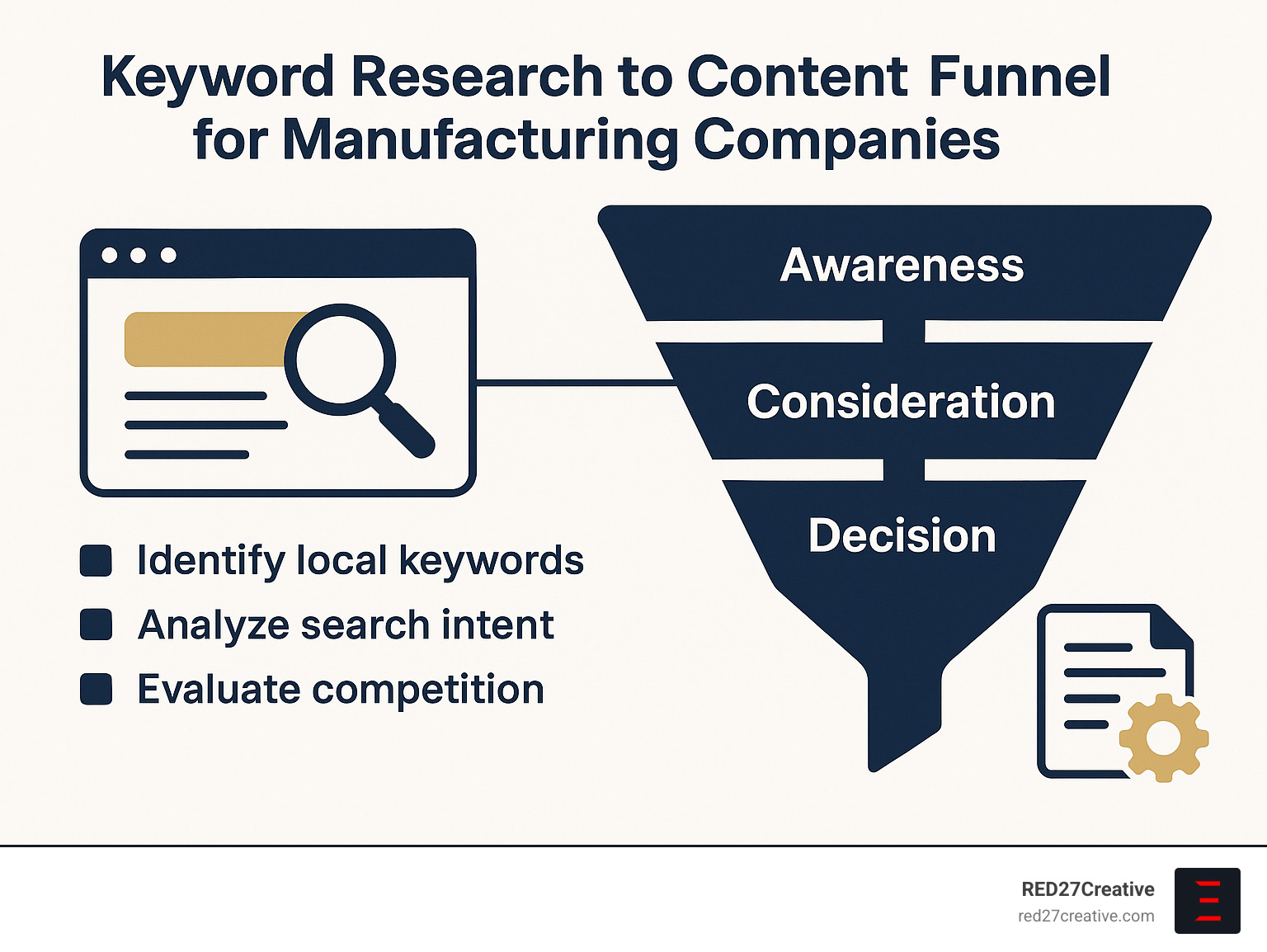
When it comes to local SEO for manufacturers, finding the right keywords is like finding the secret language your customers speak. Unlike retail shoppers, manufacturing buyers tend to use highly technical terms mixed with location-specific phrases. This is where the magic happens – when you speak their language, they find you.
Finding the Right Local Manufacturing Keywords
Imagine you’re a procurement manager looking for a metal fabricator near Aurora. What would you type into Google? Probably something like “precision sheet metal fabrication Aurora IL” or maybe “custom metal fabricator near me.” These are gold mines for your keyword strategy.
Start by listing all your core manufacturing capabilities – CNC machining, injection molding, powder coating – whatever services make your shop hum. Then, add those local touches that transform a general search into a local one. Think “metal stamping in Chicago” or “custom machining Geneva IL.”
Google itself can be your research assistant here. Type in some of your services and watch the autocomplete suggestions pop up. These are actual searches people are making! The “People Also Ask” boxes are equally valuable, showing you exactly what potential customers want to know.
For the data-driven manufacturer, tools like SEMrush, Ahrefs, or Google’s Keyword Planner can reveal search volumes and competition levels. But don’t overlook your sales team – they hear the language prospects use when describing what they need.
I’ve seen manufacturing buyers search for incredibly specific terms like “aluminum die casting for aerospace enclosures in Chicago with ±0.005″ tolerances.” These highly technical, location-specific phrases might have lower search volume, but they signal serious buying intent.
Turning Keywords into High-Converting Pages
Now that you’ve identified those golden keywords, it’s time to create content that not only ranks well but actually converts visitors into quote requests.
Your service pages should be the workhorses of your site. Create a dedicated page for each core manufacturing capability, optimized for local terms. Don’t just list features – explain how your precision machining services benefit medical device manufacturers in the Chicago area, or how your rapid prototyping capabilities help Aurora’s automotive suppliers speed up production.
Technical details matter enormously in manufacturing. Include specification tables showing materials, tolerances, and capabilities. Your prospect might be an engineer who needs to know if you can handle 316L stainless steel with specific surface finish requirements.
Case studies are particularly powerful for manufacturers. They demonstrate not just what you can do, but what you have done. Share stories (with permission) of how you solved production challenges for local clients. These build credibility while reinforcing your local presence.
Every page should make it easy for potential clients to take the next step. Clear calls-to-action, simple RFQ forms, and click-to-call phone numbers remove friction from the conversion process. In manufacturing, a single conversion can mean hundreds of thousands in revenue.
For more comprehensive strategies on creating content that resonates with manufacturing buyers, check out our Content Marketing for Manufacturers guide.
Creating Supporting Localized Assets
Beyond your core service pages, supporting content helps establish your authority and reinforces your local presence. Think of these as the conversations you might have with a prospect touring your facility.
Blog articles addressing regional manufacturing challenges perform exceptionally well. Topics like “How Illinois Manufacturers Are Navigating New Emissions Standards” or “Material Selection Guide for Midwest Weather Conditions” demonstrate both your expertise and your understanding of local concerns.
Video content has become increasingly important for manufacturers. A virtual tour of your facility can be the next best thing to an in-person visit. Show your equipment in action, highlight your quality control processes, and introduce the skilled team that makes it all happen. These videos create trust and familiarity before a prospect ever walks through your door.
Sustainability stories resonate strongly with today’s buyers. Content about your local environmental initiatives – whether it’s your solar panel installation, waste reduction programs, or community partnerships – showcases your values while strengthening local connections.
FAQ pages might seem basic, but they’re SEO powerhouses. They directly answer the questions your prospects are asking, from delivery capabilities to specific areas to compliance with local regulations. Structure these with clear questions and concise answers for maximum search visibility.
Industry guides custom to regional needs can position you as the go-to resource. A “Manufacturing Partner Guide for Chicago Medical Device Startups” might not drive huge traffic, but it will attract exactly the kind of high-value prospects you want.
All this content should feel natural and helpful, not forced or keyword-stuffed. The best local SEO for manufacturers doesn’t feel like SEO at all – it just feels like exactly what the customer was looking for.
Building Authority: Citations, Backlinks & Reviews
Let’s face it – if you want your manufacturing business to show up when local buyers search online, you need some street cred with Google. That’s where citations, backlinks, and reviews come in. Think of these as your digital reputation builders that tell search engines, “Yes, this manufacturer is the real deal!”
Citation Consistency Checklist
Ever had a customer call the wrong number looking for you? That’s what happens when your business information is inconsistent online. For effective local SEO for manufacturers, your Name, Address, and Phone number (NAP) must be identical everywhere.
Start with a thorough NAP audit. Is your company “ABC Manufacturing, Inc.” on your website but just “ABC Mfg.” on Yelp? These small inconsistencies can confuse both search engines and potential customers.
Your citation strategy should focus on quality directories where manufacturing buyers actually look. Beyond Google Business Profile, make sure you’re listed on industry powerhouses like ThomasNet and MFG.com, as well as your local chambers in places like Geneva IL, Batavia IL, and Aurora IL.
Tools like Whitespark, BrightLocal, and Moz Local can save you countless hours managing these listings. They’ll help identify where your information is missing or incorrect, and streamline the update process.
Manufacturing-specific directories deserve special attention. Being listed on Thomasnet.com, GlobalSpec, or MacRAE’s Blue Book isn’t just good for SEO—these are actual sourcing platforms where procurement managers look for suppliers. One of our clients saw a 34% increase in qualified leads after simply cleaning up inconsistent citations across these platforms.
Earning Local & Industry-Relevant Backlinks
When it comes to backlinks for local SEO for manufacturers, quality trumps quantity every time. One link from your regional manufacturing association carries more weight than dozens from random websites.
Local organization memberships provide natural backlink opportunities. Your Chamber of Commerce website, economic development organizations, and trade groups typically list member businesses with links to their websites. These are golden opportunities that many manufacturers overlook.
Share your expertise through guest articles and thought leadership. Local business publications and industry trade magazines are always looking for expert insights. One manufacturing client contributed a technical article to an industry publication that not only earned a valuable backlink but also positioned them as thought leaders, resulting in several high-value inquiries.
Educational partnerships can be particularly powerful for manufacturers. Technical schools, community colleges, and university engineering departments make excellent backlink sources. Consider offering facility tours, speaking opportunities, or apprenticeship programs that can lead to mentions on educational websites.
Don’t forget the connections you already have. Your suppliers and customers may be willing to feature you in their vendor directories or case studies. One manufacturer we worked with gained six quality backlinks simply by asking their top customers if they could be featured in their “trusted partners” section.
As one SEO expert puts it, “A single relevant, authoritative backlink can outweigh dozens of low-quality links.” For manufacturers, this couldn’t be more true.
Managing & Amplifying Customer Reviews
Reviews aren’t just nice to have—they’re essential trust signals that influence both search rankings and buying decisions. A systematic approach to generating and managing reviews can significantly boost your local SEO for manufacturers.
Create a simple review generation system that doesn’t feel forced. After successfully completing a project, have your account manager personally ask for feedback. A simple email template that says, “We value your opinion and would appreciate if you could share your experience working with us on Google” can work wonders.
While Google reviews should be your primary focus, don’t neglect industry-specific platforms. A glowing review on ThomasNet might actually bring more qualified leads than several generic reviews elsewhere.
How you respond to reviews matters just as much as getting them. Thank positive reviewers specifically for what they mentioned (“Thanks for highlighting our quick turnaround time on your custom parts!”). For negative reviews, respond professionally, acknowledge concerns, and take the conversation offline to resolve issues.
One manufacturer we worked with implemented a simple review request email that went out two weeks after project completion. Within six months, they increased their Google reviews from 7 to 42, which coincided with a noticeable boost in Map Pack visibility for local searches.
Reviews aren’t just for SEO—they provide valuable feedback. Use review sentiment analysis to identify patterns. Are customers consistently praising your quality control? Make that a centerpiece of your marketing. Are there recurring complaints about communication? That’s an opportunity for process improvement.
With a strong foundation of consistent citations, quality backlinks, and positive reviews, your manufacturing business will build the authority needed to dominate local search results—and more importantly, to earn the trust of potential customers in your service area.
Technical & Mobile Factors That Influence Local Rankings
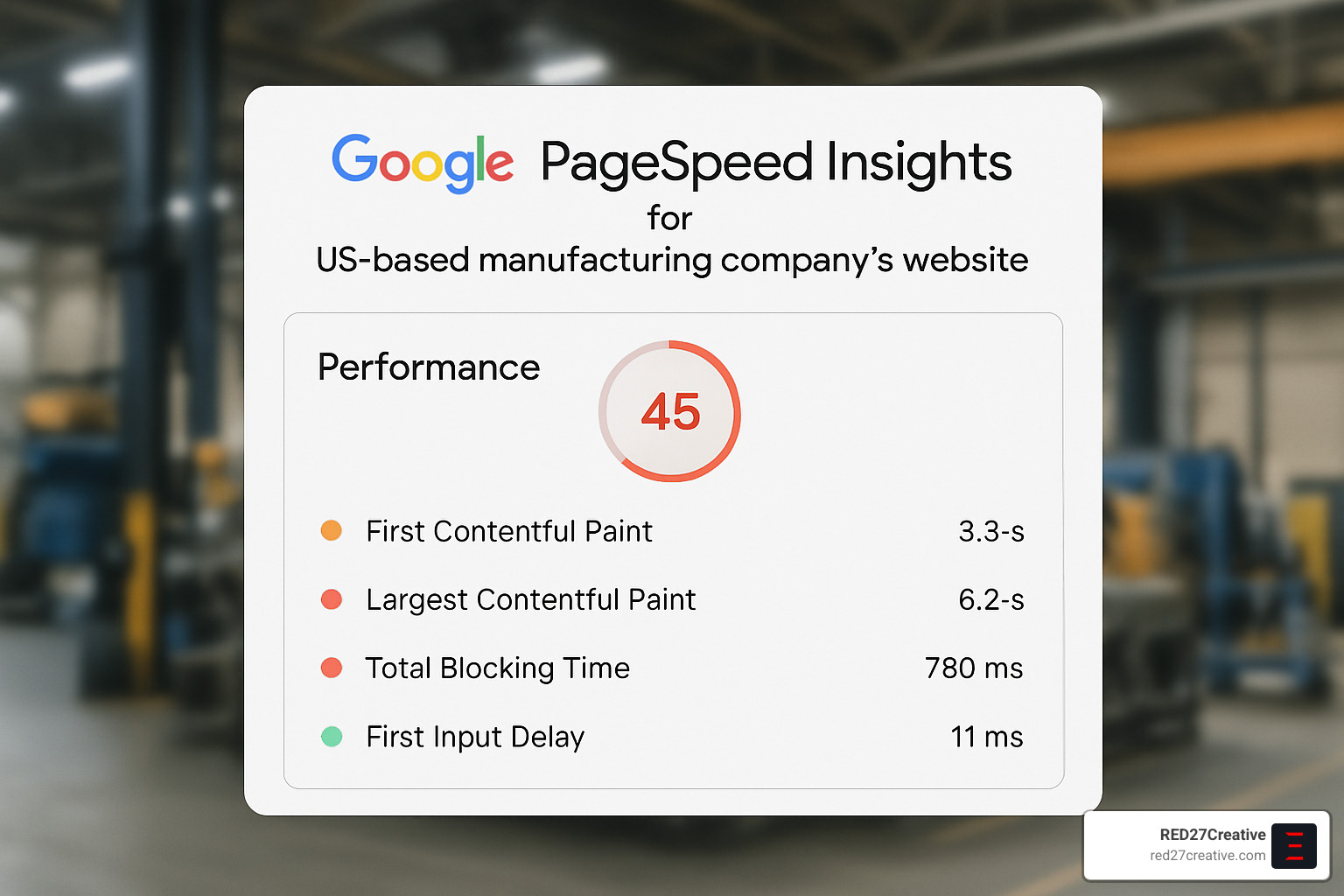
Let’s talk about something that might sound a bit technical but is absolutely critical to your success with local SEO for manufacturers – your website’s performance. Think of your website as your digital factory floor. Just like you wouldn’t invite potential clients to tour a slow, disorganized facility, you don’t want them visiting a clunky, frustrating website.
Site Speed & Core Web Vitals
Did you know that when your website takes too long to load, you’re literally watching potential customers walk away? It’s true – a one-second delay in page load time can reduce conversions by 7%. Even worse, industrial websites lose a staggering 88% of visitors when pages load too slowly. That’s like having 9 out of 10 potential customers turn around at your door before even seeing what you offer!
Making your manufacturing website lightning-fast isn’t just nice to have – it’s essential. Start by taking a good look at your images. Those beautiful, high-resolution photos of your equipment and facility are important, but they need to be properly optimized. Use modern formats like WebP, resize them appropriately, and implement lazy loading so visitors aren’t waiting for images they haven’t scrolled to yet.
Next, let’s talk about caching – think of it as preparing common materials ahead of time rather than starting from scratch with each new order. Browser caching, server-side caching, and Content Delivery Networks (CDNs) can dramatically improve load times.
Your website’s code is another area worth streamlining. Just like you’d eliminate unnecessary steps in your manufacturing process, you should remove unnecessary plugins and minify your CSS, JavaScript, and HTML. It’s like decluttering your digital workspace.
Google’s Core Web Vitals are the key metrics that matter most. Largest Contentful Paint should be under 2.5 seconds (how quickly your main content appears), First Input Delay under 100 milliseconds (how responsive your site is when someone clicks something), and Cumulative Layout Shift below 0.1 (elements not jumping around as the page loads). Check your performance regularly using Google’s PageSpeed Insights Tool and make improvements based on what you find.
Mobile Experience for On-Site Visitors
Here’s a reality check: 59% of U.S. mobile users are searching for your manufacturing business on the Google Search app, and 74% are more likely to return to mobile-friendly sites. Your potential clients aren’t just sitting at desks anymore – they’re looking for manufacturing partners while on job sites, in meetings, or commuting.
Your website needs to look great and function perfectly on everything from a 27-inch monitor to a smartphone screen. Responsive design isn’t a luxury – it’s as essential as having reliable equipment on your shop floor. When a procurement manager pulls out their phone to check your capabilities during a meeting, that experience needs to be seamless.
Pay special attention to tap targets – those buttons and links need to be large enough for human fingers (at least 48×48 pixels) with adequate spacing between them. Nothing frustrates a mobile user more than accidentally hitting the wrong button because things are too cramped.
If you’re using forms to capture RFQs (and you should be!), simplify them for mobile users. Nobody wants to fill out a 20-field form on a smartphone. Use appropriate input types so the right keyboard appears, enable autofill where possible, and consider breaking complex forms into manageable steps.
Don’t just assume your site works well on mobile – test it! Use Google’s Mobile-Friendly Test as a starting point, but also grab different devices and see how your site performs. Better yet, watch actual users interact with your site on their phones – you’ll be surprised what you learn.
And please, make your phone number tappable! When someone searches for “metal fabricator near me” and finds your business, they should be able to call you with one tap. It sounds simple, but you’d be amazed how many manufacturers miss this easy win.
Local Schema & Tracking Setup
Now let’s get a little more technical, but I promise it’s worth understanding. Schema markup is like providing a detailed specification sheet for Google – it helps search engines understand exactly what your business does and where you’re located.
LocalBusiness schema markup should include your NAP (Name, Address, Phone) information, business hours, service areas, and the specific manufacturing services you offer. This structured data helps Google confidently show your business for relevant local searches.
Don’t stop there – implement additional schema types that make sense for your manufacturing business. Product schema for your manufactured items, Service schema for your capabilities, FAQ schema for common questions, and Organization schema with your logo and contact information all help search engines better understand and represent your business.
Proper tracking is equally important. Set up Google Analytics 4 with conversion goals so you know exactly which local SEO for manufacturers efforts are paying off. Configure Google Search Console to monitor your search performance and identify opportunities for improvement.
Call tracking is particularly valuable for manufacturers since many inquiries still come through phone calls. Implement dynamic number insertion to track which marketing channels are driving calls, record call duration to assess quality, and integrate with your CRM to maintain a complete picture of your lead generation efforts.
Finally, don’t forget UTM parameters for your campaigns. These special tracking codes help you understand where your traffic is coming from – whether it’s your Google Business Profile, industry directories, email campaigns, or social media.
Yes, technical optimization requires some effort, but it forms the foundation of effective local SEO for manufacturers. By addressing these elements, you’re not just improving your search rankings – you’re providing a better experience for the exact people you want to turn into customers. And in manufacturing, where every qualified lead counts, that makes all the difference.
Measuring ROI, Overcoming Challenges & Avoiding Mistakes
Let’s face it – investing in local SEO for manufacturers is only worthwhile if you can actually see results. As a manufacturing company, you need to know that your marketing dollars are working hard for you, bringing in quality leads that turn into profitable projects.
Tracking the Metrics That Matter
The beauty of digital marketing is that almost everything is measurable. When it comes to local SEO, here’s what you should be watching:
Your Google Business Profile tells an important story – track how many people are finding you there, what actions they’re taking, and whether they’re clicking for directions to your facility. This is often your first touchpoint with potential clients.
On your website, pay attention to where your visitors are coming from geographically. Are you seeing increases in traffic from the specific areas you’re targeting? A manufacturing company in Aurora might see growing visits from neighboring Naperville or Batavia – a good sign your local strategy is working.
But traffic alone doesn’t pay the bills. What really matters is conversion tracking – are those website visitors becoming leads? Set up proper tracking for RFQ submissions, phone calls, and email inquiries. One manufacturing client of ours finded that while their overall traffic wasn’t enormous, their conversion rate from local searches was nearly triple their industry average.
To truly understand ROI, you need to connect these leads to your CRM and track them through to closed business. Our Lead Generation for Manufacturing Companies approach helps manufacturers create this closed-loop reporting so you can see exactly how much revenue your local SEO is generating.
Common Local SEO Pitfalls for Manufacturers
Even well-intentioned manufacturers can sabotage their own local SEO efforts. Here are the mistakes I see most often:
Creating duplicate location pages is a common misstep. I recently worked with a metal fabricator who had created nearly identical pages for 12 nearby suburbs, simply changing the city name. Google quickly identified this as duplicate content and actually penalized their rankings.
Thin content is another killer. Your service pages need substantial, technical information that demonstrates your expertise. Generic descriptions of “quality manufacturing services” won’t cut it – include specifications, materials, tolerances, and equipment capabilities.
NAP inconsistency continues to plague manufacturing websites. When your company name, address and phone number vary across the web (even slightly), it confuses search engines and weakens your local authority. I’ve seen rankings dramatically improve after simply standardizing how a company’s name appears online.
Many manufacturers also neglect their reviews. Potential clients read these closely, and search engines factor them into rankings. A negative review without a response can be a major red flag for prospects.
Beating National Competitors on Your Home Turf
The good news? You don’t need to be the biggest manufacturer to win at local search. In fact, smaller regional operations often have advantages over national corporations.
Focus on those longer, location-specific keywords that the big players might overlook. While they target “metal fabrication,” you can dominate “precision sheet metal fabrication in Aurora IL for medical devices.” These longer phrases often have higher conversion rates because they match exactly what the searcher needs.
Your local knowledge is a powerful differentiator. Highlight your understanding of regional regulations, showcase your community involvement, and emphasize the logistical advantages of working with a nearby manufacturer. One client of mine regularly features content about how their location near major highways reduces shipping costs for Chicago-area customers.
Speed and personalized service are your secret weapons. When your team can offer same-day quotes or facility tours while national competitors route inquiries through multiple departments, make sure your content emphasizes this agility. As one manufacturing client puts it on their website: “While other manufacturers put you on hold, we put you on the schedule.”
By avoiding common pitfalls and leveraging your local advantages, even modest-sized manufacturing operations can achieve impressive results through strategic local SEO for manufacturers. The digital playing field has never been more level – you just need to know how to play the game.
Frequently Asked Questions about Local SEO for Manufacturers
What is the fastest way to improve my local rankings?
Looking for a quick win with your local SEO? Start with your Google Business Profile. While comprehensive local SEO for manufacturers is more of a marathon than a sprint, your GBP can deliver relatively fast results.
The secret is simple: complete every section of your profile with accurate details, upload high-quality photos of your manufacturing facility and equipment, and begin actively collecting customer reviews. Don’t forget to post regular updates highlighting your latest projects or manufacturing capabilities.
Many of our manufacturing clients see noticeable improvements within just a few weeks of implementing these GBP optimizations, even while other aspects of their local SEO strategy are still developing.
How many reviews do manufacturers need to appear in the map pack?
There’s no magic number that guarantees map pack placement, but I typically recommend manufacturing businesses aim for at least 5-10 quality reviews as a solid foundation. What really matters isn’t just quantity—it’s quality, recency, and relevance.
A thoughtful review that specifically mentions your precision machining capabilities or quick turnaround times carries far more weight than several generic “great service” comments. And while there’s no minimum star requirement, maintaining at least a 4.0-star average is essential in the manufacturing sector, where quality standards are understandably high.
Review generation should be an ongoing process, not a one-time push. Fresh reviews signal to Google that your business continues to provide value to customers.
Can local SEO help if I ship nationwide?
Absolutely! Even manufacturers who ship across the country benefit tremendously from local SEO for manufacturers strategies. Think of your local presence as the foundation that supports your broader reach.
I’ve worked with numerous manufacturing clients who initially questioned the value of local SEO for their nationwide operations, only to find it created multiple advantages. A strong local presence builds credibility that extends to wider markets. Many B2B buyers prefer working with manufacturers who have an established local footprint—even when shipping is involved—because it enables facility visits, face-to-face meetings, and typically faster response times.
Plus, dominating your local market is often easier than competing nationally right away, making it a strategic first step in expanding your digital footprint.
How is local SEO different from traditional SEO for manufacturers?
While traditional SEO and local SEO share some common elements, they differ in significant ways that matter to manufacturers. Traditional SEO aims to rank your site nationally for manufacturing terms, while local SEO for manufacturers targets searches with geographic intent.
The key differences include your keyword approach (targeting “metal fabrication in Chicago” rather than just “metal fabrication”), heavy emphasis on Google Business Profile optimization, consistent NAP information across online directories, strategic review management, and creating content that speaks to regional industries and manufacturing needs.
Think of traditional SEO as casting a wide net, while local SEO is more like fishing in a specific pond where you know exactly what the fish are biting. For most manufacturers, the best approach combines elements of both strategies.
How long does it take to see results from local SEO?
I always tell our manufacturing clients to expect a gradual but steady improvement in their local visibility. Most companies begin seeing measurable results within 3-6 months, starting with improved map pack visibility, increased Google Business Profile views, and growing website traffic from local searches.
However, the full impact—particularly significant increases in qualified leads and conversions—typically takes 6-12 months of consistent effort. The timeline varies based on your starting point, the competition in your manufacturing niche, and how comprehensively you implement your strategy.
Local SEO isn’t a quick fix, but rather a sustainable approach to building your manufacturing company’s digital presence. The manufacturers who see the best results are those who commit to the process and maintain their efforts over time.
Should manufacturers focus on Google or other search engines for local SEO?
With Google commanding over 90% of the search market, it makes sense to prioritize your efforts there. I recommend manufacturing companies dedicate about 80-90% of their local SEO for manufacturers efforts to Google optimization, including your Google Business Profile, Google Maps presence, and Google Search visibility.
That said, don’t completely ignore other platforms. The remaining 10-20% of your efforts should address Bing Places and industry-specific directories relevant to your manufacturing specialties, like Thomasnet or MFG.com.
The good news is that most strategies that work well for Google translate effectively to other search engines, so your efforts won’t be wasted. By focusing primarily on Google while maintaining a presence on other platforms, you’ll create a comprehensive local search presence that captures business from multiple sources.
Conclusion
Let’s face it – in today’s digital-first world, local SEO for manufacturers isn’t just another marketing checkbox. It’s become absolutely essential for growth and staying competitive in your region.
Throughout this guide, we’ve explored how manufacturers who invest in local search optimization gain real advantages: better visibility when it matters, higher-quality leads who are actually looking for your specific services, and ultimately, more conversions from search to signed contracts.
The manufacturing sector has traditionally been a bit slower to accept digital marketing strategies compared to other industries. This actually creates a fantastic opportunity for forward-thinking companies like yours. With 84% of potential customers beginning their search for manufacturing services online, and B2B buyers typically conducting a dozen searches before reaching out to any company, your position in local search results directly impacts your revenue.
Here at RED27Creative, we’ve had the privilege of helping manufacturers throughout Illinois—from the communities of Geneva and Batavia to Aurora, Chicago, and beyond—implement practical, results-driven local SEO for manufacturers strategies. We’ve seen how these efforts generate qualified leads and help regional manufacturers outshine even their largest competitors.
Local SEO for manufacturers isn’t a one-time project you can simply check off your list. It’s an ongoing process that rewards consistent attention and refinement. The manufacturing companies seeing the greatest success are those treating local SEO as a fundamental component of their overall growth strategy—not just a marketing afterthought.
Are you ready to transform your manufacturing company’s local search presence? Our team at RED27Creative would love to discuss how our SEO marketing services can help you dominate those local search results and bring more qualified leads right to your door. With our specialized expertise in manufacturing marketing and proven track record of success, we’re uniquely equipped to help your business thrive, even in today’s competitive manufacturing landscape.
After all, when local buyers can find you easily, tour your facility, and experience your capabilities firsthand, you’ve already won half the battle. Let’s make sure they find you first.

Kiel Tredrea
https://red27creative.comTop Marketing Agency • Web, SEO & Leads • RED27Creative