Email Marketing for Manufacturers: Tips to Triumph
Maximizing ROI with Manufacturing Email Marketing
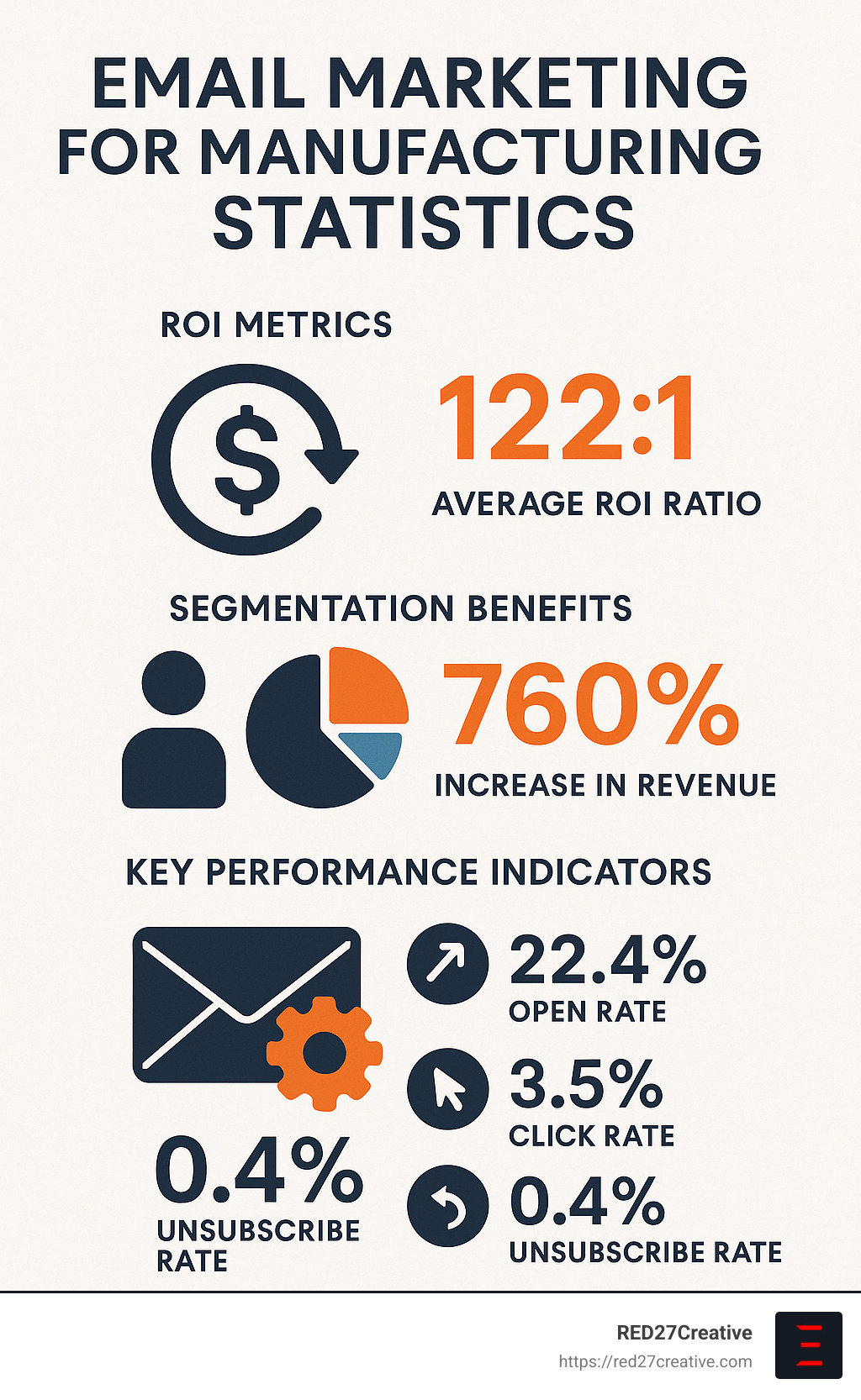
Email marketing for manufacturing is one of the most cost-effective digital strategies for industrial companies, delivering an average ROI of $42 for every $1 spent. If you’re looking to implement effective email marketing in your manufacturing business, here are the key elements to focus on:
- Segmentation: Divide your list by industry, job role, and purchase history for 30% higher open rates
- Technical Content: Create valuable, industry-specific content that addresses pain points
- Mobile Optimization: Ensure emails are mobile-friendly as 51% of emails are opened on mobile devices
- Personalization: Use recipient-specific data to increase click-through rates by up to 28%
- Compliance: Follow GDPR, CAN-SPAM, and other regulations to maintain list integrity
In today’s competitive manufacturing landscape, generic mass emails no longer cut it. Your prospects and customers expect targeted, relevant communications that speak directly to their specific challenges and needs. With 99% of consumers checking their email daily, this channel offers manufacturers a direct line to decision-makers that few other marketing methods can match.
Manufacturing companies face unique email marketing challenges: longer sales cycles, multiple stakeholders in purchasing decisions, and the need to convey complex technical information in an engaging way. Yet these same challenges create opportunities when addressed strategically.
“First impressions really do matter: Studies have shown that over a third of email recipients decide whether to open an email solely based on the subject line.”
Your manufacturing email database degrades by approximately 22.5% every year, making consistent list-building and maintenance crucial for sustained success. Meanwhile, the competitive industrial sector demands that your content stands out in crowded inboxes where recipients spend just 51 seconds reviewing an email campaign.
I’m Kiel Tredrea, founder of RED27Creative with over 20 years of experience helping manufacturing clients develop and implement email marketing for manufacturing strategies that drive measurable revenue and establish market leadership.
Terms related to Email marketing for manufacturing:
- Marketing automation for manufacturing
- Web design for manufacturing companies
- generating b2b leads for manufacturing
Email Marketing for Manufacturing: Challenges and Opportunities
When it comes to marketing in the manufacturing sector, email stands out as a powerhouse channel. Despite the rise of newer digital marketing methods, email remains the backbone of effective B2B communication for manufacturers. Let’s explore why this is the case and how you can leverage it to your advantage.
Challenges in Email Marketing for Manufacturing
The manufacturing world has its own unique set of problems when it comes to email marketing. I’ve seen these challenges working with dozens of industrial clients over the years.
Complex Sales Cycles create a marathon rather than a sprint scenario for your email strategy. Unlike shopping for shoes online, manufacturing buying decisions can stretch over months or even years. Your email campaigns need staying power—nurturing prospects over the long haul without becoming stale or losing momentum.
Multiple Decision Makers complicate the message. That cutting-edge machinery you’re selling? It needs approval from the engineer who cares about specs, the procurement manager watching the budget, and the executive focused on long-term ROI. Your emails need to speak to different priorities without losing coherence.
The Technical Complexity of manufacturing products presents another challenge. How do you explain the nuances of your precision machining capabilities or advanced materials in an email without overwhelming the reader? Finding that sweet spot between technical accuracy and readability takes skill.
I’ve noticed many manufacturing professionals still hold Traditional Communication Preferences. While they check email, they may respond better to certain formats and approaches that bridge familiar business practices with digital efficiency.
And let’s talk about List Degradation—a persistent issue in manufacturing. People change jobs, roles evolve, and companies restructure. Your carefully built email list degrades by about 22.5% annually, requiring ongoing maintenance to stay effective.
At RED27Creative, we worked with a precision parts manufacturer who initially struggled with dismal 12% open rates. The problem? They were blasting identical technical content to everyone from shop floor supervisors to C-suite executives. After we helped them segment their audience and tailor content to each role, their open rates nearly tripled to 32% within just three months.
Opportunities in Email Marketing for Manufacturing
Despite these challenges, email marketing for manufacturing offers tremendous potential when done right.
Direct Access to Decision Makers is perhaps the most valuable opportunity. Email can land directly in the inbox of that hard-to-reach procurement director or chief engineer—people who might otherwise be protected by layers of gatekeepers. A thoughtfully crafted email can open doors that might stay closed to other marketing approaches.
The Exceptional ROI of email marketing makes it particularly attractive for manufacturers watching their marketing dollars. With returns averaging $42 for every $1 spent, email delivers best efficiency for industrial companies with tight marketing budgets or skeptical leadership teams.
Unlike traditional manufacturing marketing methods like trade shows or print ads, email provides Measurable Results in real-time. You can see exactly who opened your technical specification sheet, which procurement managers clicked through to your pricing page, and what content resonates with different segments of your audience.
Manufacturing has always been built on Relationship Building, and email excels at nurturing these connections. Regular, valuable communication helps maintain relationships between long purchasing cycles and keeps your brand top-of-mind when the time comes to make decisions.
Finally, email offers a platform for Thought Leadership Positioning. By sharing your technical expertise, industry insights, and innovative solutions, you position your manufacturing company as the go-to authority in your specific niche—whether that’s precision machining, advanced materials, or custom fabrication.
When properly executed, email marketing for manufacturing doesn’t just overcome the sector’s unique challenges—it transforms them into competitive advantages that drive growth, build relationships, and establish market leadership.
Building a Successful Email Marketing Strategy
Creating an effective email marketing strategy for your manufacturing business isn’t just about sending emails—it’s about crafting meaningful connections with your audience. When done right, email becomes your most powerful tool for nurturing prospects throughout those lengthy manufacturing sales cycles.

I’ve seen how manufacturers transform their results when they take the time to build a thoughtful email strategy. The secret isn’t fancy technology—it’s understanding who you’re talking to and what matters to them.
“First impressions really do matter: Studies have shown that over a third of email recipients decide whether to open an email solely based on the subject line.”
Effective List Segmentation for Manufacturers
The days of sending the same email to everyone are long gone. When you segment your manufacturing email list, you’re essentially saying, “I understand you” to each recipient—and that understanding pays off with 30% higher open rates and 50% more clicks.
Think about your own inbox. You probably appreciate messages that speak directly to your role and challenges, right? Your customers feel the same way.
Industry segmentation makes a world of difference. The pain points of automotive manufacturers differ significantly from those in aerospace or medical device manufacturing. When you acknowledge these differences in your emails, your relevance skyrockets.
Job role targeting might be the most powerful segmentation approach for manufacturers. Engineers crave technical details and performance data, while procurement managers care about cost efficiency and delivery timelines. C-suite executives want to hear about ROI and competitive advantages, and shop floor managers need to know about implementation and maintenance.
One of our clients in Chicago implemented this role-based approach and watched their click-through rates jump from a modest 2% to an impressive 7%. Why? Because each recipient felt the message was created specifically for them—because it was!
Company size matters too. The challenges facing a small machine shop with 15 employees differ dramatically from those of a 500-person operation. By acknowledging these differences, your messages become more relevant.
Purchase history and engagement level round out your segmentation strategy, allowing you to craft messages based on past behavior and current interest levels. This personalized approach transforms your emails from generic announcements into valuable, anticipated communications.
Crafting Compelling Content
With manufacturing professionals spending just 51 seconds reviewing an email, your content needs to grab attention and deliver value quickly. No pressure, right?
Educational content works wonders in manufacturing email marketing. When you share genuine insights and technical knowledge that helps solve problems, you position your company as a trusted advisor rather than just another vendor pushing products.
Case studies are pure gold for manufacturers. There’s something powerful about seeing how a similar company solved a specific challenge. A case study we developed for a manufacturing client in Aurora generated a remarkable 35% click-through rate—far outperforming their standard product announcements.
Technical guides and whitepapers serve double duty: they provide valuable information while also generating leads when offered as downloads. They demonstrate your expertise in a tangible way that resonates with manufacturing professionals.
Behind-the-scenes content builds trust by showing your quality processes, manufacturing capabilities, or team expertise. In an industry where reliability is everything, this transparency goes a long way toward building confidence.
Subject lines deserve special attention in manufacturing email marketing. Our testing consistently shows that benefit-focused subject lines like “Increase Efficiency by 40% with XYZ Machine” outperform generic announcements like “New Product Launch: XYZ Machine” by about 13% in open rates.
Keep your content concise and scannable. Unlike your manufacturing processes that might be complex, your email communication should be straightforward. Use clear language, avoid jargon unless speaking to a technical audience, and remember that in manufacturing, clarity trumps clever marketing language every time.
Visual elements make a tremendous difference when explaining complex products. A client in Naperville saw engagement increase by 23% when they began including technical diagrams in their emails. The right visual can explain in seconds what might take paragraphs of text.
Your shop floor isn’t the only place that needs precision engineering. Your email marketing deserves the same attention to detail and quality control.
More info about Content Marketing for Manufacturers
Best Practices in Email Marketing for Manufacturers
When it comes to email marketing for manufacturing, following best practices isn’t just about checking boxes—it’s about creating connections that drive real business results. Let’s explore the strategies that will help your manufacturing emails stand out in crowded inboxes and generate measurable ROI.
Personalization and Automation in Manufacturing Email Marketing
Gone are the days when a one-size-fits-all approach would suffice. Today’s manufacturing buyers expect communications that speak directly to their unique challenges and interests.
Personalization starts with something as simple as using a recipient’s name in the subject line—a small touch that can boost open rates by 26%. But the real magic happens when you go deeper.
Think about a procurement manager at a fabrication shop receiving an email showcasing materials that complement their recent purchases, complete with specs custom to their industry. That’s personalization that resonates.
One of our manufacturing clients in St. Charles, IL took personalization to heart by customizing product recommendations based on previous purchase history. The result? Their response rates tripled, jumping from 5% to an impressive 15%. This wasn’t just a numbers game—it translated into tangible sales opportunities.
Effective personalization doesn’t have to be complicated. Start by incorporating:
- Dynamic content blocks that adjust based on recipient data
- Role-specific information that speaks to each stakeholder’s priorities
- Behavior-triggered emails that respond to website visits or download history
Automation works hand-in-hand with personalization to deliver timely, relevant communications without consuming your team’s valuable time. For manufacturers with complex sales cycles, automation creates consistency throughout the buyer journey.
A client in Geneva, IL who manufactures industrial sensors struggled with manual follow-ups after trade shows. Their sales team was overwhelmed, and promising leads fell through the cracks. After implementing an automated post-trade show sequence, their meeting conversion rate increased by 40%. The system delivered the right message at the right time, allowing their sales team to focus on high-value conversations instead of administrative tasks.
Smart automation for manufacturers should include welcome sequences that introduce new subscribers to your capabilities, lead nurturing workflows that guide prospects through your sales funnel, and post-purchase sequences that support customer success and open doors for additional sales.
Latest research on personalization in emails
Integrating Email with Other Digital Channels
Your email marketing doesn’t exist in a vacuum. For maximum impact, it should work in concert with your other marketing efforts to create a cohesive experience for prospects and customers.
I recently worked with a precision machining company that had been treating their email marketing as entirely separate from their other initiatives. Their email subscribers received different messaging than their social media followers, creating a disconnected experience. By aligning their messaging across channels and creating pathways between them, we helped them present a unified brand voice that reinforced their expertise at every touchpoint.
Email and social media make particularly powerful partners. Share snippets of your technical content on LinkedIn with links to “read more” in your email newsletter. Then promote your social channels in your emails to build your community. This cross-pollination expands your reach while maintaining consistent messaging.
Webinars offer another excellent integration opportunity for manufacturers. Use email to build anticipation before your technical presentations, send reminders to registered attendees, and follow up afterward with recordings and additional resources. A client who manufactures industrial lubricants used this approach and saw a 78% attendance rate for their technical webinars—well above industry averages.
Trade shows remain a cornerstone of manufacturing marketing, and email can dramatically improve your ROI from these investments. Create anticipation with pre-show emails highlighting your booth location and new products. Then follow up promptly with personalized messages addressing the specific interests discussed at your booth.
We helped a manufacturing client in Plainfield, IL develop a truly integrated approach combining targeted email campaigns with complementary LinkedIn advertising. The results were remarkable—162% more website traffic and 129% growth in qualified leads. The key was consistency in messaging and timing across both channels, creating multiple touchpoints that reinforced their value proposition.
When your prospects encounter the same core message whether they’re reading your email, visiting your website, or scrolling through LinkedIn, you create a powerful brand impression that builds trust and drives action.
More info about Marketing Automation for Manufacturing
Measuring and Optimizing Email Campaigns
The true power of email marketing for manufacturing comes from what happens after you hit “send.” Without measuring results and making improvements, you’re essentially flying blind. As a manufacturing company, your analytical mindset is already perfect for this data-driven approach to marketing.
I’ve worked with dozens of manufacturers who transformed their email performance simply by paying attention to the right numbers. Let me walk you through what really matters.
When you check your campaign performance, focus on these essential metrics:
Open Rate tells you how compelling your subject lines are. For manufacturing companies, hitting around 20% is solid, though I’ve seen clients reach 30%+ with the right approach. One machinery parts supplier we worked with boosted their open rates from 16% to 28% just by making their subject lines more specific to each industry segment.
Click-Through Rate (CTR) reveals if your content motivates action. A healthy manufacturing CTR lands between 2-5%. When your CTR climbs, it means your content is resonating with the technical decision-makers you’re targeting.
Conversion Rate is where rubber meets road – are recipients taking your desired action? Whether it’s requesting a quote, downloading specs, or registering for a demonstration, this metric directly ties to ROI.
Bounce Rate should stay under 2% to maintain good deliverability. Higher numbers suggest list quality issues that need immediate attention. A manufacturing client in Oswego was struggling with an alarming 8% bounce rate. After implementing our list cleaning recommendations, they brought it down to 1.7%, dramatically improving their overall deliverability and engagement.
Unsubscribe Rate ideally remains below 0.5% per campaign. A spike here might indicate your content isn’t matching audience expectations or needs.
List Growth Rate and ROI complete the picture by showing the health of your audience base and the bottom-line impact of your efforts.
Tools and Platforms for Success
Choosing the right email platform can make or break your manufacturing email strategy. I’ve seen too many companies struggle with platforms that weren’t built for their specific needs.
The best system for manufacturers typically offers robust segmentation for targeting different industries and job roles. You’ll also want powerful automation capabilities to nurture prospects through those characteristically long manufacturing sales cycles.
CRM integration is non-negotiable – your email marketing and sales data should talk to each other seamlessly. Comprehensive analytics help you make data-driven decisions, while mobile optimization ensures your technical diagrams and product information display properly across all devices.
Don’t overlook A/B testing features and compliance tools that help you maintain GDPR, CAN-SPAM, and other regulatory requirements. These might seem like nice-to-haves, but they’re essential for manufacturing companies operating globally.
Many of our manufacturing clients find tremendous value in platforms like HubSpot, which offers integrated marketing automation features. Depending on your specific needs and budget, alternatives like MailChimp, Constant Contact, or ActiveCampaign might be better fits.
When a precision components manufacturer in Elgin came to us, they were using a basic email platform that couldn’t segment by industry or buyer journey stage. After helping them transition to a more sophisticated platform, their qualified leads increased by 43% in just four months.
The key to optimization is continuous improvement. Run regular A/B tests on your subject lines, send times, email length, and calls-to-action. Keep your lists clean by removing inactive subscribers and invalid addresses. Refine your content based on engagement data, and continuously improve your segmentation.
At RED27Creative, we help manufacturing clients throughout Illinois select and implement the right email marketing platform based on their unique requirements. The best part? Once your measurement and optimization systems are in place, your email marketing becomes a predictable, scalable engine for generating qualified manufacturing leads.
Legal and Ethical Considerations
Navigating the maze of email marketing laws might sound daunting, but for manufacturers, it’s actually a tremendous opportunity to build trust. When your prospects see you taking their privacy seriously, they’re more likely to view you as a credible partner for their business.
I’ve seen how compliance creates confidence. One of our manufacturing clients in Illinois actually turned their GDPR compliance campaign into a relationship-building exercise that impressed their European prospects. What started as a legal necessity became a competitive advantage!
Key Regulations to Consider:
The email marketing landscape is governed by several important regulations that vary by region. As manufacturers often work across borders, understanding these rules is especially important:
The CAN-SPAM Act in the US requires your marketing emails to include your physical address (which actually helps build credibility), identify themselves as advertisements, and offer easy unsubscription options. Think of this as basic email etiquette that’s now legally required.
For EU contacts, the General Data Protection Regulation (GDPR) sets a higher bar, requiring explicit consent before you can send marketing materials. This might seem restrictive, but it ensures your list contains only genuinely interested prospects.
If you’re reaching Canadian manufacturers, Canada’s Anti-Spam Legislation (CASL) is among the world’s strictest regulations, demanding clear consent and simple opt-out mechanisms. Meanwhile, the Australian Spam Act establishes similar requirements for recipients down under.
I remember working with a Chicago-based industrial equipment manufacturer who inherited a problematic email list through an acquisition. Rather than risking non-compliance, we developed a re-permission campaign that not only satisfied legal requirements but actually revitalized their marketing. Their open rates jumped from 18% to 34% because they were now communicating with people who actually wanted to hear from them!
Best Practices for Compliance
Compliance doesn’t have to be complicated. These straightforward practices will keep your email marketing for manufacturing on the right side of regulations while improving your results:
Obtain clear consent through double opt-in methods where subscribers confirm their interest twice. This creates an undeniable record of permission and ensures only engaged contacts join your list.
Keep detailed records of when and how each contact joined your list. This documentation isn’t just for legal protection—it helps you understand your audience better.
Make unsubscribing painless with one-click opt-out options. Fighting to keep uninterested contacts only damages your sender reputation and wastes your marketing dollars.
Include your physical address in every email. Beyond legal compliance, this builds credibility with B2B buyers who want to know they’re dealing with a real company.
Be transparent about data usage by clearly explaining how you collect and use recipient information. Manufacturers appreciate straightforward communication about privacy practices.
Implement proper email authentication protocols like SPF, DKIM, and DMARC. These technical measures verify your sending domain, improving deliverability and protecting your brand from spoofing.
Schedule regular compliance audits to ensure your practices remain current with evolving regulations. The email marketing landscape changes constantly, and staying ahead of these changes protects your business.
One warning I always share with our manufacturing clients: purchased or rented email lists are trouble waiting to happen. Beyond the legal risks, most reputable email platforms prohibit using them, and the poor engagement from these lists can permanently damage your sender reputation.
A tool manufacturing client in Chicago implemented our recommended authentication protocols and list-cleaning practices, and saw their deliverability rate climb from 73% to 87% almost immediately. The result? More eyes on their messages and more opportunities to connect with potential customers.
Email compliance isn’t just about avoiding penalties—it’s about respecting your audience and building the kind of trust that manufacturing relationships require. When you communicate honestly and transparently, you’re laying the foundation for lasting business partnerships.
Frequently Asked Questions about Email Marketing for Manufacturing
Why is email marketing important for manufacturers?
Email marketing is a powerhouse tool for manufacturers – and for good reason. When you’re trying to reach decision-makers in industrial companies, email provides a direct line of communication that few other channels can match. The numbers speak for themselves: for every dollar you invest in email marketing, you can expect an average return of $42. That’s a remarkable ROI that outshines most other marketing investments.
For manufacturing companies dealing with complex sales cycles, email creates a consistent touchpoint with prospects and customers. It’s perfect for nurturing relationships over the months (or even years) that typical manufacturing purchase decisions can take. Whether you’re sharing detailed technical specifications, announcing product innovations, or providing industry insights, email lets you deliver this information directly to the people who need it.
What’s more, email marketing gives you something increasingly precious in today’s digital landscape: measurable results. You can track exactly who opened your message, which links they clicked, and what actions they took afterward. This data helps you continuously refine your approach for even better performance.
In an industry facing global competition and supply chain challenges, email marketing helps you stay connected with your audience while establishing your company as a thought leader in your specific manufacturing niche.
How can manufacturers effectively segment and personalize their email lists?
Smart segmentation is the secret weapon of successful manufacturing email marketers. Rather than blasting the same message to everyone, dividing your audience into strategic groups dramatically improves engagement.
Start by segmenting based on industry vertical – the message that resonates with automotive manufacturers will differ from what appeals to aerospace or consumer goods companies. Next, consider job roles within those organizations. The engineers evaluating your products care about different aspects than procurement managers or C-suite executives making final decisions.
Company size creates another natural dividing line. Small machine shops have different concerns and purchasing processes than large-scale manufacturing operations. Your existing customers deserve specialized communication based on their purchase history – what they’ve bought, how often they order, and their lifetime value to your business.
Don’t forget to segment by sales funnel stage. New leads need introductory information, while qualified prospects require more detailed content addressing specific concerns.
Personalization goes far beyond just inserting someone’s name in the subject line (though that helps too!). True personalization means tailoring the entire message content to match the recipient’s specific context and needs. Using dynamic content blocks that adjust based on recipient data can boost engagement rates by as much as 28%.
One manufacturing client we worked with at RED27Creative created separate email streams for technical personnel and business decision-makers. The technical stream included detailed specifications, performance data, and implementation guidance, while the business stream focused on ROI, competitive advantages, and strategic benefits. This approach improved their overall engagement by 30% within just three months.
What are some common mistakes to avoid in manufacturing email marketing?
Even experienced manufacturers stumble when it comes to email marketing. Knowing these common pitfalls can save you significant time and resources.
One of the biggest mistakes is overwhelming non-technical recipients with complex details. While your engineers might love diving into technical specifications, your business decision-makers need content focused on solutions and outcomes. Tailor your technical depth to each audience segment.
Ignoring mobile optimization is another critical error. With 51% of emails now opened on mobile devices, non-responsive designs can render your carefully crafted message unreadable to half your audience. Always test how your emails appear on smartphones before sending.
Many manufacturers fall into the trap of focusing exclusively on product features rather than the problems those features solve. Instead of just listing technical specifications, explain how your product or service addresses specific pain points your customers experience.
Inconsistent sending schedules undermine trust and momentum. Whether you choose weekly, bi-weekly, or monthly communications, stick to a reliable cadence that your audience can expect.
Poor list hygiene leads to declining deliverability and engagement. Regularly remove inactive subscribers and invalid email addresses to maintain a healthy, responsive list.
Other common mistakes include purchasing email lists (which leads to poor performance and potential legal issues), ignoring analytics (sending without analyzing what works), and using generic subject lines that fail to grab attention in crowded inboxes.
I remember working with a manufacturing client who was initially sending monthly product announcements filled with technical specifications to their entire contact list. By shifting to solution-focused content customized for different segments and increasing frequency to weekly touchpoints, they improved their conversion rate by an impressive 45% in just two quarters.
Avoiding these common mistakes will put you ahead of many manufacturing competitors and set you up for email marketing success that drives real business results.
Conclusion
Implementing effective email marketing for manufacturing isn’t just about sending messages—it’s about building meaningful connections with your audience. Throughout this guide, we’ve explored how manufacturers can overcome unique industry challenges to create email campaigns that truly resonate and deliver results.
When done right, email marketing becomes your most powerful tool for nurturing prospects through complex sales cycles, educating multiple stakeholders, and simplifying technical information in an engaging way. The beauty of this approach is that it combines the personal touch of relationship-building with the precision and measurability that manufacturers value.
What makes email marketing particularly powerful for manufacturers? It’s the perfect blend of direct communication, exceptional ROI, and the ability to deliver precisely targeted technical information to the right decision-makers at exactly the right time.
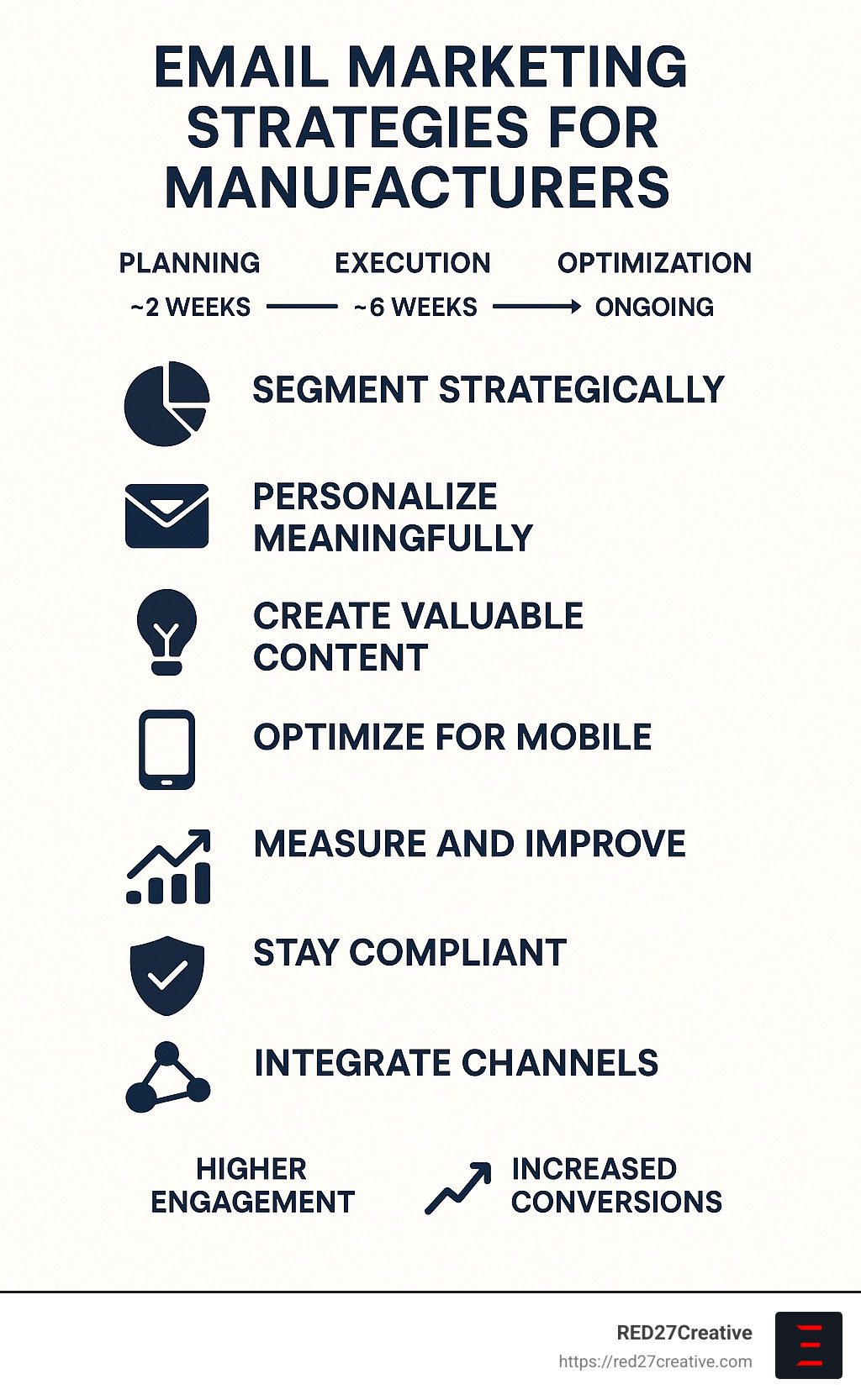
Let’s recap the essential strategies that will transform your manufacturing email marketing:
Segment strategically by dividing your list based on industry, role, and engagement level. This ensures engineers receive the technical specifications they need while procurement managers get the cost-benefit analysis they’re looking for. When you speak directly to each recipient’s specific concerns, your open rates and engagement naturally improve.
Personalize meaningfully by going beyond simply using names. True personalization means understanding each recipient’s challenges and tailoring your message to address their specific pain points. This approach builds trust and demonstrates that you truly understand their business.
Create valuable content that focuses on solutions rather than just product features. Your technical expertise is valuable—share it generously through educational content, case studies, and practical insights that help your audience solve real problems.
Optimize for mobile viewing because over half of all emails are now opened on mobile devices. A perfectly crafted message loses all impact if it’s unreadable on a smartphone, so ensure your designs look great on screens of all sizes.
Measure and improve continuously using data-driven insights. The manufacturing mindset of continuous improvement applies perfectly to email marketing—track your results, test new approaches, and refine your strategy based on what the data tells you.
Stay compliant with all relevant regulations to build trust and protect your brand. Following best practices for email compliance isn’t just about avoiding penalties—it demonstrates professionalism and respect for your recipients’ privacy.
Integrate channels by connecting your email strategy with your website, social media, content marketing, and other digital efforts. This creates a cohesive experience that reinforces your message across multiple touchpoints.
At RED27Creative, we’ve seen how these strategies transform marketing outcomes for manufacturers throughout Chicago, Aurora, Naperville, and across Illinois. Our clients consistently tell us that their improved email marketing approaches not only generate more leads but also help nurture existing customer relationships, creating a foundation for sustainable growth.
The manufacturing sector presents unique challenges, but those same challenges create opportunities when addressed with the right strategy. Your technical knowledge, industry expertise, and solution-oriented approach are tremendous assets that can be leveraged through thoughtful email marketing campaigns.
Ready to lift your manufacturing email marketing strategy? We’d love to help you implement these approaches in a way that feels authentic to your brand and resonates with your specific audience. Our team specializes in creating data-driven email campaigns custom to the unique needs of manufacturers, with a focus on generating measurable results that impact your bottom line.
Let’s work together to craft email marketing that works as precisely and effectively as the products you manufacture.

Kiel Tredrea
https://red27creative.comTop Marketing Agency • Web, SEO & Leads • RED27Creative