How to Pick a Google Ads Campaign Management Service Without Getting Burned
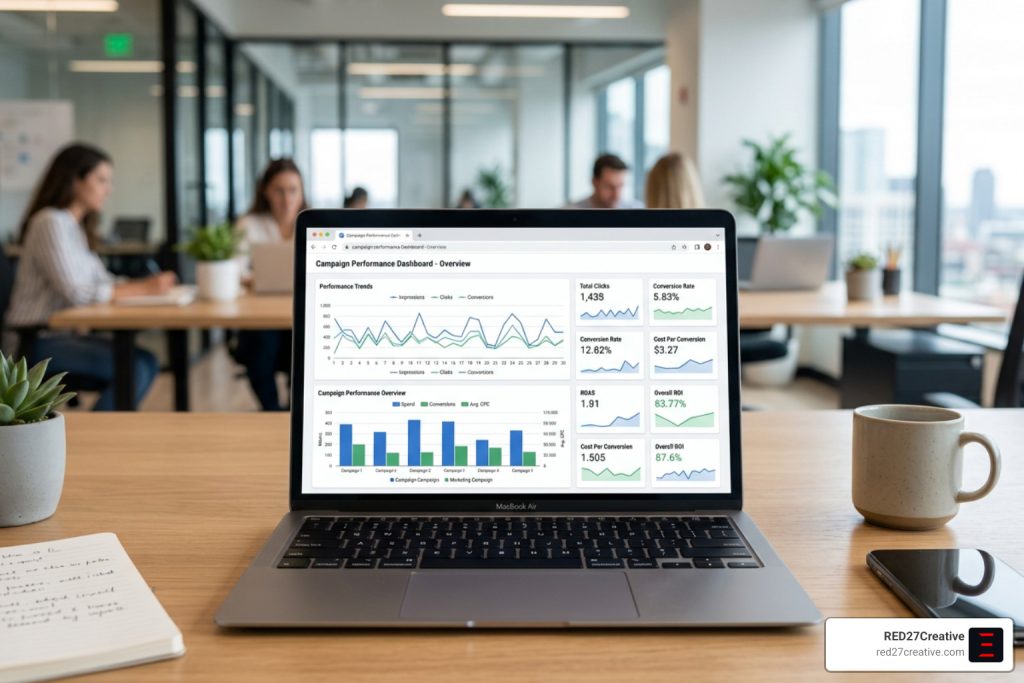
Why Most Businesses Get Burned by Google Ads (And How to Avoid It)
Google Ads campaign management services are professional solutions where a certified team handles the full lifecycle of your paid search campaigns — from strategy and setup to daily optimization and reporting.
Quick answer: What do Google Ads campaign management services include?
| What’s Included | Why It Matters |
|---|---|
| Keyword research and negative keywords | Targets buyers, blocks wasted spend |
| Bid management and Smart Bidding setup | Maximizes conversions within your budget |
| Ad copy creation and A/B testing | Improves click-through rates and Quality Score |
| Conversion tracking and attribution | Connects ad spend to real business outcomes |
| Monthly reporting and ROI analysis | Keeps you informed and in control |
Google processes over 14 billion searches every day. Over 80% of search results now contain paid ad placements, and those ads can occupy as much as 85% of the visible space above the fold. That is an enormous opportunity — but only if your campaigns are built and managed correctly.
The hard truth? Most businesses running their own Google Ads are quietly bleeding budget. Without deep platform expertise, it is easy to bid on the wrong keywords, send traffic to the wrong pages, and never realize why the leads are not coming in. As one agency puts it plainly: running Google Ads without expert management is like throwing darts blindfolded.
That is exactly what this guide is designed to help you avoid.
I’m Kiel Tredrea, founder of RED27Creative and a digital marketing strategist with over 20 years of experience building Google Ads campaign management services and integrated paid search systems for businesses ranging from local service companies to national B2B brands. I have seen what separates campaigns that generate real revenue from ones that simply drain budgets.
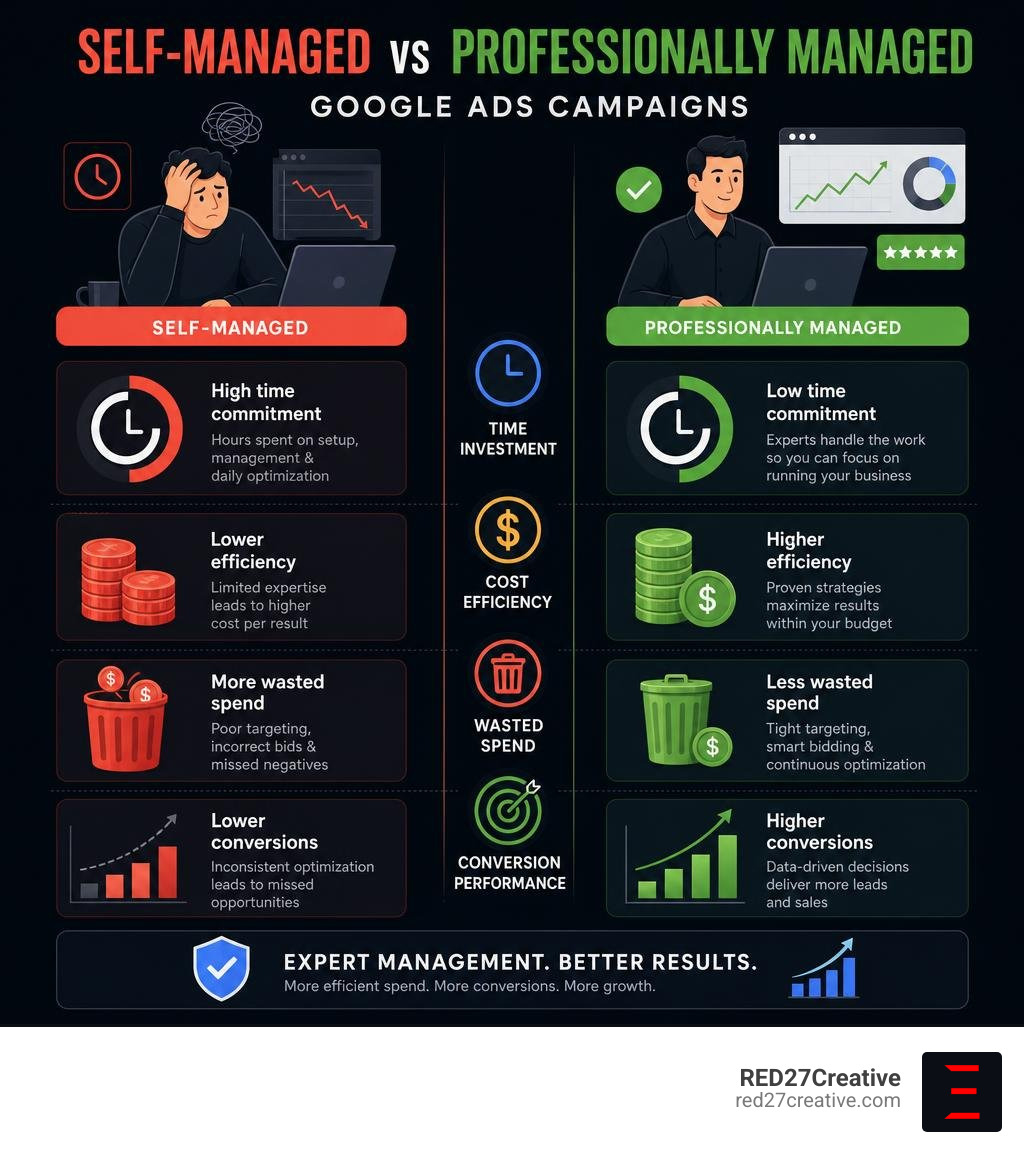
Quick look at google ads campaign management services:
What Are Google Ads Campaign Management Services?
At its core, professional Google Ads Campaign Management is the ongoing process of planning, building, and optimizing paid search campaigns. It requires daily monitoring, strategic adjustments, and deep platform expertise to align search intent with your business goals and turn raw traffic into real revenue.
A professional service ensures your ads target the right audience, use optimal bidding strategies, and maintain a high Quality Score. According to the Google Ads Official Help Center, maintaining ad relevance and landing page quality directly lowers your cost-per-click (CPC) and improves ad positions. Without this technical oversight, Google’s default automated settings can easily waste your budget on broad, non-converting queries.
Why Local Businesses Need Google Ads Campaign Management Services
For local businesses, paid search is the fastest way to drive high-intent local lead generation. Whether you are a roofing contractor in Chicago, a family law attorney in Naperville, or a boutique retailer in Geneva, your customers are searching for you online right now. Without precise geo-targeting, you risk showing ads to searchers outside your service area, resulting in wasted spend.
Partnering with an agency for Google Ads Management Services ensures your budget is spent only on prospects ready to buy. We consistently find that self-managed accounts waste 30% to 50% of their ad spend on irrelevant searches. In highly competitive local markets, utilizing specialized Naperville Pay Per Click Services or Chicago Ppc Services gives you the edge needed to outperform national competitors.
What to Expect from Professional Google Ads Campaign Management Services
Professional management provides proactive account optimization. A true partner will manage your campaigns in a client-owned account, ensuring you retain 100% ownership of your data.
A standard Google Ads Account Management agreement should always include:
- In-depth keyword research: Identifying high-intent search terms, balancing high-volume terms with cost-effective long-tail phrases.
- Negative keyword lists: Actively blocking irrelevant search queries to preserve your daily budget.
- Strategic bid management: Adjusting bids in real-time using a hybrid of human oversight and AI-assisted Smart Bidding.
- Continuous ad copy testing: Writing and testing multiple Responsive Search Ads (RSAs) to find the highest-performing combinations.

Core Campaign Types for Local and National Businesses
To build a highly profitable Google Ads Marketing Strategy, you must use the right campaign types for your specific business goals. Google offers several distinct networks, each serving a unique purpose in the customer journey. Choosing the wrong campaign blueprint can lead to disappointing results and wasted capital.

Search and Shopping Campaigns
Search campaigns target users with high buyer intent who are actively looking for your products or services. These are the classic text ads that appear at the very top of Google search results. For local service providers in Batavia, St. Charles, or Oswego, search ads are the absolute gold standard because they capture people at the exact moment they need a solution.
For e-commerce brands, Shopping campaigns connect directly to your Google Merchant Center to display product images, prices, and store names directly on the search results page. Optimizing your product data feed is essential here; the feed is the foundation of your entire shopping performance.
If you want to capture broader search queries automatically, utilizing Google Ads Dynamic Search Ads can help fill the gaps in your keyword-based campaigns by matching user searches directly to the relevant content already living on your website.
Performance Max and AI-Driven Ads
Performance Max (PMax) is Google’s newest, AI-driven campaign type that allows advertisers to access all of Google’s ad inventory — including Search, YouTube, Display, Discover, Gmail, and Maps — from a single campaign. PMax uses machine learning to find converting customers across channels, making it highly effective for both e-commerce and local lead generation.
However, PMax requires careful handling. Without proper asset group segmentation, audience signals, and negative keyword guardrails, the algorithm can easily drift toward the cheapest, lowest-quality traffic.
To learn how to leverage these automated tools effectively without losing control of your brand, read our guide on Google Ads Management Made Easy Optimize Your Campaigns For Success.
How Agencies Structure Pricing for Paid Search
Understanding how agencies charge for their services is crucial to protecting your marketing budget. Transparency in pricing ensures that both you and your agency are aligned on the same growth goals. There is no single industry standard, but most professional agencies structure their Google Ads Budget Management fees in one of three ways.
| Pricing Model | Average Cost / Structure | Best For | Pros | Cons |
|---|---|---|---|---|
| Flat Monthly Fee | $500 – $3,000+/month | Small to mid-sized local businesses | Highly predictable costs; agency isn’t incentivized to spend more | May not scale well for massive enterprise budgets |
| Percentage of Ad Spend | 10% – 20% of monthly ad budget | Growing businesses with scaling budgets | Aligns agency work with growing campaign scale | Can incentivize the agency to increase your spend unnecessarily |
| Performance-Based | Base fee + % of revenue/leads generated | E-commerce and high-volume lead gen | Direct alignment with business revenue | Requires complex tracking and high trust |
Flat Fees vs. Percentage of Ad Spend
A flat monthly retainer offers complete pricing transparency, making it easier to calculate your exact customer acquisition costs. This model is ideal for local businesses in places like Aurora, Plainfield, or Geneva who want a reliable, predictable marketing expense. With a flat fee, you know exactly what you are paying for campaign management, regardless of whether your ad spend fluctuates slightly from month to month.
On the other hand, the percentage of ad spend model is standard for larger accounts because campaign complexity naturally increases as your budget grows. A higher budget means more ad groups, more creative assets to test, and more intensive bid monitoring. To dive deeper into choosing the right model for your business, check out our Ultimate Ppc Campaign Management Guide.
Measuring Success with Key Metrics
You should never judge the success of your campaigns solely on vanity metrics like clicks or impressions. While a high click-through rate (CTR) is great, it means nothing if those clicks do not turn into paying customers. Instead, focus on bottom-line metrics that directly impact your business revenue.
Your agency should provide regular, transparent reports focusing on:
- Cost Per Acquisition (CPA) / Cost Per Lead (CPL): How much it costs to generate a single qualified lead or sale.
- Return on Ad Spend (ROAS): The revenue generated for every dollar spent on ads (e.g., a 4:1 ROAS means you made $4 for every $1 spent).
- Conversion Rate: The percentage of website visitors who take a desired action, such as calling your office or filling out a form.
- Quality Score: Google’s 1-to-10 rating of the relevance and quality of your keywords, ads, and landing pages.
By focusing on continuous Ppc Roi Optimization, you can systematically lower your acquisition costs while scaling your lead volume.
Why Landing Pages and CRO Make or Break Your Campaign
You can hire the best agency in the world to manage your Google Ads, but if your ads point to a cluttered, slow-loading homepage, you will still burn through your budget. Google Ads gets people to the door; Conversion Rate Optimization (CRO) and dedicated landing pages are what actually get them to walk inside and buy.
An effective, conversion-focused landing page should always include:
- A matching headline: The title of your landing page must directly match the message of the ad the user clicked. If your ad promises “Emergency Roof Repair in Batavia,” the landing page headline should say exactly that.
- A clear, singular Call to Action (CTA): Do not confuse your visitors with multiple options. Give them one clear action to take, such as “Call Now” or “Get a Free Quote.”
- Trust signals and social proof: Place customer testimonials, reviews, and industry certifications prominently near your CTA to build immediate trust.
- Lightning-fast load times: Mobile users will abandon a page if it takes more than three seconds to load. Speed is a direct ranking factor for your Quality Score.
By pointing your paid traffic to dedicated, optimized landing pages instead of your homepage, you can easily increase your conversion rates by 2x to 5x. This simple shift instantly slashes your Cost Per Lead and dramatically improves your overall ROAS.
Integrating Paid Search with SEO and Other Channels
While Google Ads is the fastest way to get to the top of search results, it should not live in a silo. The most successful marketing engines combine paid ads with organic Search Engine Optimization (SEO) and other digital channels to create a unified, multi-channel growth strategy.
When you run Google Ads and SEO together, you create a powerful synergy:
- Double the search real estate: Appearing in both the paid ad placements and the organic search results builds massive brand authority and trust.
- Shared keyword data: You can use your Google Ads search term reports to identify high-converting keywords and immediately target those same terms with your long-term SEO content strategy.
- Cost-effective remarketing: Use cheap Display or social media remarketing ads to stay top-of-mind with users who originally found your website through organic search but were not quite ready to buy on their first visit.
By connecting your website, local SEO, and paid search campaigns into one cohesive engine, you maximize your online visibility and turn every marketing dollar into a compounding investment.
Frequently Asked Questions About Paid Advertising
Before launching a new campaign, it is highly recommended to perform a thorough review of your existing assets using our Google Ads Audit Complete Guide. Below are answers to the most common questions business owners ask when hiring a management service.
How long does it take to see results from Google Ads?
Most campaigns see initial traffic and leads within the first week of launching. However, Google’s Smart Bidding algorithms require a 14-day learning phase to gather performance data. A complete Ppc Campaign Setup typically requires 30 to 90 days of continuous optimization to reach peak efficiency and maximum ROI.
What is a good budget for a local Google Ads campaign?
For local service providers, a starting budget of $1,000 to $3,000 per month is highly recommended. This budget allows you to cover the average cost per click in your industry while gathering enough conversion data to optimize your campaigns. You can learn more about local budgeting through our Naperville Pay Per Click Services page.
Can I run Google Ads campaigns myself?
While you can run campaigns yourself, doing so without professional experience often leads to costly guesswork and wasted budget. Professional management prevents common mistakes like poor landing page optimization, incorrect match types, and bidding on irrelevant keywords. For those wanting to learn the basics, our Google Ads Creation Ultimate Guide offers a great starting point.
What should I look for when choosing a Google Ads agency?
Look for a certified Google Partner that offers transparent, real-time reporting and guarantees 100% account ownership. Avoid agencies that lock you into long-term contracts without a trial period or those that hide your actual ad spend metrics behind bundled pricing. Consistent communication with a dedicated account manager is also key to long-term success.
Conclusion
Choosing the right Google Ads campaign management service does not have to be a risky gamble. By focusing on transparency, clear communication, and proven optimization strategies, you can find a partner that turns paid search into a highly predictable revenue driver for your business.
At RED27Creative, based in Geneva, Illinois, we help businesses build a strong online foundation, increase visibility where it matters most, and turn that visibility into consistent, qualified opportunities. Led by founder Kiel Tredrea, our team of designers, developers, and digital marketing experts brings more than 20 years of experience to building data-driven systems that connect every part of your marketing — website, SEO, local presence, and lead generation — into one unified engine for growth.
We specialize in transparent, high-performing PPC campaigns for businesses throughout Geneva IL, Batavia IL, Aurora IL, St. Charles IL, Plainfield IL, Oswego IL, Naperville IL, and Chicago IL. We eliminate the guesswork and focus entirely on the metrics that matter: leads, sales, and ROI.
Ready to stop wasting ad spend and start growing your business? Schedule a free consultation with RED27Creative today, and let us build a custom strategy designed to win.
Schema Markup for Search Engines & AI Indexing

Kiel Tredrea
https://red27creative.comTop Marketing Agency • Web, SEO & Leads • RED27Creative