From Zero to Hero: Lead Generation Strategies for Your Small Business

Why Lead Generation for Small Business Is the Growth Challenge You Can’t Ignore
Lead generation for small business is the process of attracting potential customers and moving them toward a buying decision — and it’s the single most important driver of sustainable revenue growth for small companies.
Here’s a quick breakdown of what it involves and why it matters:
| What It Is | Why It Matters |
|---|---|
| Attracting strangers and turning them into interested prospects | Without leads, sales pipelines run dry |
| Capturing contact info through offers, content, or ads | Gives you a list of people to nurture toward purchase |
| Qualifying and nurturing leads until they’re ready to buy | Improves conversion rates and reduces wasted effort |
| Tracking results to refine your approach | Turns guesswork into a predictable growth system |
The pressure is real. According to the Bank of America 2024 Business Owner Report, 29% of small business owners say they’re losing sales due to the impact of inflation. Budgets are tighter and competition is sharper. The old “word-of-mouth will carry us” mindset is no longer enough on its own.
The good news: you don’t need a massive budget to build a lead generation engine that works. You need the right strategies, applied consistently.
I’m Kiel Tredrea, founder of RED27Creative, and I’ve spent over 20 years helping small and mid-sized businesses build marketing systems that generate qualified leads through SEO, digital strategy, and integrated campaigns — making lead generation for small business a core pillar of every growth plan I develop. This guide walks you through exactly what works, what doesn’t, and how to build a system that compounds over time.
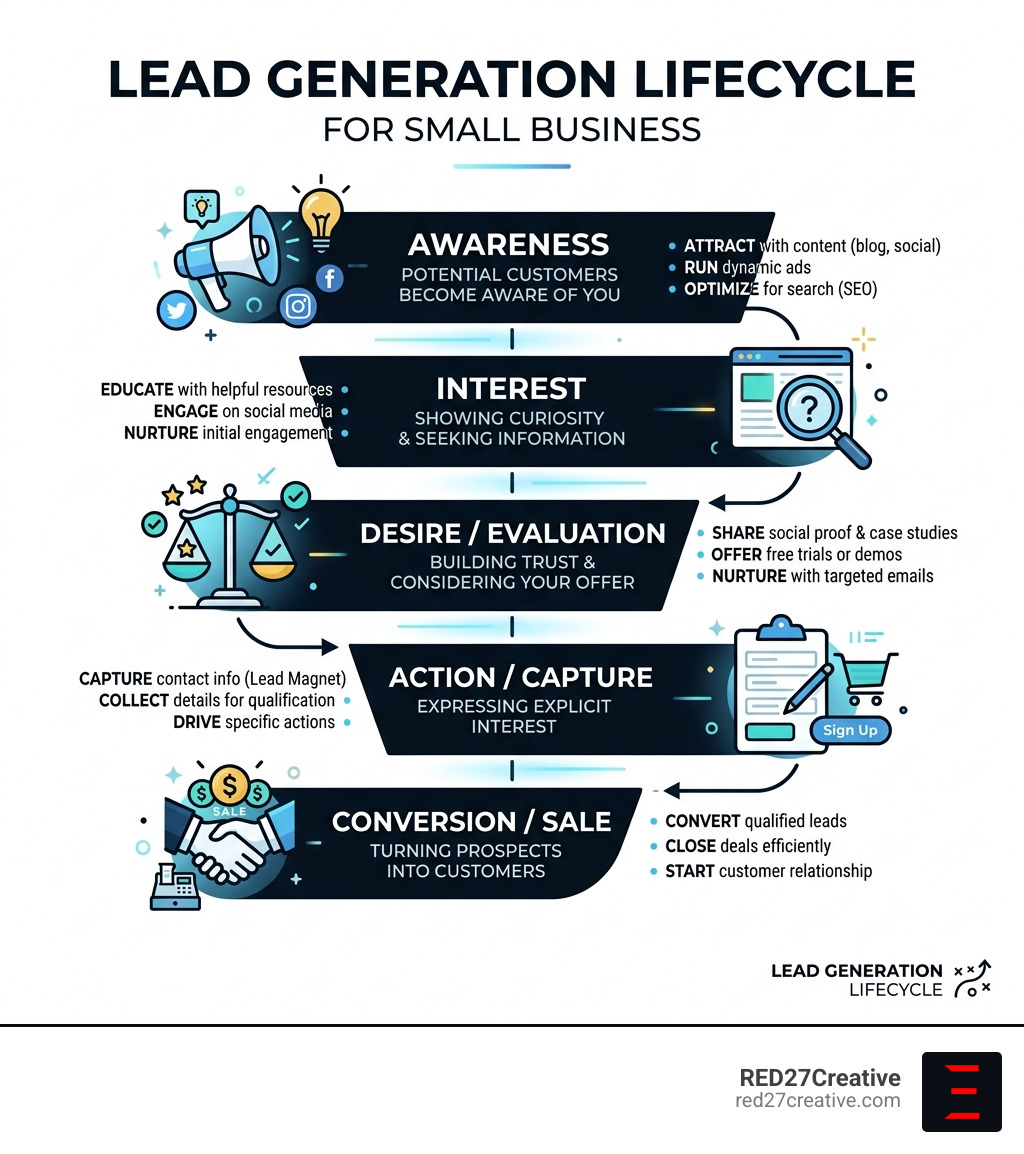
Lead generation for small business definitions:
Understanding the Fundamentals of Lead Generation for Small Business
At its heart, lead generation for small business is about creating a bridge between a stranger and a customer. A “lead” is simply someone who has expressed interest in what you do. However, not all interest is created equal.
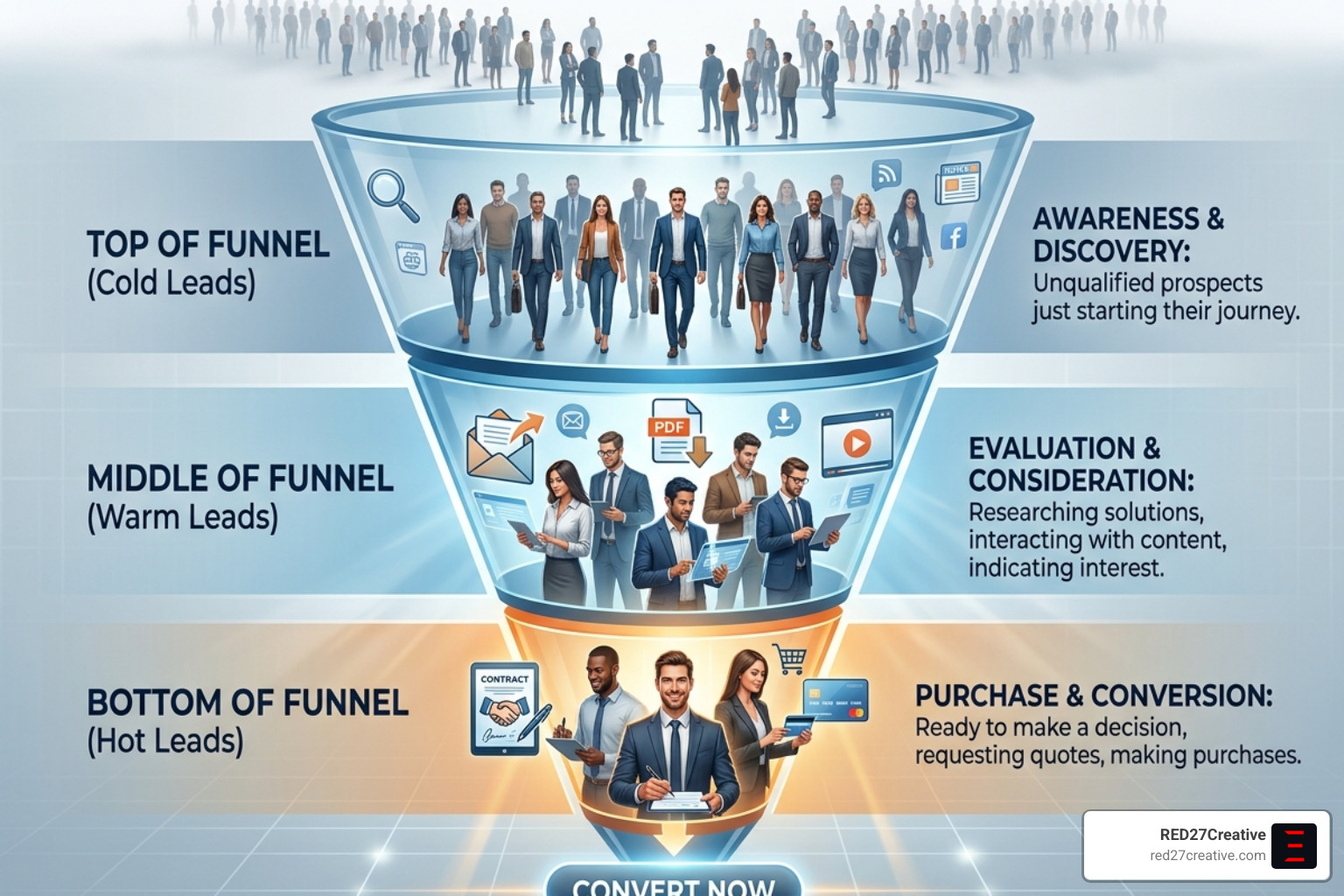
We often categorize leads by their “temperature.” Cold leads are individuals who fit your target profile but haven’t interacted with you yet. Warm leads have engaged—perhaps by downloading a guide or following you on social media.
In the professional world, we distinguish between a Marketing Qualified Lead (MQL)—someone who is interacting with your content—and a Sales Qualified Lead (SQL)—someone who is actually ready to talk numbers. To manage this flow effectively, you need a solid lead generation strategy complete guide to ensure no one falls through the cracks.
Defining Your Audience for Lead Generation for Small Business
You cannot sell to everyone. If you try, you’ll likely end up selling to no one. The first step in a successful campaign is building an audience persona. This is a detailed profile of your ideal customer, including their job title, industry, and most importantly, their pain points.
What keeps your customers up at night? For a local business in Naperville or Aurora, IL, the answer might be finding a reliable service provider who actually shows up on time. By conducting deep market research, we can tailor our messaging to speak directly to those frustrations, making our marketing feel like a solution rather than an intrusion.
Qualifying Your Prospects Effectively
Once the leads start coming in, you need to know which ones are worth your time. This is where qualification frameworks come in. The BANT framework (Budget, Authority, Need, Timeline) has been a staple for years, but modern businesses often look toward CHAMP (Challenges, Authority, Money, Prioritization) to focus more on the customer’s problems.
Another powerful method is MEDDIC, which is highly effective for complex sales. It focuses on identifying the economic buyer and the decision criteria. By implementing lead scoring—assigning points based on how a lead interacts with your site—you can generate qualified leads and ensure your sales team only spends time on “hot” opportunities.
Low-Cost Tactics to Build a Sustainable Pipeline
Many small businesses in the Chicago suburbs feel they can’t compete with big-city budgets. That’s a myth. While large corporations dump millions into broad advertising, small businesses can use “sweat equity” to win.
| Strategy | Cost Level | Time Investment | Primary Benefit |
|---|---|---|---|
| Inbound (SEO/Content) | Low to Medium | High | Long-term authority and “free” traffic |
| Outbound (Cold Email) | Low | Medium | Immediate outreach and testing |
| Referrals | Very Low | Low | Highest conversion rates |
| Networking | Very Low | High | High trust and local community bonds |
Maximizing Word-of-Mouth and Referrals
Referrals are the “holy grail” of lead generation for small business. A referred lead often closes 3 to 5 times faster than a cold one because the trust is already built in. To make this consistent, we recommend setting up a formal loyalty program. Don’t just wait for people to talk; give them a reason to.
Offer incentives—like a discount on their next service—and always ask for testimonials right after a successful project when the client is happiest. These brand advocates become a secondary sales force for your business.
Content Marketing and SEO Essentials
Content marketing is about providing value before asking for a sale. By writing helpful blog posts that answer common customer questions, you improve your search visibility. This is the core of small business SEO.
A great tactic is the “Lead Magnet.” This could be a checklist, an e-book, or a webinar that solves a specific problem. In exchange for this valuable resource, the prospect gives you their email address. This turns a passive website visitor into an active lead that you can nurture over time.
Leveraging Local SEO and Digital Presence
For businesses in Geneva, Batavia, or St. Charles, IL, being visible in your own backyard is vital. When someone searches for a service “near me,” you want to be the first name they see.
Optimizing Your Website for Conversions
Your website is your 24/7 salesperson. If it’s slow, confusing, or doesn’t work on a phone, you are losing money. Every page should have a clear Call-to-Action (CTA), like “Get a Free Quote” or “Schedule a Call.”
We focus on web design services that prioritize user experience. A mobile-responsive site isn’t just a “nice-to-have” anymore; it’s a requirement for ranking on Google and keeping potential leads from bouncing to a competitor.
Dominating Local Search Results
Local SEO is how you win the “Map Pack”—those top three spots on Google Maps. Start by claiming and optimizing your Google Business Profile. Ensure your name, address, and phone number (NAP) are consistent across all local citations and niche directories.
Managing your reviews is also critical. 77% of small business owners who use engagement tactics like responding to reviews report success. For a deep dive into winning the local market, check out our Small Business SEO Chicago Guide.
Building a High-Converting Lead Generation Strategy
A strategy is more than just a list of ideas; it’s a system. You need to know where your audience is, what content will capture their attention, and how you will follow up.
Social Media and Influencer Partnerships
Social media isn’t just for posting pictures; it’s a powerful tool for social listening. By monitoring groups on Facebook or Nextdoor in areas like Plainfield or Oswego, you can find people actively asking for recommendations and jump in with helpful advice.
For B2B companies, LinkedIn outreach is king. It allows you to target specific job titles and industries with surgical precision. If you’re feeling overwhelmed, a B2B lead generation agency can help automate these touchpoints so you can focus on running your business. You can also learn the ropes yourself with our B2B Lead Generation 101 guide.
Measuring Success in Lead Generation for Small Business
You can’t manage what you don’t measure. To know if your lead generation for small business efforts are working, you must track key metrics:
- Cost Per Lead (CPL): How much are you spending to get one person’s contact info?
- Conversion Rate: What percentage of website visitors are becoming leads?
- ROI: Are the sales from these leads covering the cost of the marketing?
Using marketing strategy and consulting helps you interpret this data so you can stop wasting money on what doesn’t work and double down on what does.
Advanced Tools and Automation for 2025
The future of lead gen is automated. Small teams can now behave like large corporations by using AI and smart software. Tools like Salesgenie (which has over 60,000 active users) or Keap can manage your contacts and automate your follow-ups.
At RED27Creative, we’re big proponents of AI chatbot lead generation. A chatbot can qualify a lead at 2:00 AM while you’re sleeping, ensuring that when you wake up, you have a booked appointment with a qualified prospect.
Streamlining the Sales Funnel with Technology
Technology should simplify your life, not complicate it. Automated workflows can send a “Thank You” email the second someone fills out a form, followed by a series of helpful newsletters over the next few weeks. This keeps your brand “top-of-mind.”
Using a chatbot for small businesses and maintaining good data hygiene in your CRM ensures that your sales funnel remains a well-oiled machine, turning cold interest into warm sales without manual effort for every single step.
Frequently Asked Questions about Lead Generation
What is the most effective lead generation for small business?
The most effective strategy typically combines local SEO with a robust referral program. By optimizing your Google Business Profile and encouraging satisfied customers to spread the word, you build immediate trust. This organic foundation, paired with targeted lead magnets, ensures a steady flow of high-quality, cost-effective prospects.
How do I generate leads with a small budget?
Small businesses can generate leads on a budget by focusing on “sweat equity” strategies like content marketing, social media engagement, and networking. Leveraging free tools for SEO and participating in local community groups or industry forums allows you to build authority and attract prospects without heavy advertising spend.
What is the difference between a lead and a prospect?
A lead is an individual who has shown initial interest, such as signing up for a newsletter. A prospect is a qualified lead that fits your ideal customer profile and has the budget and authority to buy. Transitioning leads to prospects requires effective nurturing and qualification frameworks like BANT.
How much should I spend on lead generation?
A common rule of thumb is to spend 7-10% of gross profits on marketing. For small businesses, this budget should be split between immediate lead capture (like search ads) and long-term brand building (like SEO and content).
Why is my lead generation not working?
The most common mistakes include a lack of consistency, targeting too broad an audience, or having a “leaky” sales funnel where leads are never followed up on. Automation and CRM tools can help fix these gaps.
Conclusion
Building a successful lead generation for small business engine isn’t about luck; it’s about strategy. Whether you’re a manufacturer in Chicago or a service provider in Geneva, the principles remain the same: find your audience, provide value, and use technology to scale your efforts.
At RED27Creative, we act as your growth engine. We specialize in creating unified marketing systems that deliver measurable results. If you’re ready to stop guessing and start growing, our team is here to help you build a system that attracts, builds trust, and converts.
Ready to fill your pipeline? Start growing with B2B Lead Generation Services today.

Kiel Tredrea
https://red27creative.comTop Marketing Agency • Web, SEO & Leads • RED27Creative