Manufacturing Success Starts with Smart Market Research
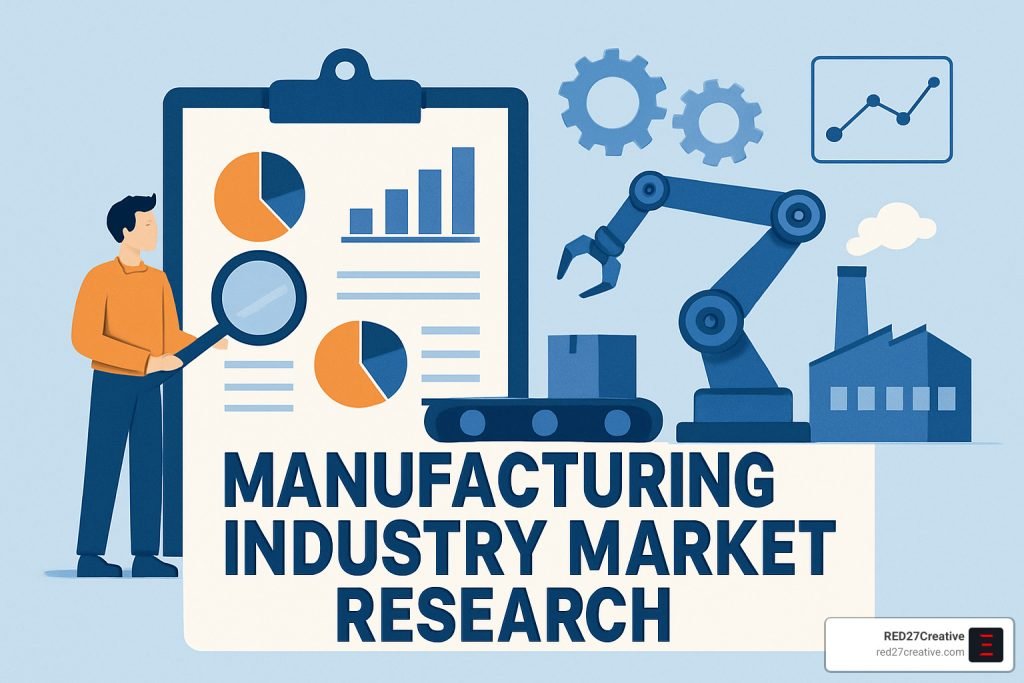
Opening Competitive Advantage Through Data-Driven Decisions
Ever feel like you’re making high-stakes manufacturing decisions in the dark? You’re not alone. In today’s rapidly evolving industrial landscape, gut feelings just don’t cut it anymore.
Manufacturing industry market research isn’t just a corporate buzzword—it’s the compass that guides smart business decisions in an increasingly complex global market. Think of it as your factory’s strategic GPS system, helping you steer around costly pitfalls while steering toward profitable opportunities.
Let me break this down for you in plain language. At its core, this research is about gathering and analyzing market information specifically custom to manufacturing environments. It answers critical questions like: Where is customer demand heading? Which technologies are worth investing in? How are your competitors positioning themselves?
For manufacturing leaders looking to stay ahead, here’s what makes this research so valuable:
It reduces risk when you’re making those million-dollar equipment investments. Before committing to that new production line, wouldn’t you want to know if the market actually wants what it’ll produce?
It spotlights growth opportunities by revealing emerging markets and untapped customer segments that might be invisible from your factory floor.
It boosts innovation by connecting your R&D team with real customer pain points, ensuring you’re solving actual problems rather than theoretical ones.
It strengthens your supply chain by identifying potential vulnerabilities before they become disruptions.
It even helps with talent strategy by forecasting skill requirements and informing your recruiting and training programs.
The global manufacturing market has reached a staggering $14.16 trillion in 2024 and is projected to grow to $20.76 trillion by 2031. In this massive playing field, the companies gaining true competitive advantage aren’t just the ones with the most efficient production lines—they’re the ones with the best market intelligence.
I’ve spent over two decades helping manufacturing companies transform data into strategic action. As Kiel Tredrea, I’ve witnessed how quality research can be the difference between thriving and merely surviving in this sector.
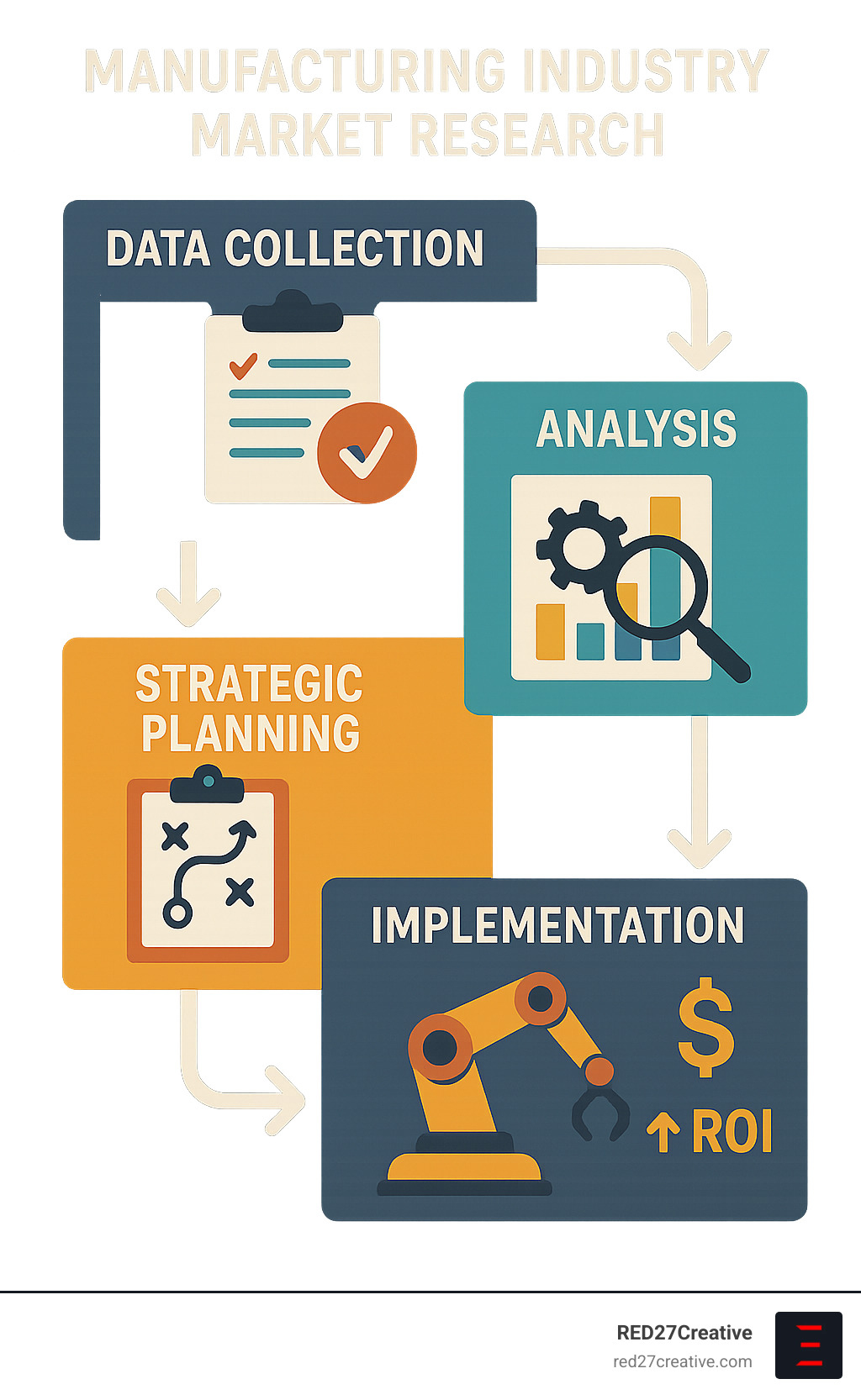
Want to explore how these research principles connect to your broader marketing strategy? Check out our resources on B2B marketing for manufacturers, lead generation for manufacturers, and local SEO for manufacturers.
In manufacturing, information isn’t just power—it’s profit. And in a sector where capital investments can run into the millions, making uninformed decisions isn’t just risky—it’s potentially catastrophic.
Manufacturing Industry Market Research 101
Let’s face it – in today’s manufacturing world, flying blind is a recipe for disaster. Manufacturing industry market research is your compass, providing the critical insights needed to steer an increasingly complex landscape.
Think of it as your strategic toolkit – the systematic way you gather, analyze, and interpret data about market conditions, customer needs, and competitive threats specifically in the manufacturing sector. This research doesn’t just inform decisions; it transforms how you approach everything from product development to market expansion, capital investments, and operational improvements.
What makes manufacturing research particularly valuable is its incredible scope. It spans the entire value chain – from raw-materials suppliers to component manufacturers, production processes, distribution channels, and end-user applications. Unlike other industries, manufacturers must understand both B2B dynamics (your direct customers) and often B2C behaviors (the end consumers who ultimately use your products).
The numbers tell the story: the global manufacturing market reached a staggering $14.16 trillion in 2024, up from $13.5 trillion in 2023. Even more impressive? It’s projected to hit $20.76 trillion by 2031, growing at a healthy 4.9% annually. With stakes this high, informed decision-making isn’t just nice to have – it’s essential.
Why Manufacturing Industry Market Research is Mission-Critical
Let’s be honest – manufacturing decisions come with enormous price tags and long-term commitments. When you’re investing millions in new production lines, facilities, or technologies, you can’t afford to guess.
As one industry report from NewtonX bluntly puts it: “Manufacturing decisions are capital-intensive and hard to undo.” This reality makes solid research not just a good business practice but a fundamental requirement for survival and growth.
Risk mitigation stands at the top of the list. When each investment decision can impact your company for years or decades, research helps identify potential pitfalls before you commit those precious capital resources. It’s like having insurance for your strategic decisions.
Stakeholder alignment becomes infinitely easier with objective data. When engineering, production, sales, and finance teams all see the same market realities, collaboration improves dramatically. Research creates a common language that bridges departmental silos.
With global competition intensifying daily, understanding international markets, competitors, and supply-chain dynamics isn’t optional – it’s essential. Your competitors are studying these factors; can you afford not to?
Perhaps most importantly, research helps you spot technological disruption before it blindsides your business. As one manufacturing executive recently told me, “In today’s environment, making uninformed decisions isn’t just risky—it’s reckless. The companies that thrive are those that make research a cornerstone of their strategic planning.”
Key Benefits of Manufacturing Industry Market Research
Beyond risk reduction, robust research delivers tangible benefits that directly impact your bottom line.
Growth mapping reveals hidden opportunities you might otherwise miss. For instance, did you know Lithuania has experienced remarkable manufacturing growth of 11.6% annually since 2019? Without research, regional gems like this often remain unfinded. Good research identifies untapped market segments, emerging applications, and geographic expansion opportunities with precision.
Smart research leads to significant cost savings. By deeply understanding market pricing dynamics, supply-chain inefficiencies, and competitive offerings, you can optimize your cost structures with confidence. The data backs this up: manufacturers who invest in market research before launching new products save an average of 28% on development costs by avoiding features customers simply don’t value.
Innovation acceleration happens naturally when research reveals unmet customer needs and emerging technologies. An impressive 86% of manufacturing executives believe smart factory solutions will be the primary drivers of competitiveness in the next five years – a finding that directly shapes innovation priorities for forward-thinking companies.
With the manufacturing skills gap widening, talent planning insights have never been more valuable. Understanding industry workforce trends helps you develop effective recruitment and retention strategies that keep your operations fully staffed with qualified personnel. This becomes especially critical when you consider that nearly three-quarters of manufacturing executives report that attracting and retaining quality workforce is their primary business challenge.
Good research doesn’t just inform decisions – it transforms your entire approach to manufacturing strategy, helping you stay ahead in an industry where the margins for error keep shrinking and the rewards for getting it right keep growing.
Core Research Methodologies for Manufacturers
When it comes to manufacturing industry market research, having the right tools in your research toolkit makes all the difference. Let’s explore the approaches that deliver the most valuable insights for manufacturers today.
Qualitative Research
Think of qualitative research as your deep-dive exploration. It’s where you get the rich context and “why” behind the numbers:
Expert interviews are conversations with industry veterans who’ve seen it all. I recently spoke with a manufacturing client who found a major regulatory shift was coming through a single conversation with an industry consultant – information that gave them a six-month head start on competitors.
Focus groups bring together the people who matter – your procurement teams, engineers, and end-users. They reveal preferences and pain points in ways surveys simply can’t capture. The magic happens when you get different stakeholders talking to each other.
Ethnographic research is basically watching how people actually use your products in real-world settings. One of our clients was shocked to find their “user-friendly” control panel consistently confused operators during shift changes – something no one mentioned in feedback forms.
Quantitative Research
While qualitative research gives you depth, quantitative approaches give you breadth and statistical confidence:
Market surveys provide hard numbers on preferences and behaviors across your target audience. The key is asking the right questions of the right people – something many manufacturers get wrong by surveying only their current customers.
Conjoint analysis helps you understand how customers value different product features. Is durability worth more than speed? Does energy efficiency trump initial cost? This technique gives you the answers, helping you optimize your product mix.
Demand forecasting uses statistical models to predict future market needs. In manufacturing, where production planning is critical, good forecasting can be the difference between profitable growth and costly overproduction.
Competitive Intelligence
Keeping tabs on your competition isn’t just smart – it’s essential:
Competitor analysis systematically assesses what others in your space are doing. Are they shifting production overseas? Investing in automation? Changing their pricing structure? These insights help you position your offerings effectively.
Benchmarking compares your performance against industry standards. One manufacturer I worked with finded their production line changeover times were 40% longer than industry benchmarks – a finding that sparked a major efficiency initiative.
Patent analysis gives you a window into competitors’ R&D activities. By tracking patent filings, you can spot emerging technologies before they hit the market.
Customer Journey Mapping
Understanding your customers’ experience from start to finish reveals critical opportunities:
Decision-making process mapping shows you who influences purchasing decisions and what matters most at each stage. In B2B manufacturing, this often reveals that the technical team, procurement, and C-suite all have different priorities.
Pain point identification highlights where customers struggle with current solutions. These friction points often represent your biggest innovation opportunities.
Touchpoint analysis evaluates all the ways customers interact with your company – from initial awareness through purchase and ongoing support.
As our friends at NewtonX wisely point out, “There’s no such thing as a B2B panel. High-quality data requires multi-step verification beyond traditional panels.” This is especially true in manufacturing, where expertise matters and generic consumer research approaches often fall flat.
Segmenting the Market the Right Way
Market segmentation is where good research becomes great strategy. For manufacturers, traditional demographic approaches often miss the mark. Instead, consider these more effective frameworks:
Firmographics looks at company characteristics that actually matter. Are you selling to automotive, healthcare, or construction? Are they large enterprises or mid-sized businesses? A client of ours finded that mid-sized companies in growth mode were far more receptive to their new technology than the large enterprises they’d been targeting.
Technographics segments based on technology adoption patterns. Some manufacturers adopt cutting-edge solutions, while others prefer proven technologies. Understanding where your prospects fall on this spectrum helps you tailor both products and messaging.
Behavioral segmentation groups customers based on how they actually buy and use products. Some value speed of delivery above all else, while others prioritize technical support or customization options. These insights help you deliver what truly matters to each segment.
I’ll never forget working with a Chicago-area manufacturer who completely transformed their sales approach after learning that mid-sized food processors with rapid growth trajectories were their ideal customers. Their targeted campaign generated 32% more qualified leads by speaking directly to the unique challenges these companies faced.
Want to improve your lead generation through effective segmentation? Check out our guide on B2B lead generation.
Manufacturing Industry Market Research for Voice-of-Customer
Voice-of-Customer (VoC) research is where you really get to understand what makes your customers tick:
Pain point analysis identifies what frustrates your customers about current solutions. One manufacturer found their customers’ biggest headache wasn’t product performance but inconsistent delivery times – a relatively easy fix that dramatically improved satisfaction.
Product-service fit evaluation assesses how well your offerings meet actual needs. This is particularly crucial as more manufacturers move toward service-based models. Are your service packages aligned with what customers truly value?
Net Promoter Score (NPS) tracking measures customer loyalty across different segments and touchpoints. While a single NPS number is interesting, breaking it down by customer type, product line, or region reveals far more actionable insights.
I recently worked with a manufacturing client in Aurora, IL who implemented a structured VoC program. They were surprised to learn their customers valued technical support and parts availability far more than initial purchase price. This insight led them to reposition around service excellence, increasing their average contract value by 18%.
Looking to put these customer insights to work in your content strategy? Our guide on content marketing for manufacturers has you covered with practical approaches that connect with your ideal customers.
2024-2025 Trend Landscape Shaping Manufacturing
The manufacturing world is changing at breakneck speed, and staying on top of these shifts isn’t just nice-to-have—it’s essential for survival. Our manufacturing industry market research reveals several game-changing trends that are reshaping the industry through 2025.
Smart Factories and Industry 4.0
Remember when “smart” just meant your phone? Now entire factories are getting the smart treatment! The numbers tell the story: according to Deloitte, a whopping 86% of manufacturing executives believe smart factory solutions will drive their competitiveness in the next five years.
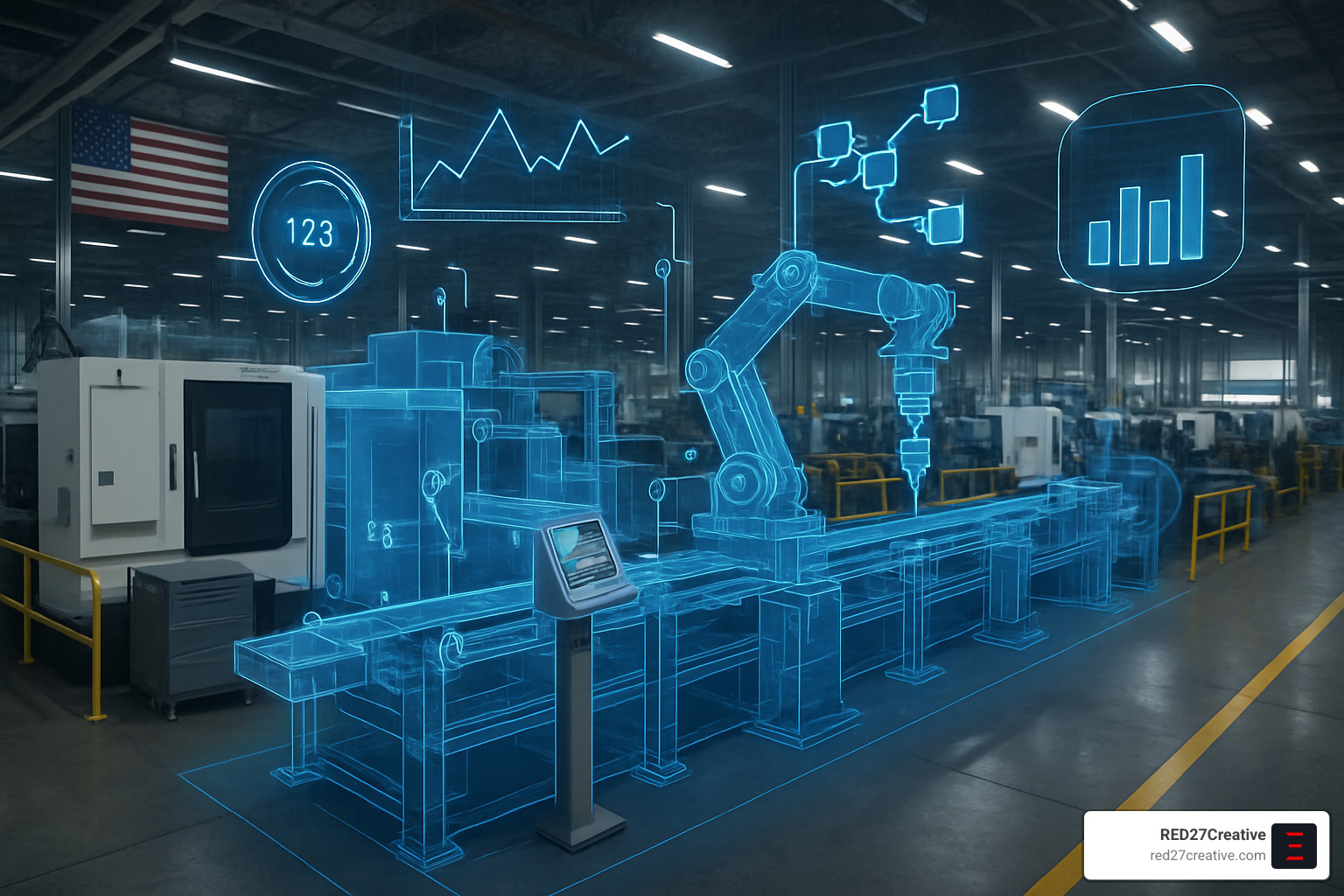
What’s making these factories so intelligent? It’s a perfect storm of technologies working together. IoT sensors quietly monitor everything in real-time, while AI and machine learning predict when maintenance is needed before breakdowns happen. Meanwhile, cloud computing stores massive amounts of data, and edge computing makes split-second decisions right on the factory floor.
As one industry report put it so well: “Smart factories blend AI, 5G, IoT, analytics, and cloud to deliver real-time insights and end-to-end visibility.” The result? More efficient assets, higher productivity, lower costs, safer workplaces, and more sustainable operations. Not a bad package deal!
Digital Twins and the Industrial Metaverse
Digital twins might sound like something from a sci-fi movie, but they’re rapidly becoming as essential to manufacturing as blueprints once were. These virtual replicas of physical assets, processes, and systems are moving beyond the experimental phase and becoming operational necessities.
The industrial metaverse takes this concept even further, creating immersive virtual environments where teams can collaborate and solve problems. The numbers from Deloitte’s research are eye-opening:
- 92% of manufacturers are already experimenting with or implementing metaverse applications
- Companies are diving in with an average of six metaverse-related implementations
- The expected productivity boost from these applications averages a healthy 12%
ESG and Sustainability Imperatives
Sustainability in manufacturing used to be a nice bonus. Today, it’s becoming the price of admission. Environmental, Social, and Governance (ESG) considerations are increasingly driving manufacturing strategy, with the sustainable manufacturing solutions market expected to reach a staggering $145 billion by 2026, growing at an 8.1% CAGR.
Carbon tracking and reduction initiatives that once seemed optional are now standard practice. Meanwhile, circular economy principles are being woven into the very fabric of product design and lifecycle management. The message is clear: sustainability isn’t just good for the planet—it’s good for business.
Electrification and Clean Technology
The shift toward electrification is picking up serious momentum, powered by both government incentives and growing market demand. Since the Inflation Reduction Act passed, nearly 200 new clean technology manufacturing facilities have been announced in the US alone. These represent $88 billion in investment and are expected to create over 75,000 new jobs.
Of course, this transition brings its own set of challenges, particularly in battery supply chains and the need for a specialized workforce. But the direction is clear—the future of manufacturing is increasingly electric.
Reshoring and Supply Chain Regionalization
Remember those pandemic supply chain nightmares? They’ve left a lasting impression. Combined with ongoing geopolitical tensions, they’ve accelerated the trend toward reshoring and supply chain regionalization.
The numbers tell a compelling story: as of July 2023, annual construction spending in US manufacturing reached $201 billion—a whopping 70% increase year-over-year. Average delivery times for production materials improved from 100 days in July 2022 to 87 days by August 2023. And 76% of manufacturers are now adopting digital tools to gain better visibility into their supply chains.
Top Five Global Players & Countries to Watch
Some countries continue to dominate the global manufacturing landscape, with each bringing unique strengths to the table.
China remains the manufacturing heavyweight, accounting for 28.4% of global manufacturing with a market size of $3,834 billion in 2023. Their integrated supply chains, massive scale, and rapidly growing technical capabilities make them a formidable force.
The United States holds strong in second place with 16.6% of global manufacturing ($2,241 billion), leveraging its innovation, productivity, and advanced technology advantages.
Japan continues to excel with its $1,013 billion manufacturing sector, renowned for quality, precision engineering, and leadership in robotics.
Germany’s $783 billion manufacturing economy maintains its reputation for engineering excellence and Industry 4.0 leadership.
India rounds out the top five with $446 billion and is projected to grow at an impressive 7.5% CAGR, powered by its growing workforce and government initiatives like “Make in India.”
On the company front, several global players are setting the pace. BASF Group leads in chemical manufacturing with pioneering sustainable practices, including recently introduced biomass-balanced ingredients. Hon Hai Technology Group (Foxconn), the world’s largest electronics manufacturer, continues to expand with a $1.6 billion investment in India. And Samsung Electronics maintains its leadership in semiconductor and consumer electronics, with a sharp focus on advanced chip manufacturing and AI integration.
Smart Factory & Generative AI Momentum
The marriage of smart factory technologies with generative AI might be the most exciting development in manufacturing today. Smart factories already leverage interconnected systems and real-time data to optimize operations through predictive maintenance, AI-powered quality control, process optimization, and smart inventory management.
Now, generative AI is taking these capabilities to new heights. It’s optimizing designs by generating multiple alternatives based on specific constraints. It’s creating digital twins of supply networks to simulate disruptions and identify resilience strategies. It’s generating virtual environments for safer, more effective worker training. And it’s revolutionizing production planning by optimizing schedules while juggling multiple variables simultaneously.
We recently worked with a manufacturing client in Naperville, IL who implemented generative AI to optimize their production scheduling. The results? A 17% increase in throughput and 23% reduction in changeover time. Now that’s the kind of improvement that gets attention in the boardroom!
As these trends continue to evolve, manufacturers who stay informed through quality manufacturing industry market research will be best positioned to turn these changes into competitive advantages.
Tackling Today’s Biggest Challenges with Research Insights
Manufacturers face a complex set of challenges that manufacturing industry market research can help address. By leveraging data-driven insights, companies can develop effective strategies to steer these obstacles:
Supply Chain Disruption
Supply chain vulnerabilities remain a top concern for manufacturers. Research shows that 80% of surveyed executives experienced a heavy or very heavy impact of disruption on their supply chains over the past 12–18 months.
Research-driven solutions include:
- Supplier diversification: Identifying alternative suppliers across different geographic regions
- Inventory optimization: Using data analytics to determine optimal safety stock levels
- Visibility tools: Implementing digital supply chain monitoring solutions
- Scenario planning: Developing contingency plans based on risk assessment
“A manufacturer used supply-chain expert interviews to map and mitigate fragile links prior to a major expansion,” notes one case study. This proactive approach enabled them to avoid potential disruptions during a critical growth phase.
Talent Shortage
Almost three-quarters of surveyed manufacturing executives identify attracting and retaining a quality workforce as their primary business challenge.
Research-informed talent strategies include:
- Skills gap analysis: Identifying specific skill shortages and development needs
- Workforce demographics: Understanding generational preferences and motivations
- Compensation benchmarking: Ensuring competitive pay and benefits
- Employer brand positioning: Developing compelling value propositions for potential employees
According to Deloitte’s research, only 46.8% of manufacturers offer flexible scheduling to production workers, highlighting an opportunity to differentiate through more employee-friendly policies.
Cybersecurity Risks
As manufacturers adopt more connected technologies, cybersecurity vulnerabilities increase. Research indicates that manufacturing is now among the most targeted sectors for cyberattacks.
Research-based cybersecurity approaches include:
- Threat assessment: Identifying specific vulnerabilities in manufacturing systems
- Security benchmarking: Comparing security measures against industry standards
- Technology evaluation: Assessing security features of potential technology investments
- Training needs analysis: Determining employee security awareness gaps
Price Volatility and Inflation
Fluctuating input costs create significant challenges for pricing and margin management. Research helps manufacturers steer this volatility through:
- Cost trend analysis: Tracking raw material and component price trends
- Pricing elasticity studies: Understanding how price changes affect demand
- Value perception research: Determining how customers perceive value versus price
- Competitor pricing monitoring: Tracking competitive pricing strategies
Aftermarket Services and Servitization
Manufacturers increasingly recognize the value of aftermarket services. Research indicates that aftermarket services can offer manufacturers 2.5 times greater operating margins than new equipment sales.
Research-driven aftermarket strategies include:
- Service need identification: Determining which services customers value most
- Pricing model testing: Evaluating subscription versus transaction-based models
- Service delivery optimization: Identifying the most efficient service delivery methods
- Customer lifecycle mapping: Understanding service needs at different product lifecycle stages
For manufacturers looking to leverage marketing automation to support these strategies, our guide on marketing automation for manufacturing provides valuable insights.
Building a Resilient Supply Chain
Supply chain resilience has become a strategic priority for manufacturers. Research-informed resilience strategies include:
Near-shoring and Friend-shoring: Relocating production closer to end markets or in politically aligned countries. Research helps identify optimal locations based on factors including:
- Labor availability and costs
- Regulatory environment
- Infrastructure quality
- Proximity to customers and suppliers
Multi-sourcing: Developing relationships with multiple suppliers for critical components. Research helps:
- Identify qualified alternative suppliers
- Assess supplier financial stability and operational capabilities
- Evaluate quality consistency across suppliers
- Determine optimal allocation across supplier base
Blockchain and Distributed Ledger Technology: Implementing blockchain for improved transparency. Research helps:
- Evaluate technology providers and solutions
- Identify high-value use cases
- Assess implementation challenges and costs
- Measure potential ROI
Scenario Modeling: Developing contingency plans for various disruption scenarios. Research supports:
- Identifying potential disruption triggers
- Quantifying potential impacts
- Evaluating mitigation strategies
- Testing response plans
For more insights on building transparent supply chains, manufacturers can refer to Harvard Business Review’s guide on Building a transparent supply chain.
Using Manufacturing Industry Market Research to Win the Talent War
The manufacturing talent shortage requires strategic approaches informed by research:
Skills Gap Analysis: Identifying specific skill shortages through:
- Current workforce capability assessment
- Future skill requirement forecasting
- Training program effectiveness evaluation
- Industry benchmark comparisons
Workforce Upskilling: Developing effective training programs based on:
- Learning preference research
- Training delivery method effectiveness
- Skill retention analysis
- Return on training investment measurement
Employer Branding: Creating compelling value propositions through:
- Candidate preference studies
- Competitive employer analysis
- Employee satisfaction research
- Recruitment channel effectiveness evaluation
Alumni Networks: Leveraging former employees as a talent resource by:
- Retiree skill and availability mapping
- Part-time and consulting arrangement preferences
- Knowledge transfer program development
- Re-recruitment incentive testing
A manufacturing client in St. Charles, IL used research insights to develop a targeted employer branding campaign that increased qualified applications by 42% and reduced time-to-hire by 27%.
Turning Insight into Growth Opportunities
When you’ve invested in manufacturing industry market research, the real magic happens when you transform those insights into tangible growth. It’s like having a treasure map – now it’s time to actually dig for gold!
New Market Entry
Breaking into new markets isn’t just about courage – it’s about making smart, research-backed moves. Think of research as your GPS for navigating unfamiliar territory.
Good market entry research answers crucial questions: How big is this market opportunity? Who are we up against? What regulations might trip us up? Which sales channels will work best for us?
I remember working with a manufacturing client in Geneva, IL who used targeted research to spot a gap in the medical device component sector that competitors had overlooked. Their research-informed strategy wasn’t just successful – it generated $3.2 million in new revenue within just 18 months. That’s the power of going where the data leads you!
Product Diversification
Expanding your product line is always risky, but research dramatically improves your odds of success. Instead of guessing what might sell, you can make decisions based on solid evidence.
The best product diversification strategies look at adjacent possibilities (where can your current capabilities take you?), unmet customer needs (what problems aren’t being solved?), emerging technologies (what’s newly possible?), and portfolio balance (what mix maximizes both growth and stability?).
Many manufacturers find that small tweaks to existing products – identified through customer interviews – can open entirely new market segments without major production changes.
XaaS and Subscription Models
The subscription economy isn’t just for Netflix and software companies anymore. Manufacturers are increasingly finding ways to transform traditional one-time purchases into recurring revenue streams through “as-a-Service” models.
Research helps answer critical questions: Which services would customers actually pay for monthly? What pricing structure makes sense? What obstacles might prevent adoption? What’s the lifetime value of a subscription customer versus a traditional buyer?
The beauty of subscription models is they create predictable revenue while deepening customer relationships. One manufacturing client told me, “We used to hope customers would remember us when equipment needed replacing. Now we’re in constant contact, solving problems before they even realize they have them.”
For manufacturers looking to drive website traffic to support these subscription offerings, check out our guide on How to Get More Traffic to Our Manufacturing Website.
Aftermarket & Servitization Strategies
The aftermarket isn’t just an add-on anymore – it’s a profit powerhouse. Research consistently shows aftermarket services deliver about 2.5 times greater operating margins than new equipment sales. That’s too significant to ignore!
Smart manufacturers are leveraging research to develop strategies like:
Remote Monitoring and Predictive Maintenance – Using IoT sensors to catch problems before they cause downtime. Research helps determine customer acceptance, perceived value, pricing models, and potential implementation challenges.
Outcome-Based Contracts – Instead of selling products, you’re guaranteeing results. Research helps assess risks, identify which performance metrics matter most to customers, and determine optimal contract structures.
AR/VR Support Solutions – Using augmented and virtual reality to provide expert support from anywhere. Research helps optimize user experience, overcome adoption barriers, and quantify the ROI.
I recently worked with a manufacturing client in Batavia, IL who transformed their business by adding subscription-based remote monitoring. Not only did they increase recurring revenue by 28%, but customer retention jumped by 17%. Their customers loved the peace of mind, and they loved the predictable cash flow.
ESG & Sustainability Playbook Driven by Data
Environmental, Social, and Governance (ESG) initiatives aren’t just about doing good – they’re increasingly becoming business necessities. Research helps manufacturers develop sustainability strategies that resonate with customers and actually deliver results.
Carbon Tracking and Reduction has become a priority for many manufacturers. Research helps identify which measurement methodologies make sense for your operation, which reduction opportunities offer the best ROI, and how customers perceive the value of these efforts.
Circular Economy Implementation – designing products for reuse and recycling – requires understanding material recoverability, customer acceptance of take-back programs, and the economics of remanufacturing.
Stakeholder Reporting is all about effectively communicating your sustainability performance. Research helps identify which metrics matter most to different stakeholders and which reporting formats have the most impact.
Clean Tech Incentives can dramatically improve the economics of sustainability initiatives. Research helps identify which programs you qualify for, optimize the application process, and calculate the true ROI including available incentives.
I recently worked with a manufacturing client in Plainfield, IL who found through research that 62% of their B2B customers had formal sustainability requirements for suppliers. This insight led them to develop a comprehensive sustainability program that secured three major contracts worth $4.7 million. What started as an environmental initiative became a major competitive advantage.
The bottom line? Research isn’t just about gathering information – it’s about finding pathways to growth that you might otherwise miss. The manufacturers who thrive in today’s complex landscape are the ones who let data light the way forward.
Technology, Tools & Best-Practice Playbook
When it comes to manufacturing industry market research, having the right tools can make all the difference between insights that gather dust and findings that transform your business. Let’s explore the technology that’s revolutionizing how manufacturers gather and use market intelligence.
Research Platforms and Tools
The days of relying solely on industry reports and trade magazines are long gone. Today’s manufacturing leaders have access to sophisticated platforms that deliver real-time insights.
AlphaSense has become something of a superstar in the manufacturing research world. This AI-powered platform sifts through content from over 10,000 sources, using their clever Smart Synonyms™ technology to understand manufacturing jargon the way an industry veteran would. It’s no wonder 95% of top consultancies and 80% of leading asset-management firms have it in their toolkit. If you’re tracking competitors or trying to spot emerging technologies before they disrupt your market, AlphaSense is worth its weight in gold.
For B2B research that goes beyond surface-level insights, NewtonX has carved out a special niche. What makes them different? They custom-recruit genuine industry experts for each project and put participants through a rigorous 5+ step verification process. When you need to understand the nuances of specialized manufacturing sectors—and they cover 140+ of them—this level of verification ensures you’re getting insights from people who truly know what they’re talking about.
Beyond these specialized platforms, manufacturers are increasingly generating their own research data through IoT sensors deployed throughout operations. These tiny technological marvels continuously capture production efficiency metrics, equipment performance data, and quality-control measurements—creating a goldmine of operational intelligence that feeds directly into market strategy.
Digital twins have also transformed from futuristic concept to practical research tool. These virtual replicas of physical manufacturing environments let you test process optimizations, simulate different factory layouts, and develop training scenarios without disrupting actual production. It’s like having a sandbox version of your entire operation where you can experiment risk-free.
The newest kid on the block is generative AI, which is already showing tremendous promise for manufacturing research. From modeling potential supply-chain disruptions to analyzing thousands of customer feedback comments in minutes, these tools are helping manufacturers process information at unprecedented speed and scale.
Ensuring Data Quality and Compliance
All the fancy technology in the world won’t help if your data isn’t trustworthy. As one research leader at NewtonX bluntly puts it, “30–40% of data sold is discarded as unusable.” Ouch.
Sample verification is where quality begins. The best manufacturing researchers implement multi-step verification processes that validate industry expertise, confirm roles and responsibilities, and assess experience levels. When you’re making million-dollar decisions based on research, you need to know your insights came from qualified sources.
Data privacy has become increasingly critical, particularly with the global reach of many manufacturing operations. GDPR compliance isn’t just about avoiding fines—it’s about responsible data stewardship through proper consent management, data minimization practices, and transparent processing. Your research participants need to know exactly how their input will be used.
The most reliable research programs implement 5-step quality checks that include source validation, methodology assessment, data consistency verification, outlier identification, and comparative analysis against secondary sources. This belt-and-suspenders approach helps catch anomalies before they lead to costly strategic mistakes.
With AI playing a growing role in research, bias monitoring has become essential. This includes evaluating the diversity of training data, ensuring algorithm transparency, validating outputs against multiple sources, and conducting regular bias audits. AI is only as good as the data it learns from—garbage in, garbage out still applies, even with the fanciest algorithms.
Manufacturing Industry Market Research Automation Tips
The volume of data available to manufacturers today is both a blessing and a challenge. Automation helps tame this data deluge and extract meaningful insights.
Real-time dashboards have become the command center for research-driven manufacturers. These centralized visualization tools put KPIs, trends, competitive intelligence, and customer feedback in one place, making it easier to spot connections between different data streams. One manufacturing executive told me these dashboards transformed their monthly research reviews from “dreaded data dumps to strategic discussions.”
Smart manufacturers are also setting up automated alerts that flag significant changes in their market environment. These might include competitor announcements, price changes, regulatory updates, or technology breakthroughs. When a major customer suddenly starts researching alternative suppliers or a competitor files an interesting patent, you want to know immediately—not when you happen to check your dashboard next month.
API integrations tie research platforms directly to your business systems, creating a seamless flow of intelligence. Connecting your research tools to your CRM lets you enrich customer profiles with market insights. Linking to your marketing automation platform helps you measure campaign performance against market trends. These integrations eliminate the silos that often prevent research from directly informing day-to-day operations.
A perfect example comes from a manufacturing client in Oswego, IL who implemented an automated competitive intelligence dashboard. When the system alerted them to a competitor’s production-capacity expansion, they quickly adjusted their market strategy and retained key accounts that might otherwise have been vulnerable. That’s the power of automation—turning information into action at the speed of business.
For manufacturers looking to boost their lead generation with these automated research insights, check out our guide on lead generation for manufacturing companies.
Frequently Asked Questions about Manufacturing Industry Market Research
What is the first step in manufacturing industry market research?
Beginning your manufacturing industry market research journey starts with defining clear, actionable objectives. Think of it as creating a roadmap before starting on a cross-country trip—you need to know where you’re headed before you start driving! Collaborative workshops with product development, marketing, and sales teams help turn vague curiosities into specific questions that shape your research plan.
How does research help mitigate supply chain risks?
Research provides end-to-end visibility. It assesses supplier financial health, maps single-source dependencies, and models disruption scenarios. One client created a digital twin of their supply chain and finded an over-reliance on a single component supplier. This finding led them to qualify two additional suppliers—protecting production when the original supplier suffered a fire.
Which technologies are essential for modern research programs?
Successful programs blend AI-driven analytics, IoT sensor data, digital twins for simulation, and secure blockchain for traceability. AI spots patterns in unstructured data, IoT delivers real-time performance metrics, and digital twins let you test strategies virtually before investing on the factory floor. Together, these tools turn raw data into actionable intelligence.
Conclusion
In today’s and ever-changing manufacturing landscape, manufacturing industry market research isn’t just a nice-to-have—it’s absolutely essential for companies that want to thrive rather than merely survive. I’ve seen how quality research transforms manufacturing businesses throughout Illinois—from busy Chicago to suburban Aurora, from historic Geneva to tech-forward Naperville.
The manufacturers who consistently outperform their competition aren’t just the ones with the best equipment or the largest facilities. They’re the ones who’ve made research a cornerstone of their strategic planning and decision-making processes.
Think about research as your manufacturing business’s navigation system. Without it, you’re essentially driving blindfolded through an obstacle course of supply chain disruptions, talent shortages, and technological upheavals. Not exactly a recipe for success!
Here’s what we’ve learned at RED27Creative from working with manufacturing leaders who’ve acceptd research as their competitive edge:
Make research an ongoing conversation, not a once-in-a-while event. The manufacturers who gain the most valuable insights establish systematic, continuous research programs rather than conducting one-off projects when problems arise.
Blend your approaches for the fullest picture. Combining qualitative insights (the “why” behind decisions) with quantitative data (the “what” and “how many”) creates a comprehensive understanding that neither approach can deliver alone.
Accept the tech revolution in research. Today’s most successful manufacturers are leveraging AI, IoT sensors, and digital twins to gather deeper, more accurate insights faster than ever before.
Focus relentlessly on actionability. The best research directly informs specific decisions and strategies—it doesn’t just gather dust on a digital shelf somewhere. Every research initiative should answer the question: “What will we do differently based on what we learn?”
Quality matters more than quantity. Implementing rigorous verification processes ensures you’re making million-dollar decisions based on reliable data, not misleading information.

The manufacturing world today presents both unprecedented challenges and extraordinary opportunities. From navigating supply chain uncertainties to using smart factory technologies, from addressing sustainability imperatives to winning the talent war—success belongs to companies armed with the best information and insights.
At RED27Creative, we specialize in helping manufacturers develop research programs that deliver actionable insights and genuine competitive advantage. We understand the unique challenges of your industry and have helped dozens of manufacturers transform research into revenue growth.
Your journey to research-driven growth doesn’t end here. For more practical strategies on leveraging these insights to drive website traffic and business growth, I’d recommend exploring our guide on generating traffic to your website.
In manufacturing, the company with the best information often becomes the company with the best bottom line. Isn’t it time your research program became your competitive advantage?

Kiel Tredrea
https://red27creative.comTop Marketing Agency • Web, SEO & Leads • RED27Creative