Unlock Your Pipeline: Strategies to Generate Qualified Leads
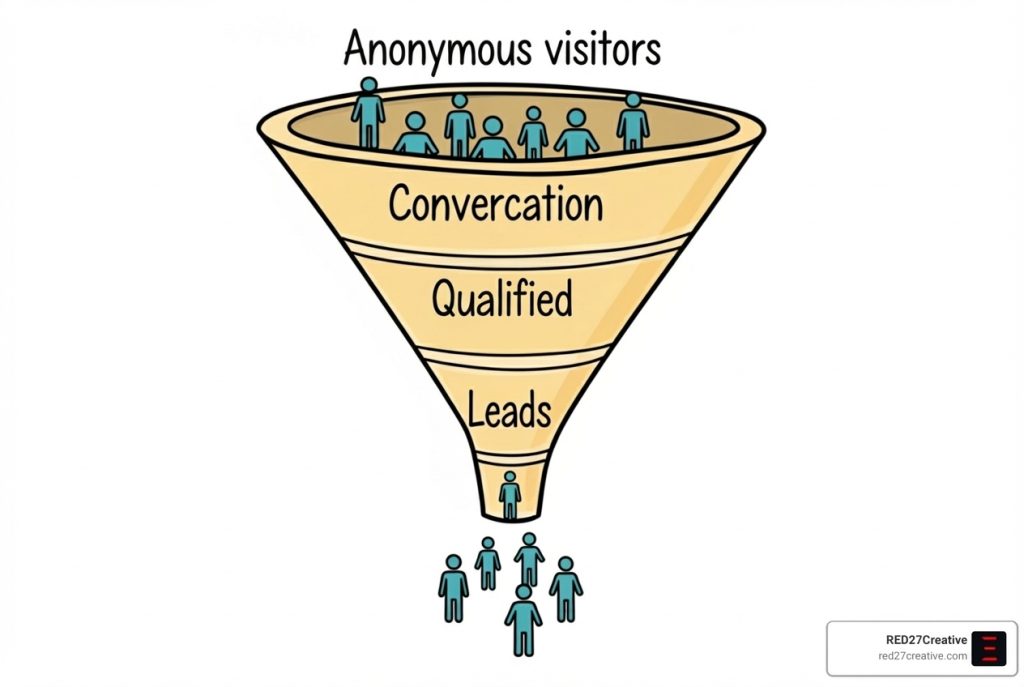
Why Generating the Right Leads Changes Everything
To generate qualified leads, you need three core components working together: a clearly defined ideal customer profile (ICP), strategic content and campaigns that attract high-intent prospects, and a system to capture, score, and measure lead quality. The goal isn’t just more leads—it’s more leads that convert into revenue.
Key steps to generate qualified leads:
- Define your Ideal Customer Profile (ICP) – Know who you’re targeting based on firmographics, budget, pain points, and buying authority
- Build trust through content – Use SEO, blogs, and social media to attract prospects before they’re ready to buy
- Deploy targeted campaigns – Leverage Google Ads, Facebook Ads, and retargeting to capture high-intent visitors
- Pre-qualify and score leads – Use intake forms, lead scoring, and frameworks like BANT to prioritize the right opportunities
- Measure and optimize – Track ROI, cost per lead, and conversion rates to refine your system over time
Lead generation is the engine of business growth. Companies that get it right can see results like 645 leads generating $425,000 in revenue in a single quarter. But most businesses struggle—not because they lack traffic, but because they attract the wrong visitors or fail to convert the right ones.
The difference between a lead and a qualified lead is everything. A lead is anyone who shows interest. A qualified lead matches your ideal customer profile, has a real need, possesses the budget and authority to buy, and is ready to take action. Generating qualified leads means building a system that attracts the right people, engages them with value, and moves them smoothly toward a decision.
This guide walks you through proven strategies to generate qualified leads at every stage of the funnel—from defining your target audience and creating content that builds trust, to running targeted campaigns and measuring ROI. Whether you’re a marketing director, business owner, or executive responsible for growth, you’ll learn how to turn visibility into revenue with a unified, data-driven approach.
I’m Kiel Tredrea, founder and president of RED27Creative, and I’ve spent over 20 years helping B2B and service-based companies generate qualified leads through integrated marketing systems that combine SEO, web optimization, and lead generation into measurable growth. My team and I specialize in building strategies that don’t just bring in more traffic—they bring in the right traffic that converts into real business results.
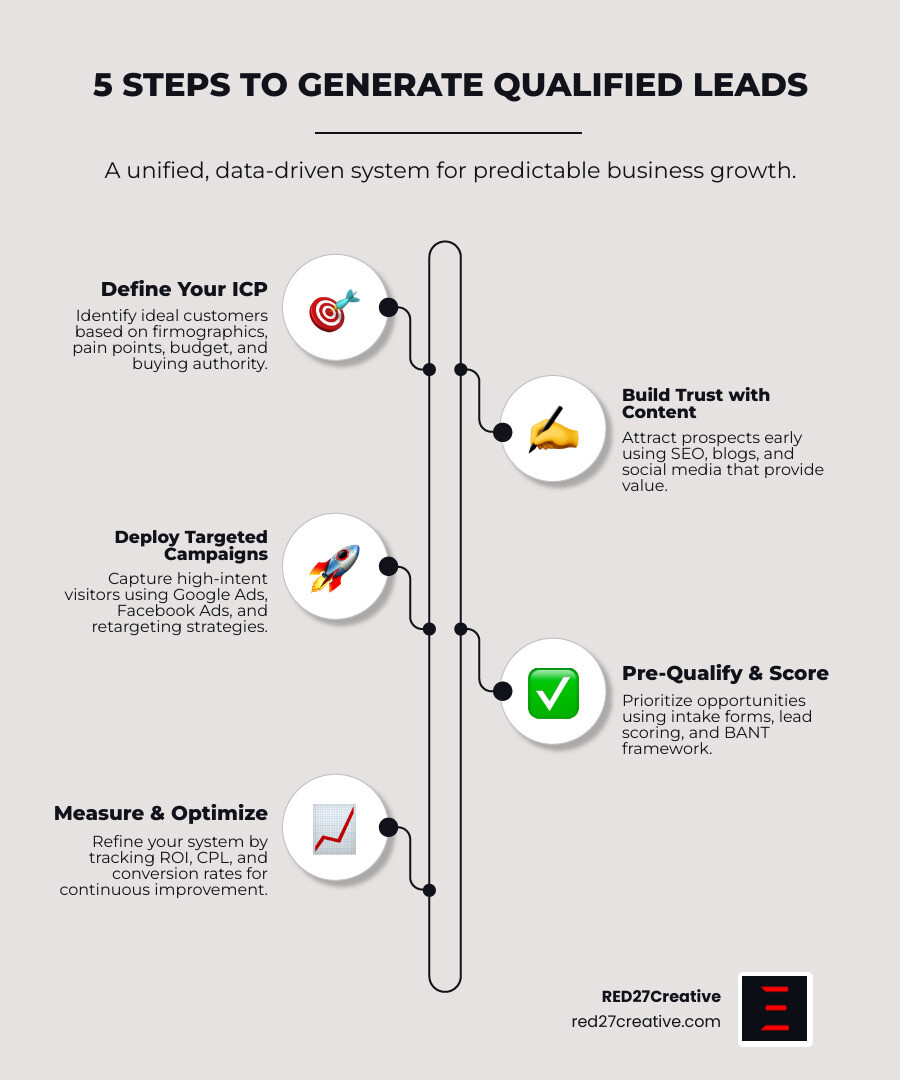
Generate qualified leads terms explained:
The Foundation: Defining Your Target and Understanding Lead Quality
Success starts with attracting the right leads—not just more leads. By understanding who your ideal customer is, you can tailor your efforts to attract those most likely to convert.
What is a Qualified Lead?
A lead is anyone who shows interest, but a qualified lead is a potential client who matches your ideal client profile (ICP) in terms of need, budget, and timing. These leads are a good fit for your business and far more likely to become paying customers. The journey of a lead often involves different stages of qualification:
- Marketing Qualified Lead (MQL): A prospect who has engaged with marketing content (e.g., downloaded an ebook) and shows potential but isn’t ready for a sales call.
- Sales Qualified Lead (SQL): A prospect vetted by marketing and sales, confirmed to have a need, budget, and authority, and is ready for a direct sales engagement.
- Product Qualified Lead (PQL): Common in SaaS, a PQL is a prospect who shows buying intent through product usage, like a free trial user hitting a key milestone.
- Service Qualified Lead: An existing customer who expresses interest in an upgrade or new service during a support interaction.
Understanding these distinctions allows for tailored nurturing and a smooth transition from interest to conversion.
Building Your Ideal Customer Profile (ICP)
To effectively generate qualified leads, you must first define your Ideal Client Profile (ICP), which outlines the characteristics of your perfect customer.
Key characteristics for your ICP include:
- Firmographics: Industry, company size, revenue, location (e.g., businesses in Geneva IL, Batavia IL, Aurora IL, St. Charles IL, Plainfield IL, Oswego IL, Naperville IL, Chicago IL).
- Demographics: Job titles and roles of key decision-makers.
- Technographics: The technology stack they currently use.
- Pain Points & Goals: The challenges your product or service can solve.
Defining your ICP is crucial for focusing marketing resources on the most promising prospects and avoiding wasted time and budget.
Mapping the Lead Generation Funnel
Understanding how prospects move from stranger to customer is key. This journey is often visualized as a lead generation funnel with three main stages:
- Top of the Funnel (TOFU): In the awareness stage, attract a wide audience with educational content like blog posts and social media that address their pain points.
- Middle of the Funnel (MOFU): In the consideration stage, offer in-depth content like ebooks, webinars, and case studies to position your business as a viable solution.
- Bottom of the Funnel (BOFU): In the decision stage, focus on conversion with content like product demos, free trials, and consultations.
Each stage requires different strategies to guide prospects effectively, ensuring that by the time a lead reaches BOFU, they are well-informed and highly qualified.
Attracting High-Intent Prospects: Inbound Strategies that Work

Providing value and building trust attracts prospects before they’re ready to buy. This inbound approach focuses on drawing customers in by creating helpful experiences and content custom to their needs.
The Role of Content Marketing and SEO
Content marketing and SEO are a powerful duo for attracting qualified leads. Content builds trust, answers questions, and significantly increases your online visibility. When prospects are searching for solutions, we want our clients to be the answer they find.
Did you know that companies see up to 134% more website traffic with strategic SEO? This isn’t just about showing up in search results; it’s about showing up for the right search queries, those that indicate high intent. Our B2B SEO Strategies focus on optimizing your website and content to rank for keywords your ICP is actively searching.
From informative blog posts to comprehensive guides, our content writing and editing services ensure that every piece of content serves a purpose in your lead generation efforts. The goal is to attract leads who are already interested in your offering, rather than interrupting people with unsolicited messages. This aligns perfectly with the inbound methodology, where we create valuable content and experiences that attract qualified prospects.
Leveraging Social Media for Lead Generation
Social media is no longer just for brand awareness; it’s a vital channel to generate qualified leads. Platforms like Facebook and LinkedIn offer unparalleled opportunities to engage prospects where they spend a significant amount of their time.
Consider this: nearly 70% of marketers use Facebook in their marketing strategy. For B2B businesses, LinkedIn is a goldmine. Our Lead Generation Social Media strategies focus on creating content that resonates with your target audience, fostering engagement, and driving them to your website. The real power of social media advertising lies in its ability to segment audiences with incredible precision, ensuring your message reaches the right people.
Our B2B LinkedIn Lead Generation Service leverages LinkedIn’s professional network to connect with decision-makers, share industry insights, and promote gated content. This helps us nurture relationships and identify prospects who are actively seeking solutions.
Building Trust and Authority
In today’s competitive landscape, trust is currency. To generate qualified leads, businesses must establish themselves as authoritative and reliable. One of the most effective ways to do this is by showcasing social proof.
Testimonials, case studies, and online reviews act as powerful endorsements. When potential clients see that others have had positive experiences with your business, it significantly boosts their confidence. We help our clients implement strategies for how to get more reviews and effectively leverage them across their marketing channels.
The “halo effect” suggests that positive impressions in one area can influence overall perception. Logos of satisfied clients or press mentions on your website can trigger this effect, building instant credibility. Adding social proof in the form of testimonials, using the voice of your happy customers, is a highly effective strategy. People also tend to look at faces more than other images, so featuring your team and client success stories visually can build immense trust and authority.
How to Generate Qualified Leads with Targeted Campaigns
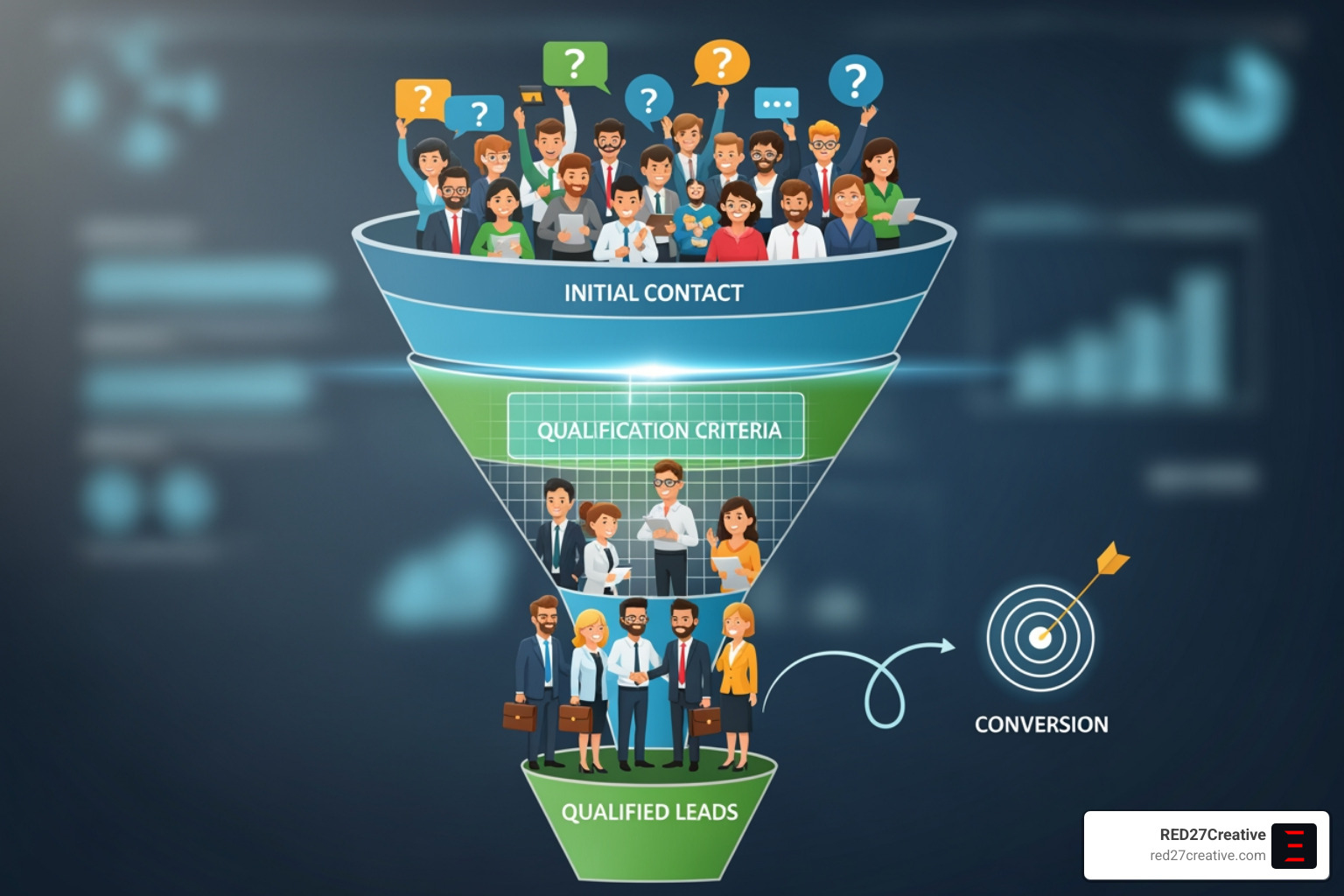
Once you’ve laid the foundation, the next step is to capture leads through scalable, targeted campaigns using paid advertising and smart retargeting.
Using Paid Ads: Google Ads and Facebook Ads
Paid advertising on platforms like Google and Facebook are effective ways to generate qualified leads, each with distinct strengths.
| Feature | Google Ads | Facebook Ads |
|---|---|---|
| Intent | High (captures active searchers) | Lower (creates demand, targets based on interests) |
| Targeting | Keywords, location, demographics | Demographics, interests, behaviors, custom audiences |
| Cost | Can be higher for competitive keywords | Generally lower CPC, but requires more nurturing |
| Format | Text ads, Shopping, Display, Video | Image, video, carousel, lead forms |
Google Ads (PPC) excels at capturing high-intent prospects actively looking for a solution, like someone searching for “IT consulting companies Chicago.” Our Google Ads Campaign Management ensures your ads appear at the top of relevant search results.
Facebook Ads allows for precise audience targeting based on demographics, interests, and behaviors. This is ideal for creating demand among those who fit your ICP but aren’t actively searching. Using Google for intent and Facebook for reach creates a powerful lead generation engine.
Efficient Lead Capture with Retargeting
Not every visitor converts on their first visit. Retargeting re-engages warm audiences who have shown interest but haven’t yet taken action. With tools like the Meta Pixel, we can track website activity and show targeted ads to these users on Facebook and Instagram, reminding them of your services. This is a cost-effective way to convert prospects already familiar with your brand. Hootsuite offers a guide to installing the Meta Pixel.
Optimizing Your Website to Generate Qualified Leads
Your website is the central hub for all lead generation efforts, so optimizing it for lead capture is non-negotiable.
Best practices for website optimization include:
- High-Converting Landing Pages: Use dedicated, focused landing pages for each campaign with a single, clear call to action. Our website design services focus on creating pages that convert.
- Clear Calls to Action (CTAs): Use prominent, action-oriented CTAs (e.g., “Get a Free Quote,” “Download the Ebook”).
- Streamlined Forms: Keep forms as short as possible, asking only for essential information to reduce friction.
- Live Chat and Chatbots: Use AI chatbot lead generation for immediate engagement and to capture contact details from casual browsers.
Your entire website flow should guide visitors from awareness to action. Each page must be built for a specific purpose that aligns with the visitor’s journey and your marketing goals.
Qualifying, Measuring, and Optimizing for Maximum ROI
Generating leads is just the first step. To succeed, you must qualify them, measure your efforts, and continuously optimize for maximum return on investment. This ensures your marketing efforts translate into actual sales.
Best Practices to Pre-Qualify New Leads
Pre-qualifying leads is essential to ensure your sales team focuses on prospects who are a good fit. This process helps determine if a lead has the budget, authority, need, and timing (BANT) to become a customer.
- Intake Forms: Use detailed intake forms on your website to gather crucial information upfront. For example, a law firm might ask for a prospect’s city to ensure they are within their service areas like Geneva, St. Charles, or Aurora, IL.
- Qualifying Questions: Integrate specific questions into forms or initial conversations that align with your ICP, such as budget or current provider status.
- The BANT Framework: This classic framework is invaluable for assessing lead readiness.
- Budget: Does the lead have the financial resources to invest?
- Authority: Does the lead have decision-making power?
- Need: Does the lead have a clear problem your offering can solve?
- Timing: Is the lead looking to implement a solution soon?
By using these practices, we can effectively pre-qualify new leads, ensuring that the sales team connects with prospects who are ready and able to buy. A cohesive intake process is paramount for managing leads efficiently.
Using Lead Scoring and Grading
Not all leads are created equal. Lead scoring and grading help prioritize them effectively, guiding your sales and marketing teams on where to focus their energy.
- Lead Scoring: This involves assigning numerical values to leads based on their behavior. A prospect who downloads a product demo receives a higher score than someone who just visits your homepage. Points are added for actions like visiting key pages or opening emails, and deducted for inactivity.
- Lead Grading: This evaluates a lead’s fit with your ICP. A lead from a large enterprise in your target industry would receive a higher grade (e.g., A) than one from a smaller, unrelated business (e.g., C).
When used together, lead scoring and grading offer a comprehensive view of a lead’s potential. This helps in scoring traffic sources for better ROI and ensures a smooth transition from lead generation to sales conversion by focusing on the most promising prospects.
Measuring ROI and Proving Your Impact
The ultimate goal of lead generation is to drive revenue, so measuring the return on investment (ROI) is critical. We use analytics tools to showcase and maximize the impact of our lead generation efforts.
Key metrics to track include:
- Cost Per Lead (CPL): The cost to acquire a single lead.
- Cost Per Acquisition (CPA): The cost to convert a lead into a paying customer.
- Conversion Rate: The percentage of leads that become customers.
- Sales Cycle Length: The time it takes for a lead to move through the sales process.
- Customer Lifetime Value (CLTV): The total revenue a customer is expected to generate.
By consistently monitoring these metrics, we can identify what’s working and where to optimize. For example, a campaign with a high CPL might still be highly profitable if it also has a high conversion rate and CLTV. A common pitfall is failing to align sales and marketing teams. We ensure a smooth transition by integrating CRM platforms and establishing clear processes for lead handoff and feedback. This continuous feedback loop allows for ongoing refinement, ensuring lead generation efforts consistently deliver high-quality, sales-ready prospects.
Frequently Asked Questions about Generating Qualified Leads
What is the difference between a lead and a qualified lead?
A lead is anyone who shows interest in your product or service. A qualified lead matches your ideal customer profile and is more likely to convert, based on criteria like budget, authority, need, and timing. We focus on identifying these high-potential prospects to maximize your marketing efficiency.
What are the most effective channels to generate qualified leads?
The best channels depend on your audience, but a mix of SEO, content marketing, Google Ads, social media (especially LinkedIn for B2B), and email nurturing is highly effective. We analyze your unique business to determine the optimal channel mix for your specific goals and target market.
How do you measure the quality of a lead?
Lead quality is measured by lead scoring (actions taken), grading (fit with ICP), conversion rates, sales cycle length, and customer lifetime value. By tracking these metrics, we ensure your sales team prioritizes the leads most likely to become valuable, long-term customers.
Conclusion: Build Your Unified Engine for Growth
Generating qualified leads requires a unified, data-driven system. By defining your ideal customer, attracting them with valuable content, capturing interest with targeted campaigns, and qualifying and measuring results, you create a predictable engine for growth.
At RED27Creative, we understand that true growth comes from more than just traffic; it comes from converting that traffic into consistent, qualified opportunities. Our team in Geneva, IL, and across the Chicago metropolitan area, specializes in building integrated lead generation systems that connect every part of your marketing—from advanced SEO and local listings to custom web design and strategic consulting—into one cohesive engine.
Partner with us for expert Lead Generation Services and open up your pipeline today. We’re ready to help you build the right foundation, increase your visibility where it matters most, and turn that visibility into measurable results.

Kiel Tredrea
https://red27creative.comTop Marketing Agency • Web, SEO & Leads • RED27Creative