Beyond the Click: Mastering Paid Search for Explosive Lead Growth

Why PPC & Paid Lead Generation Drives Measurable Business Growth
PPC & Paid Lead Generation uses paid advertising platforms like Google Ads and LinkedIn to drive targeted traffic to landing pages designed to capture potential customer contact information.
Quick Answer: How PPC Lead Generation Works
- Target high-intent keywords – People actively searching for your solution
- Create compelling ads – Click-worthy copy that addresses pain points
- Send traffic to conversion-focused landing pages – Not your homepage
- Capture lead information – Forms, calls, or demo requests
- Track and optimize – Measure Cost Per Lead (CPL) and ROI
- Scale what works – Increase budget by 15-20% incrementally
Key Benefits:
- Immediate visibility (no waiting for SEO rankings)
- Around 80% of companies rely on PPC to fuel their growth
- PPC traffic converts roughly 50% better than organic traffic
- Businesses earn an average of $2 for every $1 spent on ads
- Complete control over targeting, budget, and lead quality
Struggling with unpredictable lead flow or campaigns that only generate clicks? The difference between burning money and building a profitable lead machine is strategy, structure, and systematic optimization.
Critical mistakes like sending traffic to homepages, ignoring mobile users, or a “set it and forget it” approach lead to high costs and low conversions.
When done right, PPC is a predictable growth channel. You gain instant visibility on Google, reach decision-makers on LinkedIn, and retarget prospects. You control the audience, the action, and the cost per lead.
This isn’t about vanity metrics; it’s about turning ad spend into revenue. Success requires understanding the full journey, from keyword research to landing page design and tracking bottom-line KPIs.
I’m Kiel Tredrea, founder of RED27Creative. With over 20 years of experience helping B2B businesses drive measurable growth, this guide will show you how to build, optimize, and scale PPC & Paid Lead Generation campaigns for qualified leads and real ROI.
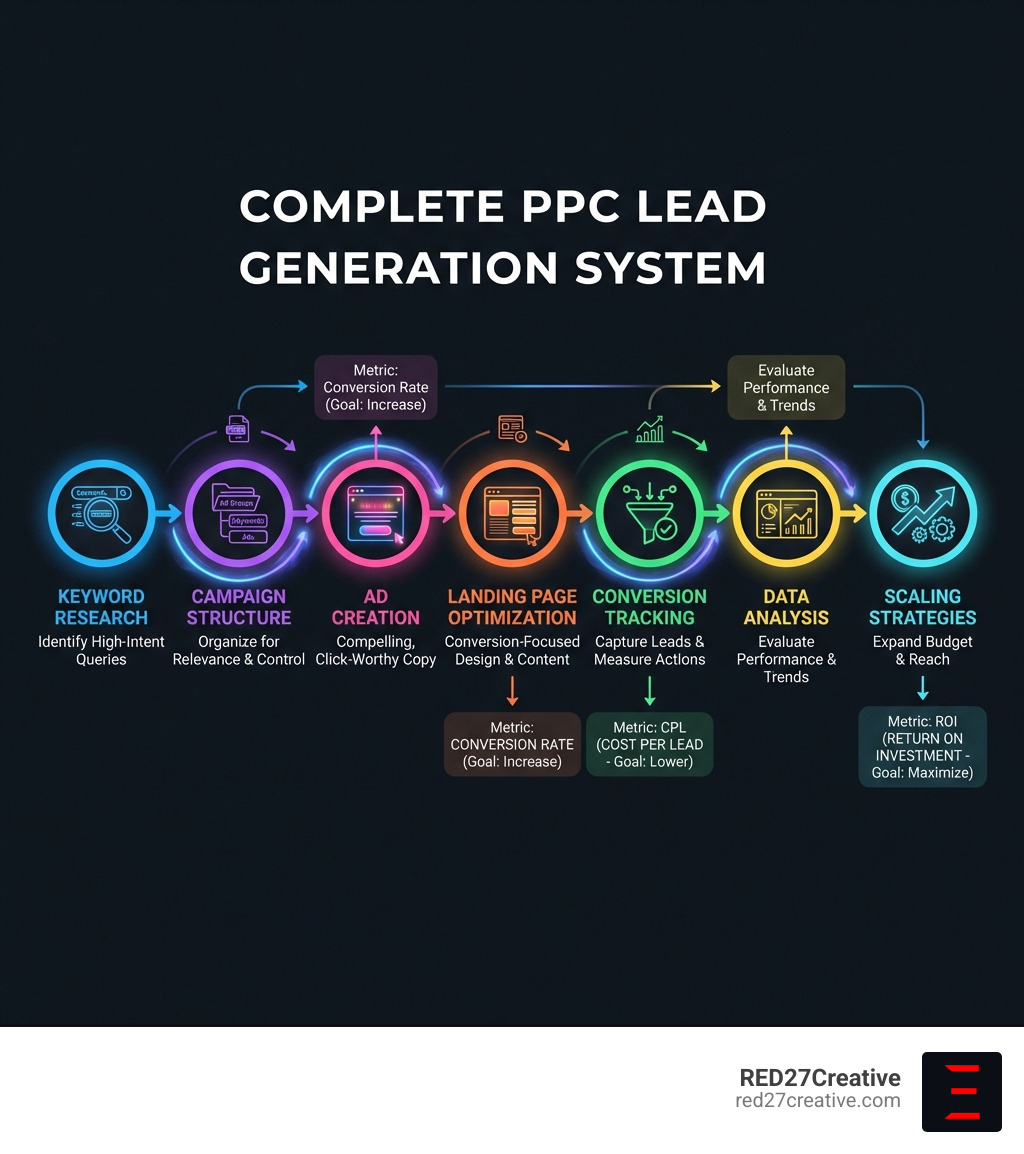
PPC & Paid Lead Generation word guide:
The Foundation: Why PPC is a Game-Changer for Lead Generation
PPC & Paid Lead Generation uses paid ads to capture leads. It strategically reaches people actively searching for your solution, making it vital for businesses in areas like Geneva, Naperville, and Chicago needing consistent, qualified leads.
Unlike organic SEO, which can take months to rank, PPC delivers instant visibility. Your ads can appear on the first page of search results almost immediately, putting your business directly in front of high-intent searchers.
PPC’s targeting precision is a game-changer. We can pinpoint demographics, locations (like Aurora, Batavia, or St. Charles, IL), interests, and job titles to reach the most likely leads, ensuring efficient budget allocation.
PPC traffic converts roughly 50% better than organic traffic, generating more leads. Its unparalleled measurability lets us track every click, conversion, and dollar to optimize campaigns and prove ROI. Businesses often earn an average of eight times their investment back.
Key Benefits Over Other Marketing Channels
Compared to other channels, PPC’s advantages are clear. Its immediate visibility bypasses SEO’s long wait times, providing instant traffic while SEO builds long-term growth.
PPC often boasts a higher conversion intent than social media advertising. People on Google are actively looking for solutions, while social media ads often interrupt users not in a buying mindset.
Granular PPC data is invaluable. We see which keywords, ads, and landing pages drive conversions, allowing for continuous optimization and refined targeting to attract the most qualified prospects.
Remarketing is a powerful tool for re-engaging website visitors. It guides interested prospects down the sales funnel, helping achieve the multiple touchpoints often needed for conversion.
It’s clear that advertising is a massive industry, and the majority of Google’s revenue is generated through advertising. This dominance signifies the effectiveness of paid search.
Lead Generation vs. Brand Awareness Campaigns
Not all PPC campaigns are created equal; their objectives dictate their structure. We differentiate between PPC & Paid Lead Generation campaigns and brand awareness campaigns.
| Feature | Lead Generation Campaign | Brand Awareness Campaign |
|---|---|---|
| Goal | Direct, measurable action (form fills, calls, demos) | Increase visibility, recognition, and recall |
| KPIs | Cost Per Lead (CPL), Conversion Rate, Lead-to-Close Rate | Impressions, Reach, Engagement Rate, Brand Mentions |
| Ad Copy | Offer-focused, problem/solution, clear Call-to-Action | Value-focused, emotional, storytelling |
| Landing Page | Conversion-optimized, minimal distractions, short forms | Informational, engaging content, brand story |
| User Intent | High commercial intent, actively seeking solutions | Broad audience, often early in buyer’s journey |
| Measurement | Direct ROI, sales pipeline impact | Brand uplift studies, direct traffic, branded searches |
For PPC & Paid Lead Generation, the goal is direct action. Success is measured by Cost Per Lead (CPL) and lead-to-close rate. Ad copy is offer-focused, and landing pages are designed for conversion.
Brand awareness campaigns aim for visibility, with KPIs like impressions and reach. While not generating leads directly, they warm up audiences for future efforts. For a deeper dive, explore our B2B Demand Generation Ultimate Guide.
Building Your High-Converting Campaign from the Ground Up
A successful PPC & Paid Lead Generation campaign requires a solid blueprint. Launching without a plan burns ad spend, so we use strategic planning to ensure every campaign, from Plainfield to Oswego, IL, is set up for success.
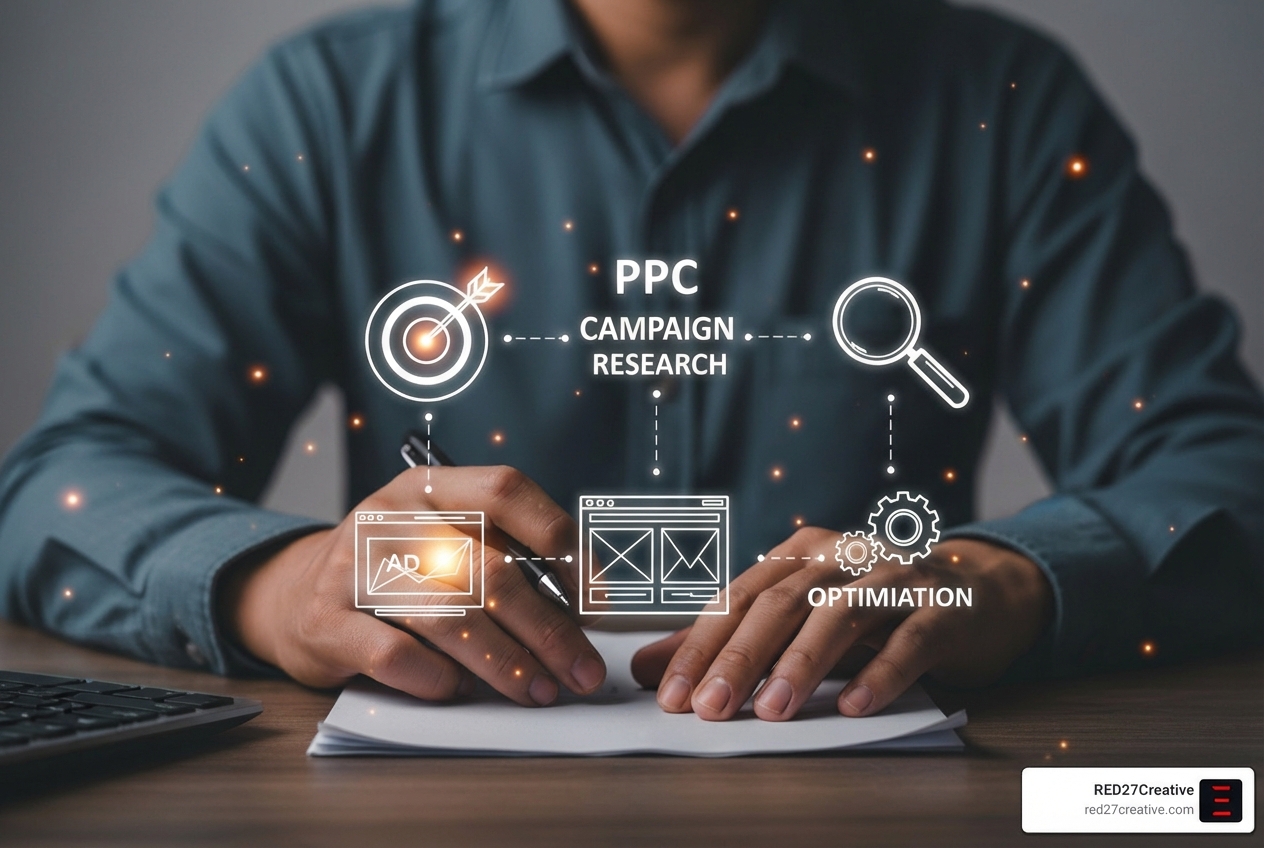
Our process starts with a deep understanding of your business, customers, and value proposition to ensure every campaign element is aligned for lead capture. Find more guidance on our PPC Campaign Setup page.
Identifying High-Intent Keywords for PPC & Paid Lead Generation
Identifying high-intent keywords is the most critical step in PPC & Paid Lead Generation, connecting us with people actively seeking your solution. We target commercial or transactional keywords (e.g., “best PPC services Chicago”) over informational ones (e.g., “what is CRM software”).
We categorize keyword intent to guide our strategy:
- Informational: Users seeking general information.
- Navigational: Users looking for a specific brand.
- Commercial Investigation: Users researching services with intent to buy.
- Transactional: Users ready to take a lead action (e.g., “PPC management firm Geneva IL quote”).
Long-tail keywords (e.g., “B2B lead generation for manufacturing”) have lower volume but higher conversion rates due to strong intent. We use keyword research tools to find them.
Negative keywords are equally important for avoiding wasted spend on irrelevant terms like “free” or “template,” which improves lead quality. Our Google Ads Marketing Firm experts excel at this.
Choosing the Right PPC Platforms
The right platform depends on your target audience. Google Ads captures active searchers, while LinkedIn targets professionals by job title.
- Google Ads: Our go-to for capturing existing demand. It’s ideal for high-intent keywords and immediate lead generation.
- LinkedIn Ads: Invaluable for B2B lead generation, allowing us to target professionals by job title, industry, and company size. We specialize in B2B LinkedIn Lead Generation Service to connect with your ideal buyers.
- Facebook/Instagram Ads: Effective for B2B demographic targeting and brand awareness, leveraging detailed user data.
We consider user intent and budget for each platform. Google users have immediate needs, while LinkedIn users are in a professional mindset. Costs per click and lead also vary.
Crafting Irresistible Ads and High-Converting Landing Pages
Your ad and landing page must work in harmony. Ad copy must be compelling, benefit-driven, and include a clear Call-to-Action (CTA) that addresses pain points.
A high-converting landing page is a dedicated page focused on a single conversion goal, not your homepage.
Here are the essential elements of a high-converting landing page:
- Message Matching: The landing page headline must echo the ad’s promise (e.g., a “free B2B marketing checklist”). This creates a seamless experience and boosts Quality Score.
- Compelling Headline: A clear, benefit-driven headline that grabs attention.
- Benefit-Driven Copy: Concise text that highlights your value proposition.
- Strong Call-to-Action (CTA): A prominent button (e.g., “Get Your Free Demo”) that tells users what to do next.
- Minimal Form Fields: Only ask for essential information. A form with 3 fields converts better than one with 7.
- Trust Signals: Include testimonials, client logos, and security badges to build credibility.
- Mobile-First Design: Your landing pages must be fast-loading and responsive, as over half of PPC traffic is mobile.
- No Distractions: Remove unnecessary navigation and external links.
We continuously A/B test elements like headlines and CTAs to find what resonates best. Our Complete Digital Marketing Funnels Guide offers more insights on optimizing conversion paths.
Mastering PPC & Paid Lead Generation: Optimization, Scaling, and ROI
Launching a PPC & Paid Lead Generation campaign is just the beginning. Mastery requires continuous optimization, responsible scaling, and meticulous ROI measurement. We build systems that learn and improve, turning ad spend into an efficient lead-generating machine.
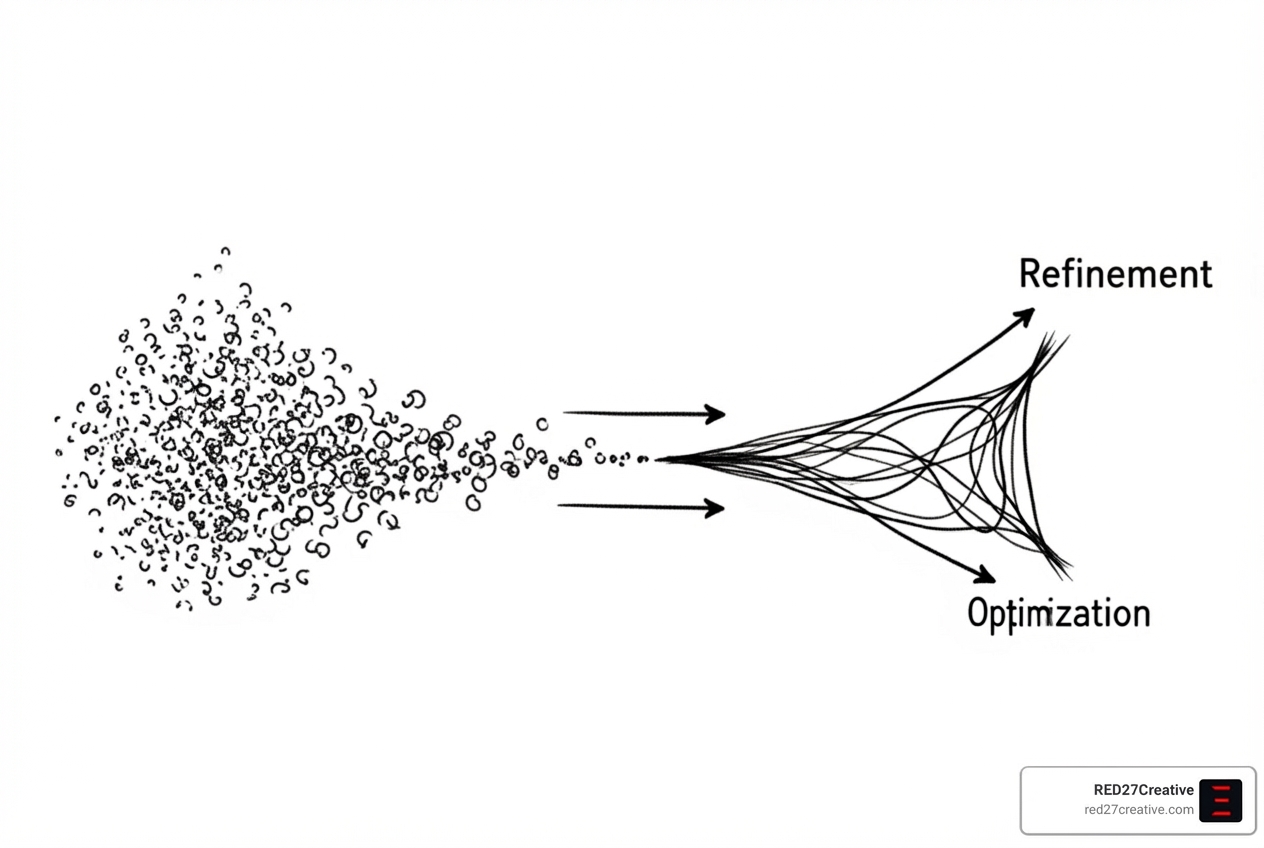
Optimizing Campaigns with A/B Testing and Data Analysis
Optimization is the ongoing process of refining campaigns based on performance data, using a systematic approach to achieve your lead generation goals.
- Testing Ad Copy Variations: We continuously test headlines, descriptions, and CTAs to find combinations with the highest Click-Through Rates (CTR) and conversion rates.
- Landing Page A/B Tests: We test elements like form length, images, value propositions, and CTA placement to maximize conversions.
- Analyzing Search Term Reports: These reports show the actual queries that triggered your ads, which is gold for finding new keywords and adding negative keywords.
- Adjusting Bids: We monitor bid performance and adjust strategies (e.g., Manual CPC to Target CPA) to achieve the desired Cost Per Lead (CPL).
- Optimizing for Quality Score: A high Quality Score lowers ad costs and improves ad positions. We improve it by ensuring strong message match and high CTRs.
- Device and Location Performance: We analyze performance on devices (desktop vs. mobile) and in specific areas (like Naperville vs. Chicago) to tailor strategies.
Our Google Ads Audit Complete Guide provides a framework for this continuous improvement.
Scaling Your Campaigns Responsibly
When a PPC & Paid Lead Generation campaign is successful, responsible scaling is key to maintaining efficiency without disrupting the algorithm.
- When to Scale: Only scale proven campaigns that consistently deliver qualified leads at an acceptable CPL and ROI.
- Incremental Budget Increases: We recommend incremental budget increases of 15-20% every few days to allow the platform’s algorithm to adjust.
- Expanding Keyword Targets: Look for related high-intent keywords or broader match types for successful keywords.
- Exploring New Ad Formats: If search ads work, consider expanding to display, YouTube, or other campaigns with similar targeting.
- Geographic Expansion: If a campaign performs well in one city, cautiously expand to nearby areas like St. Charles or Batavia, IL, monitoring performance closely.
Scaling isn’t just spending more; it’s strategically expanding what works. Our PPC Campaign Strategy details this measured approach.
Measuring True ROI for PPC & Paid Lead Generation
Measuring true ROI goes beyond clicks or leads. We connect ad spend directly to sales revenue, which is crucial for B2B’s long sales cycles.
Key Performance Indicators (KPIs) we track:
- Cost Per Lead (CPL): Total campaign cost divided by the number of leads.
- Lead-to-Close Rate: This measures lead quality. A campaign with a higher CPL might be more profitable if its leads close at a higher rate.
- Customer Lifetime Value (CLV): The total revenue a customer is expected to generate. CLV helps determine how much you can profitably spend to acquire a customer.
To measure true ROI, we implement offline conversion tracking by connecting ad platforms to your CRM. This allows the platform to optimize for high-value customers, not just leads.
Attribution models beyond last-click are also critical for understanding a buyer’s journey. We use models like Linear, Position-Based, or Data-Driven to accurately view each channel’s influence and help you Generate Qualified Leads that impact your bottom line.
Advanced Tactics and Common Pitfalls to Avoid
Mastering PPC & Paid Lead Generation requires looking beyond the basics to advanced strategies and common pitfalls. This builds a resilient lead generation system. For new businesses, our PPC for Startups guide offers custom advice.
The Difference Between Lead Gen and E-commerce PPC
While both use PPC, lead generation and e-commerce strategies differ significantly, and understanding these differences is crucial for success.
- Qualification Process: E-commerce has no qualification process; users buy directly. B2B lead generation requires a qualification process to understand prospect needs.
- Sales Cycle Length: E-commerce has a short sales cycle. Lead generation often involves longer, complex sales cycles that require nurturing.
- Ad Copy Focus: E-commerce copy drives transactions (“Buy Now”). Lead gen copy focuses on information exchange (“Get a Free Quote”).
- Landing Page Goals: E-commerce pages aim for direct sales. Lead gen pages aim for lead capture (form fills, calls).
- Nurturing vs. Immediate Gratification: Lead generation builds a relationship over time, while e-commerce seeks immediate purchases.
Our B2B PPC Services are designed for the nuances of lead generation in complex sales processes.
Common Mistakes That Waste Your Ad Spend
Even experienced marketers fall into common PPC & Paid Lead Generation pitfalls. We avoid these to ensure your budget is spent effectively.
- Sending Traffic to the Homepage: Your landing page must be hyper-focused on the ad’s offer, not a general homepage. This creates friction and lowers conversions.
- Poor Message Match: If your ad promises a “free consultation” but the landing page doesn’t, users will bounce. The ad and landing page must align.
- Ignoring Negative Keywords: Failing to use negative keywords means paying for irrelevant clicks and attracting unqualified leads.
- “Set It and Forget It” Mentality: PPC requires continuous monitoring, analysis, and optimization to remain effective.
- Not Tracking Conversions: Without proper conversion tracking, you’re driving blind and won’t know what’s working or your true CPL.
- Overly Broad Ad Groups: Lumping too many keywords into one ad group leads to generic ad copy and low Quality Scores.
- Neglecting Mobile Optimization: With over half of PPC traffic from mobile, ignoring mobile-friendly design means losing potential leads.
Staying Ahead: Industry Trends and Continuous Learning
The paid media landscape is constantly evolving. Staying updated is essential to maintain a competitive edge in PPC & Paid Lead Generation.
- AI in PPC: Artificial intelligence is increasingly automating bidding, targeting, and ad creation. Leveraging AI is crucial. Our insights into AI Chatbot Lead Generation are one example of how we stay current.
- Privacy Changes: Evolving privacy regulations (like GDPR) and cookie deprecation impact targeting. We adapt our strategies to ensure compliance.
- New Ad Formats: Platforms regularly roll out new ad formats (e.g., video, interactive ads). Experimenting with these can open new opportunities.
- Platform Updates: Google Ads and LinkedIn frequently update their algorithms. Staying informed helps us adapt quickly.
- Following Industry Experts: We follow thought leaders like Mike Rhodes for insights and best practices.
Continuous, data-driven education and experimentation are essential for optimal results.
Frequently Asked Questions about PPC Lead Generation
What is a good Cost Per Lead (CPL) for a PPC campaign?
A “good” CPL is relative to your industry, profit margins, and Customer Lifetime Value (CLV). Instead of chasing benchmarks, focus on your lead-to-close rate. A profitable CPL is any cost that allows you to acquire a customer while maintaining a healthy ROI.
How long does it take to see results from PPC lead generation?
You can see traffic and impressions almost immediately. However, generating a consistent flow of qualified leads typically takes a few weeks to a few months. This period is for data collection, A/B testing, and optimization to find what works.
How much should I budget for my first PPC campaign?
Start with a test budget you’re comfortable with, typically $1,000 – $2,500 for the first month. This provides enough data to establish a baseline CPL and identify winning elements. You can then scale your budget based on performance and ROI.
Conclusion: From Clicks to Conversions, Build Your Growth Engine
PPC & Paid Lead Generation is a strategic system for creating a predictable pipeline of qualified prospects. By building a solid foundation, creating relevant experiences, and relentlessly optimizing with data, you can turn ad spend into explosive business growth. The key is focusing on the entire customer journey, not just the click. RED27Creative specializes in building these unified marketing systems. Based in Geneva, IL, we help businesses across the Chicago area, including Naperville, Aurora, and St. Charles, turn visibility into qualified opportunities.
Ready to turn your visibility into measurable results? Explore our Google Ads Management Services and let’s build your growth engine together.

Kiel Tredrea
https://red27creative.comTop Marketing Agency • Web, SEO & Leads • RED27Creative