From Clicks to Conversions: Mastering Website Optimization for Enterprise Growth

The Strategic Pillars of B2B Website Optimization
B2B website optimization is the ongoing process of improving your website’s technical performance, search visibility, user experience, and conversion paths to turn professional visitors into qualified leads and measurable revenue.
Quick answer — what B2B website optimization covers:
| Pillar | What It Means |
|---|---|
| SEO | Ranking for high-intent keywords your buyers actually search |
| Speed | Pages that load in under 2 seconds to prevent revenue loss |
| UX | Clear navigation that guides multiple stakeholders toward action |
| CRO | Turning existing traffic into leads through testing and trust signals |
Here’s a number that should stop you cold: the average B2B website converts less than 2% of its visitors into leads. That means 98 out of every 100 people who find your site leave without doing anything.
And yet, 70% of the B2B buyer’s journey now happens digitally. Your website isn’t just a marketing asset — it’s your hardest-working salesperson. It’s running 24 hours a day, fielding questions from 6 to 10 stakeholders who each research independently before a single conversation with your sales team ever happens.
The problem most B2B companies face isn’t a lack of effort. It’s that their site was built to look credible, not to perform. Fast load times, clear messaging, intent-matched content, and frictionless conversion paths are what separate a digital brochure from a genuine revenue engine.
This guide walks you through exactly how to close that gap.
I’m Kiel Tredrea, founder of RED27Creative, and over the past 20 years I’ve helped hundreds of B2B brands turn underperforming websites into measurable growth systems through B2B website optimization strategies that combine SEO, conversion design, and data-driven performance. Let’s get into what actually moves the needle.
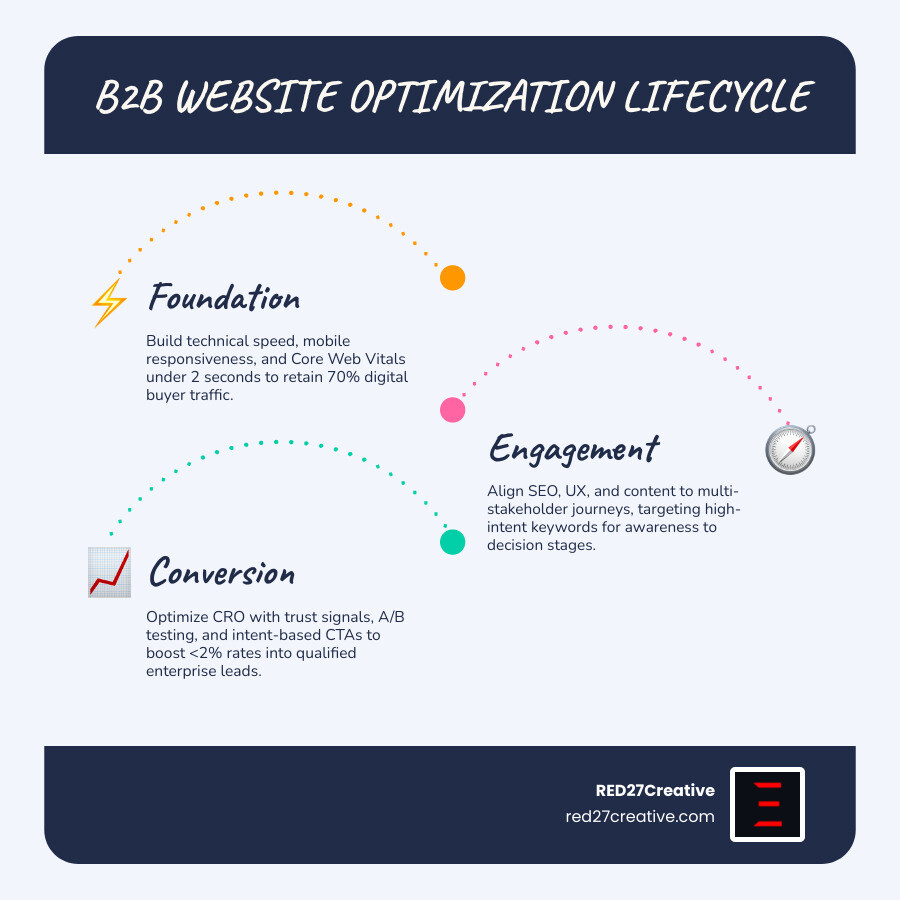
Terms related to B2B website optimization:

To build a high-performance B2B site in 2026, we have to move past “set-it-and-forget-it” mentalities. Real growth comes from a unified approach where four specific pillars work in harmony. If one is weak, the entire lead generation engine stalls.
First, we focus on visibility through SEO—ensuring the right people find you. Next, we address speed and technical performance because even a one-second delay can erode trust and kill conversions. Then comes User Experience (UX), which ensures that once they arrive, they can find what they need without cognitive overload. Finally, we apply Conversion Rate Optimization (CRO) to turn that interest into a formal inquiry.
At RED27Creative, we’ve found that website conversion rate optimization is often the fastest way to increase revenue without spending a dime more on traffic. By refining the experience for your existing visitors, you maximize the value of every click. This requires data-driven web design that uses actual user behavior—like heatmaps and scroll depth—to dictate where buttons, text, and trust signals should live.
Intent-Aligned SEO Strategy
In B2B, traffic volume is a vanity metric. What matters is intent. Ranking for a broad term might bring thousands of visitors, but if they aren’t looking to solve a specific business problem, they won’t convert.
We prioritize “money keywords”—those high-intent phrases that indicate a buyer is in the evaluation or decision stage. Think “enterprise cloud security platform pricing” instead of just “cloud security.” Effective SEO website design maps these keywords to specific pages, ensuring that when a CFO or IT Director lands on your site, the content matches exactly what they were searching for.
User Experience and Information Architecture
B2B buyers are famously busy. Research shows that 37% of visitors will leave a site simply due to poor navigation. Our goal is to reduce “cognitive load”—the mental effort required to use your site.
This means organizing your information architecture around buyer problems rather than internal company departments. A frictionless experience often includes self-service portals and clear, hierarchical menus that allow a researcher to find spec sheets, pricing, or case studies in two clicks or less. When you invest in custom web design and development, you aren’t just buying a pretty layout; you’re building a logical path that guides multiple stakeholders toward a “yes.”
Technical Foundations: Speed, Mobile, and Core Web Vitals
Technical debt is a silent killer of B2B leads. Google’s Core Web Vitals (CWV) are no longer just “nice-to-have” metrics; they are essential ranking and conversion factors. Amazon famously found that every 100ms of latency cost them 1% in sales. In the B2B world, a two-second delay in page rendering leads to roughly a 4% loss in revenue per visitor.
We focus on three main metrics:
- LCP (Largest Contentful Paint): How fast the main content loads. Aim for under 2.5 seconds.
- INP (Interaction to Next Paint): How quickly the site responds to a user’s click.
- CLS (Cumulative Layout Shift): Ensuring elements don’t jump around as the page loads.
To hit these targets, we utilize image compression and the WebP format, which reduces file sizes without sacrificing the professional look of your brand. For businesses looking for a leading Aurora IL web design and development agency, these technical fixes are often the first step in our optimization roadmap. Responsive website development ensures these performance gains translate across every device your buyers use.
Mobile-First B2B Website Optimization
It’s a myth that B2B happens only on desktops. In 2026, 80% of B2B buyers use mobile devices during working hours for research and purchasing. If your “Request a Quote” form is impossible to fill out with a thumb, you are losing half your pipeline.
We optimize for mobile by simplifying menus and ensuring CTAs are “thumb-friendly” and prominently placed. Whether you are running a WordPress B2B website or a custom stack, the mobile experience must be as robust as the desktop version.
Advanced Schema and AI Indexing
As AI-driven search (like ChatGPT and Gemini) becomes more prevalent, B2B website optimization must include “Generative Engine Optimization” (GEO). We use structured data and FAQ schema to help search engines—and AI models—understand exactly what you sell and who you serve. This technical SEO layer ensures your brand is the one cited when an AI assistant answers a buyer’s complex query. This is a core part of our enterprise WordPress solutions, making your site readable for both humans and machines.
Content Strategy for the Multi-Stakeholder Buyer Journey
B2B purchasing is rarely a solo act. A typical enterprise deal involves 6 to 10 decision-makers across IT, Finance, Operations, and Marketing. Your content must speak to all of them.
| Stage | Buyer Intent | Content Format |
|---|---|---|
| Awareness | “How do I fix [Problem]?” | Educational Blogs, Original Research |
| Consideration | “What are the best tools for [Solution]?” | Comparison Guides, White Papers |
| Decision | “Is this vendor the right fit for us?” | Case Studies, ROI Calculators, Demos |
By creating topic clusters, we build deep topical authority. This involves a “pillar” page—like a comprehensive guide to B2B enterprise web design—linked to dozens of supporting articles that answer specific stakeholder questions.
Building Authority with B2B Website Optimization
Trust is the real bottleneck in B2B. Third-party validation is 2.4 times more trusted than brand messaging alone. To build E-E-A-T (Experience, Expertise, Authoritativeness, and Trustworthiness), we prioritize thought leadership and original research.
When you publish proprietary data, you become the primary source for your industry, which naturally earns high-quality backlinks. This is exactly why we focus on local authority, such as providing B2B SEO in Saint Charles Illinois, to help businesses dominate their specific niche.
Personalization and Behavioral Data
Modern B2B website optimization uses visitor identification software to see which companies are browsing your site—even if they don’t fill out a form. By using firmographic data (industry, company size, revenue), we can serve dynamic content.
Imagine a visitor from a healthcare company seeing a hero image and case study specific to medical technology, while a manufacturing visitor sees something entirely different. These conversion focused websites feel personal and relevant, significantly shortening the sales cycle.
Conversion Rate Optimization (CRO) and Trust Signals
Once you have the right traffic, you need to convert it. CRO is the science of finding where visitors are “leaking” out of your funnel and plugging those holes. We use A/B testing to compare headlines, button colors, and form lengths.
Social proof is your most powerful weapon. Logos of recognizable clients, certifications, and video testimonials should be placed near high-friction points, like your contact form. We also implement “intent-based CTAs.” Instead of a generic “Contact Us” on every page, we might use “Download the Integration Guide” on a technical page and “Get a Custom Quote” on a pricing page.
For complex offerings, we use “progressive profiling.” Instead of asking for 10 fields of information at once, we ask for three. The next time that visitor returns, we ask for three more. This reduces friction while still giving your sales team the data they need. Our lead generation services are built around these high-conversion tactics to ensure no lead is left behind.
Measuring Success and Building a Unified Roadmap
You cannot optimize what you do not measure. We move beyond vanity metrics like “pageviews” and focus on pipeline impact. Success is measured by:
- Qualified Lead Volume: How many visitors fit your Ideal Customer Profile (ICP)?
- Cost Per Lead (CPL): Is your optimization making your marketing more efficient?
- Conversion Rate by Channel: Which traffic sources drive the most revenue?
Building a unified roadmap requires aligning your marketing, sales, and technical teams. We start with a technical audit and a content gap analysis, then build a sprint-based plan to tackle the highest-impact items first. Our SEO web design packages are designed to provide this structured path to growth, ensuring every update serves a strategic purpose.
Frequently Asked Questions about B2B Website Optimization
What is B2B website optimization and why is it important?
B2B website optimization is the continuous process of improving a site’s performance, search visibility, and user experience to convert professional visitors into qualified leads. In 2026, it is essential because 70% of the buyer’s journey is digital, and a slow or confusing site directly results in lost enterprise revenue.
How long does it take to see results from B2B optimization?
Technical improvements like page speed and mobile fixes often yield results within days. Conversion rate optimization (CRO) typically shows measurable impact within 4 to 8 weeks, while comprehensive SEO strategies and authority building generally require 3 to 6 months to achieve significant ranking shifts and sustained lead flow.
Which pages should be prioritized first for optimization?
Priority should be given to high-intent “money pages” that sit closest to the point of conversion. This includes the homepage, core product or solution pages, pricing sections, and demo request or contact pages. Optimizing these first ensures that existing traffic has the highest possible chance of converting into the pipeline.
Conclusion
At RED27Creative, we don’t believe in digital brochures. We believe in websites that work as hard as you do. Led by founder Kiel Tredrea and based in Geneva, Illinois, our team brings over 20 years of experience to the table. We specialize in building data-driven systems that connect your web design, SEO, and lead generation into one unified engine for growth.
Whether you are looking for web design services in Naperville, Batavia, or Chicago, our goal is the same: to turn your website into your most productive salesperson. B2B website optimization isn’t a one-time project; it’s a strategic commitment to excellence that pays dividends in leads, trust, and long-term revenue. Ready to see what a fully optimized site can do for your bottom line? Let’s build something that converts.

Kiel Tredrea
https://red27creative.comTop Marketing Agency • Web, SEO & Leads • RED27Creative