Struggling with Leads? Master the Art of B2B Sales Generation

Why B2B Lead Generation is Your Growth Engine
Without a steady stream of qualified leads, even the best sales teams can stall. In fact, according to HubSpot research, 61% of marketers say generating traffic and leads is their top challenge. The problem isn’t just getting names—it’s attracting the right prospects who actually convert into revenue.
This guide delivers a proven roadmap to generate B2B sales leads, changing your marketing into a predictable engine for business growth. We’ll cover foundational concepts and advanced strategies to attract, engage, and convert your ideal buyers.
B2B lead generation is different from B2C. Your buyers are skeptical, do extensive research, and often involve multiple decision-makers. They’re looking for solutions to real business problems, not impulse purchases. This means your approach must be strategic, data-driven, and focused on building trust over time.
The businesses that master lead generation create predictable revenue streams. They know where their best leads come from, what messaging resonates, and how to nurture prospects efficiently. They’ve built a system—not just a collection of random tactics.
The key is understanding that lead generation isn’t one thing. It’s a complete ecosystem where your website, content, SEO, social media, and sales process all work together. Each piece supports the others, creating momentum that compounds over time.
I’m Kiel Tredrea, founder of RED27Creative, and I’ve spent over 20 years helping B2B companies generate B2B sales leads through integrated marketing systems that combine strategy, content, and technology. My team and I build lead generation engines that deliver measurable results by connecting every marketing touchpoint into one unified, performance-driven framework.
Generate B2B sales leads terms explained:
- b2b lead generation agency
- b2b linkedin lead generation service
- inbound b2b lead generation services
Understanding the Foundations of B2B Lead Generation
![Diagram showing MQL, SQL, and SAL stages, alt=”Lead qualification stages: MQL, SQL, SAL”]
B2B lead generation is the strategic process of identifying and attracting potential business customers to build a robust sales pipeline. It’s about more than just finding contacts—it’s about gathering actionable business intelligence that drives sustainable revenue and growth. A strong lead generation process ensures your sales team focuses on prospects who are genuinely interested and likely to convert.
This crucial first step in the sales pipeline helps us attract new potential buyers to our business. Without it, there are no leads to flow through the sales pipeline, no conversions, no customers, and ultimately, no business. It also provides key information to sales and marketing teams, informing product development and overall business direction.
[Internal Link: B2B Lead Generation 101: How to Attract and Convert Ideal Buyers]
Decoding Lead Types: MQL vs. SQL vs. SAL
Understanding lead stages is critical for effective nurturing. A Marketing Qualified Lead (MQL) shows interest through marketing (e.g., downloading an ebook) but isn’t ready for sales. These are potential leads identified by the marketing team as likely to purchase based on target criteria.
A Sales Qualified Lead (SQL) demonstrates clear buying intent, such as requesting a demo. SQLs are active leads that have directly engaged with the company and sales team. They are essential for B2B lead generation and must be followed up with promptly.
A Sales Accepted Lead (SAL) is an SQL that the sales team has reviewed and agreed to pursue. This classification ensures sales and marketing are aligned on which leads to prioritize.
| Lead Type | Criteria (Marketing Actions) | Sales Readiness | Next Steps |
|---|---|---|---|
| MQL | Downloaded content, subscribed to newsletter | Not yet ready for sales | Nurturing with educational content |
| SQL | Requested demo, pricing inquiry, contacted sales | High buying intent | Immediate sales contact and follow-up |
| SAL | Sales team accepted SQL for pursuit | Actively being pursued | Direct engagement, solution presentation |
These distinctions allow us to deploy the right engagement strategies at each stage. MQLs need nurturing, while SQLs and SALs indicate immediate purchase intent, making them a top priority for our sales team.
The B2B Lead Generation Process: A Step-by-Step Funnel
![Lead generation process from ICP to conversion, alt=”B2B lead generation funnel from ICP to conversion”]
A successful lead generation process guides potential customers through the buyer’s journey, from initial awareness to final purchase. This structured approach ensures we deliver the right message at the right time, building trust and moving prospects efficiently through our Complete Digital Marketing Funnels Guide. It’s about attracting the right prospects at the right time with the right message.
Step 1: Identify Your Ideal Customer Profile (ICP)
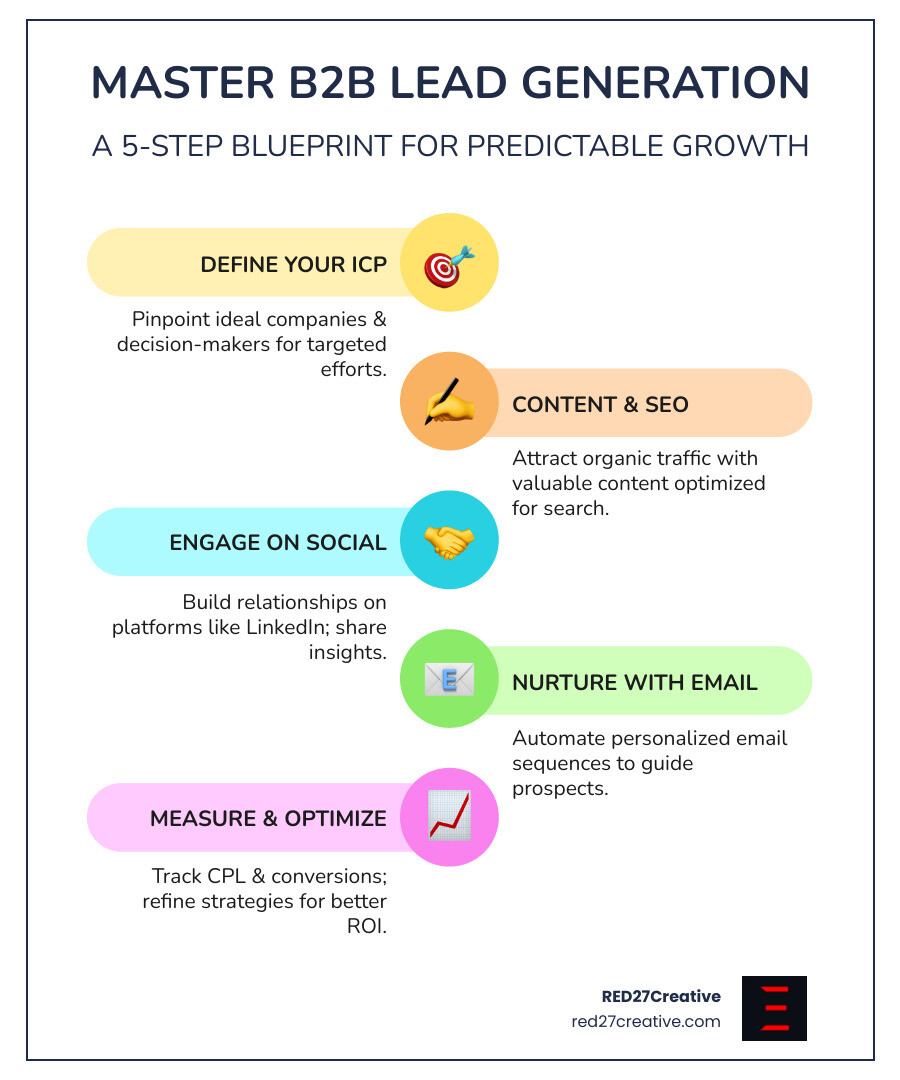
Before you can find your ideal customers, you must know who they are. Develop a detailed Ideal Customer Profile (ICP) and buyer personas by defining company attributes (industry, size, revenue), decision-maker roles, pain points, and goals. This includes understanding their purchase criteria and how they consume information. A clear positioning process helps us understand our unique value proposition for this audience.
Step 2: Attract and Capture Interest
With your ICP defined, attract their attention using a mix of inbound and outbound channels. Buyers expect to find us online, with more than 70% of their journey happening digitally before sales even gets involved. Create valuable content, optimize for search, and use lead capture forms or gated content to collect contact information. Make it easy for interested prospects to engage with your brand.
[Internal Link: Crushing Lead Capture for Fintech SaaS]
Step 3: Align Sales and Marketing for Peak Performance
Lead generation thrives when sales and marketing work in harmony. This alignment requires shared definitions for lead stages, Service Level Agreements (SLAs) for follow-up, and unified technology. A cohesive strategy ensures a seamless handoff and prevents qualified leads from falling through the cracks. We define clear MQL, SQL, and SAL definitions, establish SLAs, and conduct regular communication between our teams.
Top Strategies to Generate B2B Sales Leads in 2024
![Marketing strategy mind map with interconnected tactics, alt=”B2B lead generation strategies mind map”]
The modern B2B landscape requires a multi-channel approach that combines inbound attraction with targeted outbound efforts. Strategies like Account-Based Marketing (ABM) enable highly personalized campaigns, while a strong digital presence ensures you capture prospects actively searching for solutions. We build a diverse, integrated strategy that meets buyers where they are, whether they’re in Geneva, Batavia, or downtown Chicago.
[Internal Link: B2B Demand Generation Ultimate Guide]
Leverage Content Marketing and SEO to Generate B2B Sales Leads
Creating high-value content that provides value and addresses your ICP’s pain points is the cornerstone of inbound lead generation. We optimize this content for search engines (SEO) to attract organic traffic from businesses actively seeking your solutions. This includes blog posts, white papers, case studies, and industry-specific resources, ensuring we’re visible when potential clients in Naperville or St. Charles are searching.
[Internal Link: Industrial Marketing Services for Manufacturers]
Harness Social Media for Relationship Building
Social media, especially LinkedIn, is a powerful tool for B2B prospecting and relationship building. With 55 percent of decision-makers using LinkedIn to vet companies, an active and engaging presence is essential. We use social selling to connect with prospects, share insights, and participate in industry conversations, moving beyond casual mentions to meaningful engagements.
[Internal Link: Lead Generation Social Media]
Nurture Leads with Email Marketing and Automation
Once you’ve captured a lead, the journey has just begun. Email marketing is essential for lead nurturing, allowing us to build relationships over time with personalized drip campaigns and segmented content. Marketing automation tools help deliver these targeted messages at scale, keeping your brand top-of-mind and guiding prospects through their buyer’s journey.
Build Trust with Social Proof and Credibility
B2B buyers rely on peer validation. 92% of buyers trust peer recommendations, and 95 percent of consumers read reviews before buying. We showcase case studies, customer testimonials, and encourage referrals to build the trust needed to close deals. This social proof acts as a powerful endorsement, making your brand more appealing to new prospects.
Engage and Capture with Interactive Content and Events
Static content is no longer enough. In fact, 81 percent of marketers agree that interactive content is more effective at grabbing attention. We use webinars, virtual events, quizzes, and calculators to engage your audience and capture high-intent leads. Tools like AI Chatbot Lead Generation can further improve engagement by qualifying visitors and routing them to the right resources automatically.
Amplify Your Reach with Paid Advertising and Remarketing
Paid advertising on platforms like Google and LinkedIn allows us to target your ICP with precision. We can reach specific decision-makers in Plainfield or Oswego with relevant ads. Remarketing campaigns are particularly effective, letting us re-engage past website visitors with relevant ads, keeping your solution top-of-mind as they move through their decision-making process.
Optimizing Your Efforts: The Role of Data and Personalization
Making data-driven decisions separates successful lead generation from guesswork. By tracking key performance indicators (KPIs) and analyzing results, we can refine your strategy, double down on what works, and optimize your budget for maximum ROI. This analytical approach is central to effective Business Growth Consulting Services.
Personalize at Scale with Account-Based Marketing (ABM)
Personalization is now an expectation. Account-Based Marketing (ABM) is a powerful strategy for targeting high-value accounts with custom messaging and custom content. ABM aligns sales and marketing to deliver a hyper-relevant experience that resonates with key decision-makers, making every interaction feel custom. This is particularly effective for our clients targeting larger enterprises in Chicago.
Use A/B Testing and Analytics to Refine Your Approach
Never assume you know what works best. We continuously run A/B tests on your emails, landing pages, and calls-to-action to optimize for conversions. Even small changes can have a big impact; for example, an A/B test once increased a campaign’s donation rate by 18.6 percent by simply changing a button’s text. We use analytics tools like Google Analytics and session recording software (like Microsoft Clarity) to understand user behavior and identify opportunities for improvement on your website.
The Modern Tech Stack for B2B Lead Generation
![Logos of CRM, automation, and prospecting tools, alt=”B2B lead generation tech stack”]
The right technology multiplies your lead generation efforts. A well-integrated tech stack automates manual tasks, provides valuable insights, and enables your team to work more efficiently. From managing customer relationships to orchestrating outreach campaigns, these tools form the backbone of The Ultimate B2B Lead Generation Solution.
Essential Tools and Technologies
To effectively generate B2B sales leads, we rely on a suite of integrated tools:
- Customer Relationship Management (CRM) system: This is our central hub for all lead data, tracking interactions and managing the sales pipeline.
- Marketing automation platforms: These platforms allow us to nurture leads at scale with personalized drip campaigns, ensuring timely follow-ups.
- Prospecting tools: We use tools like LinkedIn Sales Navigator to find and connect with decision-makers efficiently. Many sales engagement tools offer integrations with Sales Navigator for a seamless workflow.
- Email-finding tools: Services like Hunter.io help us find individual email addresses when we know the person’s name and company.
- Live chat software: Tools such as Intercom or Drift allow us to engage with website visitors immediately, capturing contact information and nurturing leads in real-time.
Overcoming Common B2B Lead Generation Challenges
Even with the best strategy, challenges will arise. Many businesses struggle with lead quality versus quantity, long sales cycles, and proving ROI. 85% of B2B marketers consider lead generation their #1 challenge. Overcoming these problems requires a focus on data, continuous optimization, and a clear understanding of the financial impact of your efforts.
We often see companies chasing volume over quality, neglecting credibility, or failing to measure what truly matters. It’s easy to get caught up in vanity metrics, but what truly drives growth is a focus on qualified leads that align with your ideal customer profile.
Understanding the Cost and ROI of Lead Generation
To justify your marketing spend, you must measure its return on investment (ROI). We track metrics like Cost Per Lead (CPL) and compare it to Customer Lifetime Value (CLV). This financial clarity allows us to allocate your budget effectively and demonstrate the direct contribution of your lead generation activities to the company’s bottom line. The most important metric isn’t just the CPL itself, but its cost relative to your deal size and customer lifetime value.
[Internal Link: Mastering Leads Marketing]
Frequently Asked Questions about How to Generate B2B Sales Leads
What is the difference between inbound and outbound B2B lead generation?
Inbound lead generation attracts customers through valuable content and SEO, drawing them to your business. Outbound involves proactively reaching out to prospects via calls or emails. A blended strategy is often most effective, as inbound leads typically have higher conversion rates while outbound can target high-value accounts directly.
How can I improve the quality of my B2B leads?
To improve lead quality, refine your Ideal Customer Profile (ICP) to target the right businesses. Implement a lead scoring system to prioritize prospects based on fit and engagement. Create highly targeted content that addresses the specific pain points and needs of your ideal buyers, ensuring every lead is a good fit.
What role does AI play in modern B2B lead generation?
AI transforms lead generation by automating repetitive tasks and providing predictive insights. It powers lead scoring to identify promising prospects and enables personalized outreach at scale. AI-driven tools like AI Chatbot Solutions for Businesses can also qualify website visitors 24/7, ensuring no opportunity is missed and improving efficiency.
Conclusion: Building Your Engine for Growth
Mastering B2B lead generation is an ongoing process of strategy, execution, and optimization. It requires a unified approach where content, SEO, social media, and technology all work together to create a predictable engine for growth. By focusing on your ideal customer, providing value at every touchpoint, and making data-driven decisions, you can fill your sales pipeline with qualified opportunities.
At RED27Creative, we build these integrated systems for our clients, turning visibility into measurable results. We help businesses in Geneva, Batavia, Aurora, St. Charles, Plainfield, Oswego, Naperville, and Chicago establish a strong online foundation and convert opportunities into measurable success.
Ready to build a predictable pipeline? Explore our B2B Lead Generation Services.

Kiel Tredrea
https://red27creative.comTop Marketing Agency • Web, SEO & Leads • RED27Creative