Zero to Leads: The Ultimate Startup Guide to Finding Customers

Why Lead Generation for Startups Is the Hardest – and Most Important – Thing You’ll Do
Lead generation for startups is the process of finding, attracting, and converting strangers into potential customers. For early-stage companies, it is also one of the clearest paths to market validation, cash flow, and sustainable growth.
At RED27Creative, lead generation is a core part of the growth systems we build for startups, local businesses, and B2B companies. A strong lead generation strategy connects your website, SEO, local visibility, content, outreach, and conversion paths into one measurable engine.
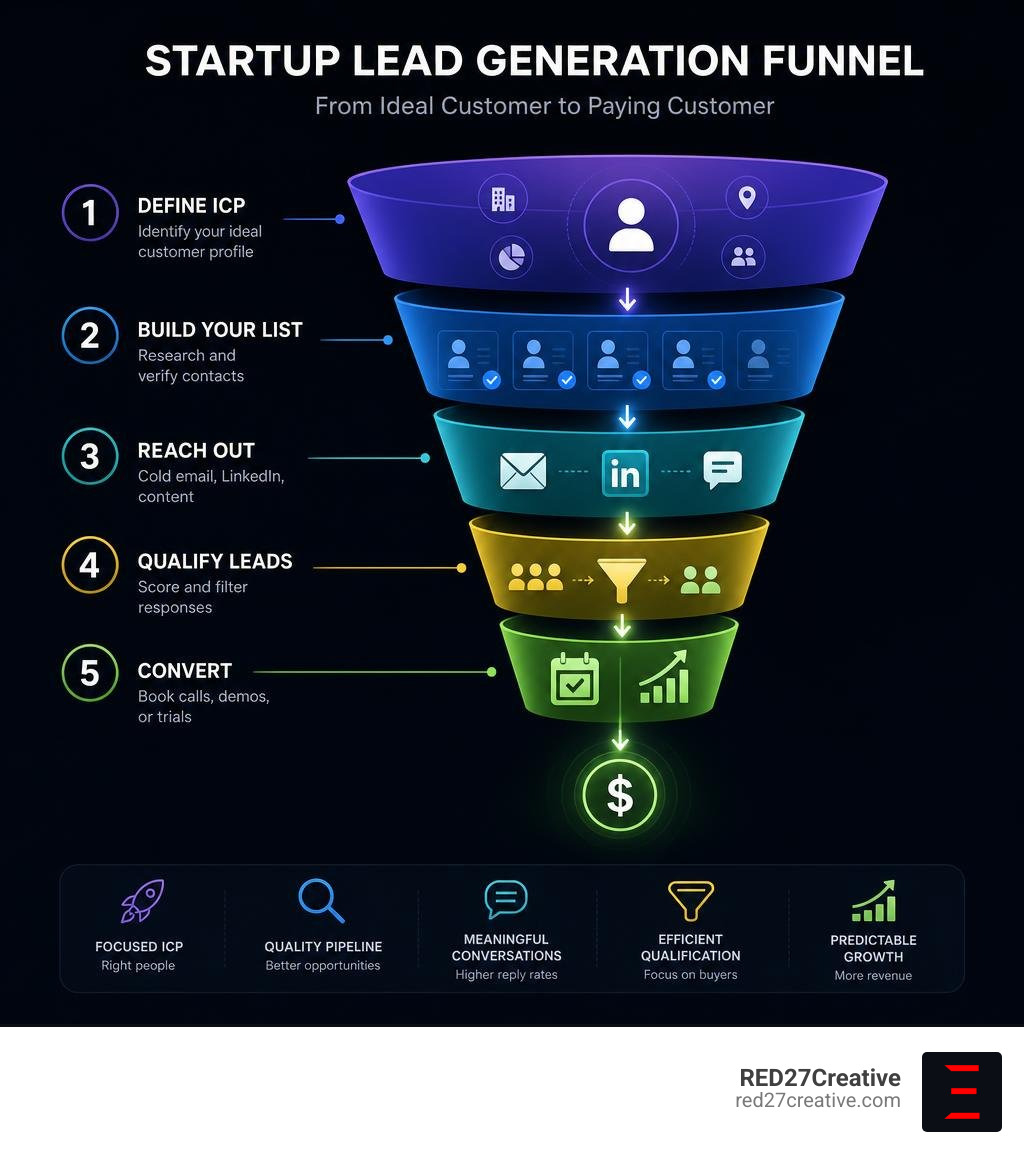
Here is a quick-reference breakdown of what effective startup lead generation looks like:
| Stage | What You’re Doing | Goal |
|---|---|---|
| 1. Define ICP | Identify your ideal customer profile | Know exactly who to target |
| 2. Build your list | Research and verify contacts | Quality over quantity |
| 3. Reach out | Cold email, LinkedIn, content | Start conversations |
| 4. Qualify leads | Score and filter responses | Focus on buyers, not browsers |
| 5. Convert | Book calls, demos, or trials | Turn interest into revenue |
| 6. Measure | Track CAC, LTV, reply rates | Optimize what works |
Most early-stage founders start with a great product and zero customers. Getting that first traction can feel impossible when you are short on budget, time, and team support. You are not outspending competitors. You are outthinking them.
The good news is that a lean, focused lead generation system can work from day one. You do not need a full sales team or a massive ad budget. You need a clear process, a conversion-focused website, accurate tracking, and the discipline to run the system consistently.
I’m Kiel Tredrea, founder of RED27Creative, and I’ve spent over 20 years helping businesses build marketing systems that generate predictable, qualified leads. In this guide, I’ll walk you through how lead generation for startups works and how to build your first pipeline from scratch using practical, measurable steps.
Essential Lead generation for startups terms:
What is Lead Generation for Startups and Why Does It Matter?
Lead generation for startups is the process of identifying people or companies that may need your product, earning their attention, and moving them toward a sales conversation, demo, trial, or consultation. For an early-stage company, it is not just a marketing activity. It is a practical way to test demand and learn what buyers actually care about.
For startups, lead generation also functions as a market validation system. Every form submission, reply, booked call, and lost deal gives you data about your offer, pricing, positioning, and audience. That feedback helps you improve your product and your go-to-market strategy faster.
Startup failure is often connected to issues like poor market fit, limited funding, weak positioning, or ineffective customer acquisition. Without a reliable system to attract and convert qualified prospects, even strong products can struggle to gain traction.
Startups face a common chicken-and-egg problem: you need customers to fund growth, but you need proof of demand to win customers confidently. Early-stage lead generation helps break that cycle by finding early adopters who are willing to engage before you have a large brand presence.
Unlike established companies with existing recognition, startups must build trust from scratch. That is why your website, messaging, search visibility, local presence, and follow-up process need to work together. To see how smaller businesses can move from zero visibility to a working pipeline, explore our guide on From Zero To Hero Lead Generation Strategies For Your Small Business.
Inbound vs. Outbound: Choosing Your Primary Acquisition Channel

When launching your first campaigns, you will usually choose between inbound marketing and outbound prospecting. Inbound marketing draws prospects to you through search, content, local SEO, social media, and lead magnets. Outbound prospecting reaches targeted people directly through cold email, LinkedIn, calls, and founder-led outreach.
For most startups, trying to master both channels at the same time creates unnecessary complexity. Outbound gives you immediate control over who you contact and how quickly you test messaging. Inbound creates compounding value by turning your website and content into long-term acquisition assets.
Here is how the two approaches compare for early-stage teams:
| Feature | Outbound Prospecting | Inbound Marketing |
|---|---|---|
| Time to First Lead | Days to weeks | 3 to 6 months |
| Control Over Targeting | Extremely high (You choose the list) | Medium (Dependent on search intent) |
| Upfront Cost | Low (Data tools and sequencing) | Medium to High (Content creation and SEO) |
| Long-Term ROI | Linear (Stops when your activity stops) | Exponential (Compounds over time) |
| Primary Channels | Cold email, LinkedIn, cold calling | SEO, blogging, lead magnets, social media |
If you are operating on a tight budget, outbound is often the logical starting point because it allows you to test hypotheses quickly. You can read more about launching lean outbound campaigns in this guide on Startup Lead Generation on a Tight Budget in 2026.
Once you have validated your message through outbound, you can turn those insights into scalable inbound assets. RED27Creative helps businesses build those assets through SEO, web design, content strategy, local listings, and conversion-focused lead generation systems. Learn more about this approach through our Inbound B2B Lead Generation Services.
How to Build a High-Converting Startup Lead Generation Engine
A high-converting startup lead generation engine requires more than a list of contacts. It needs a defined audience, accurate data, relevant messaging, a trustworthy website, and a follow-up process that turns interest into qualified opportunities.
If you chase every lead in sight, you will quickly waste time on prospects who are not ready, not qualified, or not a fit. The better approach is to build a repeatable workflow that prioritizes the right accounts, captures buyer intent, and measures every stage of the funnel.
Defining Your Ideal Customer Profile (ICP) for Lead Generation for Startups
Your Ideal Customer Profile (ICP) is a detailed description of the company or buyer that gets the most value from your product. To define your ICP, look beyond basic firmographics like industry, location, and company size. Include behavioral signals, decision-maker roles, technology stack, buying triggers, and pain points.
For example, instead of targeting “all technology companies,” narrow your focus to “seed-stage B2B SaaS startups with 5 to 20 engineers that recently shipped a product and need more qualified demos.” This level of precision makes your messaging easier to personalize and easier to convert.
Strong ICP work also improves SEO and website strategy. When you know exactly who you serve, you can build service pages, landing pages, lead magnets, and content around the questions your buyers are already searching for.
If you want to find your first wave of users quickly without manual spreadsheet research, tools like Find Early Adopters: AI Finds Your First 100 Users in Minutes | Lessie AI can help you identify high-intent targets in less time.
Crafting Messaging for Lead Generation for Startups
Once you know who you are targeting, your messaging must address specific pain points and business outcomes. The biggest mistake startups make is writing self-centered copy that lists product features instead of explaining why the buyer should care.
An effective outbound message should follow a simple three-sentence rule:
- The Observation: Mention a specific trigger or situation relevant to their business.
- The Problem & Value: Connect that observation to a common pain point and how you solve it.
- The Soft CTA: Ask a low-friction question rather than pushing for a 30-minute meeting.
Keep your tone authentic and conversational. Write like a helpful founder or advisor, not a corporate robot. For stronger conversion, make sure the same value proposition appears consistently across your outreach, landing pages, website copy, and follow-up emails.
For a deeper dive into writing copy that attracts and converts qualified buyers, read our blueprint on B2B Lead Generation 101 How To Attract And Convert Ideal Buyers.
Essential Tools and Metrics to Measure Startup Success

To build a predictable revenue engine, you must move from guesswork to data-driven decision-making. That requires a practical tool stack, clean tracking, and a clear view of the numbers that affect revenue.
Your primary tool stack should include:
- A Central CRM: Adopt a CRM the moment you have more than five active leads. Spreadsheets quickly become messy and lead to missed follow-ups.
- Contact Research & Enrichment: Tools like Apollo or Clay can help you build and verify targeted lists.
- Outreach Automation: Platforms like Instantly or Smartlead can help you scale personalized email campaigns responsibly.
- Website and Conversion Tracking: Use analytics, form tracking, call tracking, and CRM attribution to understand which channels generate qualified opportunities.
Once your tools are in place, focus on the metrics that actually affect growth. Email open rates can be useful, but they are often skewed by privacy settings and security filters. Prioritize reply rates, booked meeting rates, qualified opportunity rates, customer acquisition cost, and LTV:CAC ratio.
A healthy outbound campaign often targets an open rate of 35% to 50% and a reply rate of 5% to 15%, depending on list quality, offer strength, and industry. Of those replies, many teams aim to convert 10% to 25% into scheduled meetings or product demos.
For startups, the goal is not just more leads. The goal is a measurable system that shows which channels, pages, messages, and campaigns produce revenue. This is where RED27Creative’s work in SEO, web design, local visibility, and lead generation systems fits together.
For a complete step-by-step walkthrough on setting up these workflows and tracking your metrics, consult Lead Generation for Startups: Build Your First Pipeline (2026). To learn how to guide those newly acquired leads through your entire sales funnel, check out From Prospect To Profit Mastering Your B2B Lead Generation Funnel.
Advanced Strategies: Pre-Launch Lead Gen and Local SEO
You do not have to wait until your product is fully built to start generating leads. Pre-launch lead generation allows you to validate demand, build a waitlist, interview potential users, and create early momentum before your official launch.
You can find high-intent prospects by monitoring public communities like Reddit, Hacker News, LinkedIn groups, industry Slack communities, and specialized forums. Look for people actively complaining about existing solutions or asking questions such as, “Is there a tool that does X?” By engaging authentically and offering early access, you can build relationships with beta users and potential buyers.
To master this pre-launch approach, read Find Startup Clients Before Launch (2026) | Needle.
Startups should also consider the power of local SEO, especially if they serve a defined region or want to build trust in a specific market first. If your startup is based in the Chicago area, including Geneva, Batavia, Aurora, St. Charles, Plainfield, Oswego, Naperville, or Chicago, local search visibility can become a cost-effective acquisition channel.
Local SEO can include optimizing your Google Business Profile, improving local listings accuracy, earning local backlinks, building location-specific landing pages, and collecting credible reviews. These actions help nearby customers find and trust your business when they search for relevant services.
If you are looking for local business visibility resources in these areas, you can explore regional resources like the Leads Groups – Geneva Chamber of Commerce or view the Top Startups in Naperville – StartupBlink.
For startups looking to accelerate their initial local traction with paid search, combining local SEO with targeted PPC campaigns can yield rapid results. Read more about structuring these campaigns in our guide on Ppc For Startups.
Frequently Asked Questions About Startup Lead Generation
What is lead generation for startups?
Lead generation for startups is the process of attracting, identifying, and converting potential customers into qualified opportunities. It usually includes defining an ideal customer profile, building targeted lists, creating landing pages, running outreach or inbound campaigns, qualifying responses, and measuring which channels produce real revenue.
What is the ideal LTV to CAC ratio for a startup?
The ideal Customer Lifetime Value (LTV) to Customer Acquisition Cost (CAC) ratio for a growing startup is often 3:1. This means a customer should generate about three times more revenue than it costs to acquire them. A lower ratio may signal overspending, while a much higher ratio may indicate underinvestment in growth.
How long does it take to see results from inbound lead generation?
Inbound lead generation typically takes 3 to 6 months to produce consistent organic traffic and qualified leads. SEO, content marketing, and domain authority take time to build, but results can compound. Once strong pages rank, inbound can reduce cost per lead and create durable visibility.
Should startups hire an agency or build an in-house lead generation team?
Many startups begin with outsourced or agency-supported lead generation before hiring in-house. An agency can provide strategy, tools, tracking, SEO, web design, and campaign execution without the overhead of a full team. Once the channel is proven, startups can decide what to bring internal.
Conclusion
Building a successful lead generation system from scratch is challenging, but it is achievable with the right strategy. By defining a tight Ideal Customer Profile, choosing the right primary acquisition channel, and tracking the metrics that drive revenue, startups can turn early uncertainty into a predictable pipeline.
The strongest startup lead generation systems connect every part of marketing. Your website must convert. Your SEO must attract relevant search demand. Your local presence must build trust where it matters. Your outreach must start qualified conversations. Your reporting must show what is working.
At RED27Creative, we help startups and growing businesses design, build, and optimize high-converting marketing engines. From our headquarters in Geneva, Illinois, we deliver advanced SEO, local listings management, custom web design, strategic consulting, and data-driven lead generation systems that turn visibility into measurable opportunities.
Whether you are looking for support in Chicago or need local expertise in Geneva, Batavia, Aurora, St. Charles, Plainfield, Oswego, or Naperville, we are here to help you build a marketing foundation that works.
Are you ready to stop guessing and start scaling? Explore our specialized Lead Generation Services today, and let’s build a pipeline that works for your startup.

Kiel Tredrea
https://red27creative.comTop Marketing Agency • Web, SEO & Leads • RED27Creative